Roundtable Hosted by the Korea Chamber of Commerce and Industry
Proposals on Korea-Japan Economic Cooperation, Labor-Management Issues, and U.S. Tariff Response
The five major economic organizations representing Korea's business community met with Kim Moonsoo, the People Power Party's presidential candidate, on the 22nd and conveyed the need to create new growth engines and pursue structural reforms for the Korean economy.
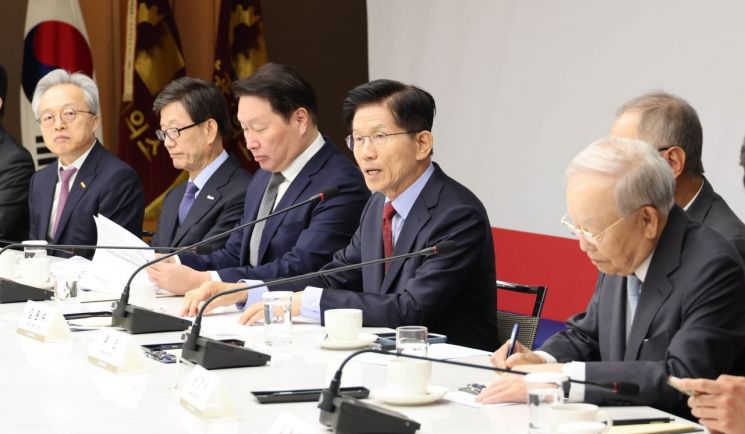 Kim Moonsoo, the People Power Party's presidential candidate, is delivering a greeting at a meeting with five economic organizations on the 22nd. Photo by Korea Chamber of Commerce and Industry
Choi Taewon, Chairman of the Korea Chamber of Commerce and Industry, Sohn Kyungshik, Chairman of the Korea Employers Federation, Ryu Jin, Chairman of the Federation of Korean Industries, Yoon Jinshik, Chairman of the Korea International Trade Association, and Choi Jinshik, Chairman of the Korea Federation of SMEs, held a meeting with candidate Kim at the Chamber Lounge of the Korea Chamber of Commerce and Industry in Jung-gu, Seoul, on this day.
The heads of the economic organizations each took turns presenting policy suggestions to candidate Kim in their respective areas of interest.
First, Chairman Choi Taewon stated, "Warning lights have come on for the Korean economy as low growth becomes the new normal, making it urgent to secure new growth engines and pursue structural reforms." He emphasized the need for economic cooperation with Japan, attracting high-level overseas talent, and advancing the software industry.
Chairman Choi stressed, "If we expand the size and voice of our economy through a Korea-Japan economic alliance, we can also set the 'rules.' By sharing the costs of addressing social issues and high energy expenses, we can reduce costs and expand the scale of advanced and venture industries."
Regarding attracting overseas talent, he said, "To advance high-tech industries, we need to attract about 5 million highly skilled foreign professionals. Only by bringing in high-level talent can we boost domestic consumption. Frankly, the influx of low-wage workers has not significantly benefited the Korean economy."
Chairman Sohn Kyungshik, referring to the extension of the statutory retirement age, remarked, "Considering the seniority-based pay system, a uniform extension of the statutory retirement age will further increase the burden of older workers and reduce opportunities for youth employment. Policies should be considered to promote generational balance through post-retirement reemployment."
Regarding working hours, Chairman Sohn said, "In manufacturing and high-tech industries, working hours should be flexibly managed according to the characteristics and realities of each sector. The discussion of a 4.5-day workweek would inevitably impose a heavy burden on companies. Please ensure that the issue of working hours is discussed in a way that allows companies to exercise autonomy through labor-management agreements."
On the so-called "Yellow Envelope Law" (amendments to Articles 2 and 3 of the Trade Union and Labor Relations Adjustment Act), which seeks to strengthen the responsibility of primary contractors and limit employers' claims for damages against unions, he argued, "Companies have too few means of response. If the labor law is amended, there is concern that even the basic ecosystem of industry could collapse."
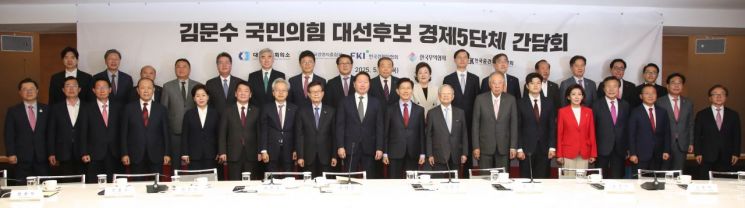 Kim Moonsoo, the People Power Party presidential candidate (tenth from the left in the front row), and Choi Taewon, chairman of the Korea Chamber of Commerce and Industry (ninth from the left in the front row), along with the heads of the five major economic organizations, are taking a commemorative photo with the attendees. Photo by Korea Chamber of Commerce and Industry
Chairman Ryu Jin proposed measures such as business restructuring, revitalizing the construction industry and domestic demand through landmark projects, and supporting connections between large corporations and startups.
Chairman Ryu said, "I was recently invited to France, where President Macron held a meeting exclusively with Korean business leaders and personally fielded about ten questions. I found it truly enviable."
Chairman Yoon Jinshik remarked, "Strategic responses to U.S. tariff policies are among the most urgent pending issues. Before the mutually deferred tariffs are fully implemented, I hope that a comprehensive public-private outreach to the United States will sufficiently communicate the position of our industries."
Chairman Yoon emphasized, "Small and medium-sized enterprises face significant difficulties in expanding exports due to structural constraints such as overseas certification, customs clearance, non-tariff barriers, as well as funding and manpower. We need to eliminate unnecessary regulations and systematically establish a policy foundation that supports the growth of promising export-oriented SMEs into global companies."
Chairman Choi Jinshik, mentioning the issue of inheritance and gift taxes, expressed concern, "Large corporations find it difficult to exit due to their extensive domestic infrastructure, but mid-sized companies can leave relatively easily. If we do not create an environment conducive to business, there will be no reason for them to remain in Korea."
Chairman Choi further stated, "We must boldly expand the taxable income brackets for salaried workers, which have not changed in 20 years. In a country where anyone earning over 88 million won faces a 35% tax burden, who would be motivated to work?"
He added, "I hope we can revise the Korea-U.S. nuclear agreement to reprocess waste (radioactive waste) at Kori and Wolsong and thereby lower electricity costs."
After hearing the business community's policy suggestions, candidate Kim responded, "I am in complete agreement. If I become president, I will appoint a dedicated senior secretary within the presidential office to handle business grievances and focus on communication."
In addition to the heads of the five major economic organizations, the event was attended by presidents of chambers of commerce nationwide, Park Seunghee, President of Samsung Electronics, Lee Hyunghee, Chairman of the SK SUPEX Council's Communication Committee, Sung Kim, President of Hyundai Motor Company, and about 20 others.
On May 8, the five major economic organizations also invited Lee Jaemyung, the Democratic Party's presidential candidate, to a meeting where they requested support for fostering new industries and responding to U.S. tariffs. Ahead of the presidential election, they also delivered a list of 'four major fields and 100 key tasks' to each political party, including strengthening AI capabilities, fostering the aerospace industry, and responding to U.S. trade measures.
© The Asia Business Daily(www.asiae.co.kr). All rights reserved.
![Clutching a Stolen Dior Bag, Saying "I Hate Being Poor but Real"... The Grotesque Con of a "Human Knockoff" [Slate]](https://cwcontent.asiae.co.kr/asiaresize/183/2026021902243444107_1771435474.jpg)
















