Pilots Scramble for Emergency Training Upon Sortie Order
Trump's Portrait Displayed... Symbol of ROK-U.S. Combined Operations
"(Mission code) Training battle, 41 minutes!"
When Colonel Park Geunhyeong, Director of Combat Operations at the Air Force Operations Command, issued an emergency scramble order as part of a simulated training scenario, the standby pilots in the emergency room at the Air Force Seosan Base in South Chungcheong Province immediately rushed toward the hangar where the KF-16 fighter jets were stationed. These pilots are part of the "8-minute standby team," who are required to board their jets and take off within eight minutes whenever unidentified tracks from neighboring countries enter South Korean airspace or the Korea Air Defense Identification Zone (KADIZ).
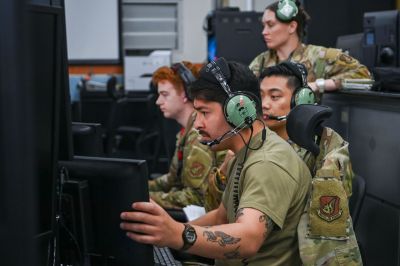
On the morning of the 21st, at the Korea Air and Space Operations Center (KAOC) at the Air Force Osan Base in Gyeonggi Province, which I visited, the facility was bustling with operational activity from early in the day. American service members with distinctive foreign appearances were frequently seen throughout the facility, even more so than their Korean counterparts. A portrait of U.S. President Donald Trump was displayed on one side of the corridor. This seemed to underscore the fact that this place is truly the heart of the ROK-U.S. combined air operations.
KAOC integrates and operates the combined surveillance and reconnaissance assets of South Korea and the United States during peacetime, focusing on 24-hour monitoring and analysis of enemy activities and signs of provocation in the airspace, KADIZ, and space domains. In wartime, the air force commanders of both countries oversee all operational situations and airspace information in real time from KAOC's combat command post (Top Dais). They are responsible for controlling aerial operations such as reconnaissance, defense, and attack, as well as wartime missile operations involving the army, navy, and air force, to secure air and space superiority and to swiftly eliminate enemy nuclear and missile threats and key military capabilities.
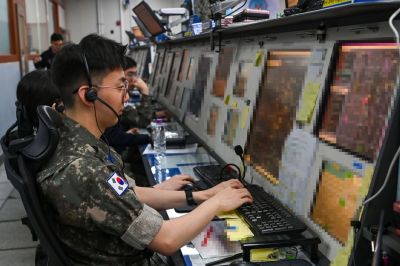
Although it was reported to be the hottest morning in 120 years, the interior of the KAOC, located in a bunker, felt almost chilly. An Air Force official said, "Even though it's May, we are working in thermal underwear," and added, "Maintaining a 24-hour surveillance system does place a significant physical burden on the personnel."
Within KAOC are the Master Control and Reporting Center (MCRC), which detects, controls, and responds to all tracks within KADIZ; the Korea Air and Missile Defense (KAMD) operations center, which detects and responds to enemy missile threats; and other key command and control units of the ROK-U.S. Air Forces, such as the U.S. 7th Air Force's 607th Air and Space Operations Center and U.S. Space Forces Korea, which perform similar roles as KAOC.
The MCRC is a core command and control unit of the Air Force, utilizing both national and combined/joint assets to detect and identify all flying objects within the detection range and to deploy Air Force assets in response. The 1st MCRC operates at Osan Base, and the 2nd MCRC operates at Daegu Base. According to the Air Force, five control teams work in four shifts to ensure uninterrupted 24-hour mission execution, in line with their slogan, "The unsleeping eyes that guard the sky."
The MCRC is composed of air surveillance, identification, and weapons operations teams. The air surveillance team analyzes and assesses data detected by Air Force air control radars, E-737 airborne early warning and control aircraft, Army short-range air defense radars, and Navy Aegis ships to determine whether a track is real. The identification team determines the nationality, type, and purpose of each track, while the weapons operations team deploys the optimal available response assets (aircraft, surface-to-air missiles, ship-to-air missiles) to respond accordingly.
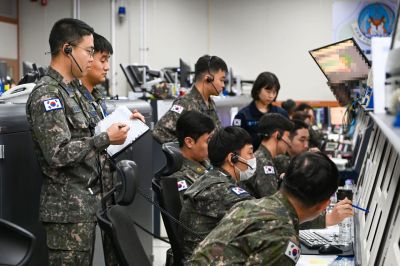
The KAMD operations center is the core command and control system of the three-axis system that detects early signs of North Korean missile threats and conducts defensive operations. As soon as ballistic missiles are detected by various surveillance systems such as the Air Force missile surveillance unit, Aegis ships, and early warning satellites, the information is consolidated, and the predicted impact point is calculated and quickly communicated to both the military and civilians. An Air Force official explained, "Since ballistic missiles can reach the Seoul metropolitan area within three minutes and Busan within seven to eight minutes after launch, rapid warning dissemination is a very important part of the KAMD operations center's role."
Additionally, ballistic missile information consolidated via the tactical data link is transmitted to each missile defense battery, where intercepts are carried out using surface-to-air missiles such as Cheongung and Patriot. At the same time, the detected missile flight path is reverse-calculated, and the estimated launch site is sent to the CBM operations room, which then issues attack orders to available combined air assets to quickly neutralize enemy transporter erector launchers (TELs) and similar targets. The Air Force plans to further enhance its missile defense capabilities by sequentially acquiring L-SAM and M-SAM Block III systems in the future.
Brigadier General Kim Seunghan, Director of the Air and Space Operations Center at the Air Force Operations Command, stated, "Osan Base is the center of the ROK-U.S. alliance, and especially KAOC is the heart of combined forces and air operations. We are committed to fulfilling our airspace defense mission with the determination that we are at the forefront and at the center of the three-axis system responding to nuclear and missile provocations."
© The Asia Business Daily(www.asiae.co.kr). All rights reserved.
![Clutching a Stolen Dior Bag, Saying "I Hate Being Poor but Real"... The Grotesque Con of a "Human Knockoff" [Slate]](https://cwcontent.asiae.co.kr/asiaresize/183/2026021902243444107_1771435474.jpg)

















