With the expansion of ultra-long-term Treasury bond issuance, the average remaining maturity of Treasury bonds surged to 13.2 years as of the end of last year. There are recommendations to strengthen liquidity monitoring, diversify Treasury bond maturities, and consider introducing short-term Treasury bonds with maturities of one year or less in order to reduce the concentration on ultra-long-term bonds.
Jang Boseong and Jung Hwayeong, research fellows at the Korea Capital Market Institute, attended the "KCMI Issue Briefing" held at the Yeouido Financial Investment Center on the morning of the 22nd, under the theme "Background of the Prolongation of Treasury Bond Maturities and Implications for Efficient Management." They stated, "The most notable feature of Treasury bond issuance over the past decade has been the sharp increase in ultra-long-term bonds, particularly those with 30-year maturities."
According to the Korea Capital Market Institute, the average remaining maturity of Treasury bonds increased significantly from 7.1 years in 2014 to 13.2 years in 2024. This is in contrast to the fact that the change in average remaining maturity in major countries during the same period remained under two years. Research fellow Jang explained, "Although the 30-year bond was introduced relatively late (September 2012) compared to other maturities, its issuance share has continued to expand, becoming the largest among all maturities since 2021." He added, "In 2024, 30-year bonds accounted for 30.2% of total Treasury bond issuance."
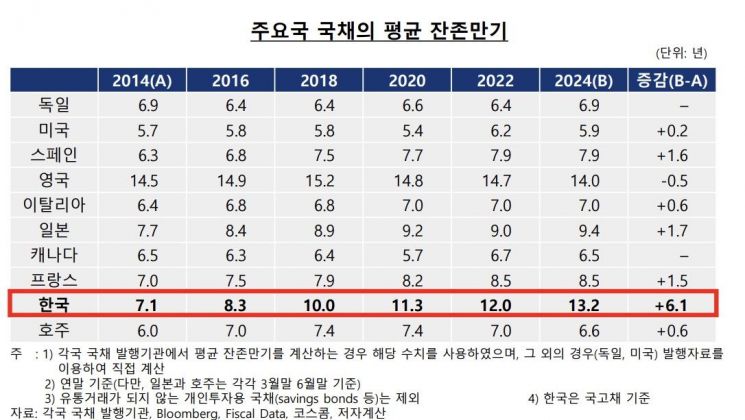
The background behind the lengthening of Treasury bond maturities is attributed to both demand-side and supply-side factors. On the demand side, regulatory changes in the insurance industry have significantly increased insurers' demand for ultra-long-term bonds. On the supply side, the issuance of ultra-long-term bonds other than Treasury bonds is limited in the domestic bond market.
First, research fellow Jang noted, "With the introduction of new accounting standards (IFRS17) and the new risk-based capital regime (K-ICS), insurers are now required to value their liabilities at market prices, which has increased the need to extend asset duration by purchasing ultra-long-term Treasury bonds." He continued, "Because insurance company liabilities have very long durations, extending asset duration is necessary for interest rate risk management." He also pointed out, "Although insurers' demand for ultra-long-term bonds has increased significantly, the issuance of ultra-long-term bonds other than Treasury bonds in the domestic bond market remains minimal. As a result, demand for ultra-long-term bonds has centered on Treasury bonds, enabling the government to raise funds at lower costs through ultra-long-term bond issuance."
If the current issuance ratio is maintained, it is estimated that the amount of elapsed ultra-long-term bonds will increase by about 10% annually until the early 2030s, and by 2032-2033, it will exceed twice the level of 2025. Research fellow Jang warned, "There are concerns that overall liquidity in the Treasury bond market could structurally decline," and pointed out, "Ultra-long-term Treasury bonds tend to experience a sharp drop in liquidity when they are no longer benchmark issues."
Accordingly, research fellow Jang recommended: ▲ strengthening liquidity monitoring of elapsed ultra-long-term bonds and enhancing market function; ▲ efficient diversification of Treasury bond maturities; and ▲ easing the concentration of ultra-long-term bond issuance in the medium to long term. He stated, "As Treasury bonds will be included in the World Government Bond Index (WGBI) starting in April next year, the importance of market liquidity will increase. Therefore, policy efforts to manage the liquidity of elapsed bonds should be strengthened to maintain stable market access." He explained, "If distribution becomes difficult, the government can enhance liquidity through early redemption and exchange operations."
He also argued, "The expansion of ultra-long-term bond issuance could result in large-scale maturities concentrated on specific dates, which may pose risks to future Treasury bond management. Therefore, efforts to diversify maturities are required." He added, "As the maturity of top outstanding issues approaches, early redemption and exchange should be used to reduce the volume of maturing bonds." In particular, he emphasized that, "Currently, the national debt issuance limit is set based on the total amount, which restricts the flexible operation of early redemption and exchange. It is urgent to revise the National Finance Act to switch the issuance limit to a net increase basis, as is the case in major countries."
Finally, from a medium- to long-term perspective, research fellow Jang suggested, "As part of efforts to ease the concentration on ultra-long-term bonds, it is worth considering the introduction of short-term Treasury bonds with maturities of one year or less." He added, "After the completion of regulatory implementation, insurers' demand for ultra-long-term bonds is expected to weaken, and preparations are needed for the potential slowdown in insurers' growth due to demographic changes. Typically, short-term interest rates are lower than long-term rates, which is advantageous in terms of cost. In addition, the supply of short-term safe assets can effectively complement the financial market."
© The Asia Business Daily(www.asiae.co.kr). All rights reserved.
![Clutching a Stolen Dior Bag, Saying "I Hate Being Poor but Real"... The Grotesque Con of a "Human Knockoff" [Slate]](https://cwcontent.asiae.co.kr/asiaresize/183/2026021902243444107_1771435474.jpg)















