High Proportion Maintaining Top Grade at 69.6%
Higher Than Korean (57.7%) and Inquiry (51.1%)
"Strategies Should Differ by Grade Level"
A study has found that even if students retake the College Scholastic Ability Test (CSAT), it is not easy to improve their mathematics scores.

On May 22, Jinhaksa analyzed the CSAT scores of repeat test-takers who used Jinhak.com’s “Regular Admission Prediction” service for both the 2024 and 2025 academic years. The results showed that the average percentile score for Korean, Mathematics, and Inquiry subjects in the 2025 academic year was 75.3, an increase of 5.8 points from 69.5 in the 2024 academic year.
The percentile score indicates the percentage of test-takers who scored below a given score. For example, a percentile of 75.3 means that 75.3% of all test-takers received a lower score. This can be interpreted as a student’s ranking improving from the top 30.5% before retaking the test to the top 24.7% after retaking it.
Although it may be expected that scores would improve after an additional year of preparation, the results showed that the increase was not significant in mathematics.
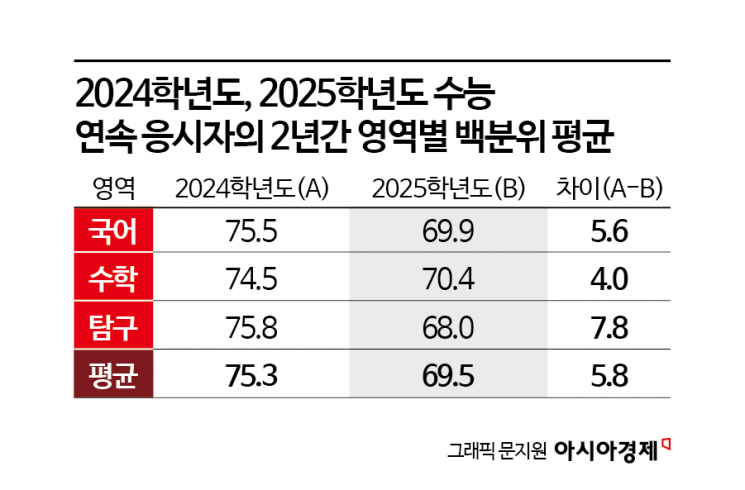
By subject area, the largest increase in percentile was seen in Inquiry, which rose by 7.8 points from 68.0 in the 2024 academic year to 75.8 in the 2025 academic year. Korean improved by 5.6 points, from 69.9 to 75.5 over the same period. However, mathematics increased by only 4.0 points, from 70.4 to 74.5.
Additionally, 41.5% of repeat test-takers received the same grade in mathematics for two consecutive years. This is higher than the percentage who maintained the same grade in Korean (35.3%) or Inquiry (32.6%). The proportion of students whose mathematics grade improved was 41.0%, which is lower than the improvement rates in Korean (45.0%) and Inquiry (48.0%).
The difficulty in improving mathematics scores is attributed to the strong concentration of high-performing students in this subject. Among students who received the top grade (Grade 1) in mathematics on the 2024 CSAT, 69.6% maintained the same grade on the 2025 CSAT. In comparison, the retention rates for Korean and Inquiry were much lower, at 57.7% and 51.1%, respectively.
In particular, students in the middle and lower tiers had even more difficulty raising their mathematics scores, and this trend was more pronounced compared to other subjects. Among students who were in Grades 5 and 6 for mathematics, only 53.3% and 56.8%, respectively, improved their grade. Among Grade 7 students, only 48.3% saw their grade improve.
In contrast, more than half of the students in Korean who were in Grade 5 (60.2%), Grade 6 (71.6%), and Grade 7 (79.2%) improved their scores. In the Inquiry area, 7 to 8 out of 10 students who were in Grade 5 (69.9%), Grade 6 (79.0%), and Grade 7 (87.0%) saw their grades rise.
Woo Yeoncheol, head of the Jinhaksa Admissions Strategy Research Institute, stated, “In mathematics, the gap between high and low performers is more entrenched than in other subjects. Also, there are a significant number of high-performing students among current students.” He advised, “Although mathematics is not an easy subject in which to raise scores, students should respond with differentiated strategies according to their grade level.”
© The Asia Business Daily(www.asiae.co.kr). All rights reserved.
![Clutching a Stolen Dior Bag, Saying "I Hate Being Poor but Real"... The Grotesque Con of a "Human Knockoff" [Slate]](https://cwcontent.asiae.co.kr/asiaresize/183/2026021902243444107_1771435474.jpg)

















