Collaboration Among Eight Central Ministries to Overcome the Crisis of Regional Extinction
Up to 2 Billion Won in Support, Infrastructure to Be Developed by 2028
The Ministry of Land, Infrastructure and Transport announced on May 21, 2025, that it has selected the final 10 locations for the 2025 Regional Vitality Town development project.
The Regional Vitality Town project is a multi-purpose space initiative designed to address the risk of regional extinction by combining residential infrastructure and living services, thereby improving settlement conditions in local areas and supporting population inflow and retention. Introduced in 2023, the project is promoted through collaboration among a total of eight central government ministries, including the Ministry of Land, Infrastructure and Transport, the Ministry of Education, the Ministry of the Interior and Safety, the Ministry of Culture, Sports and Tourism, the Ministry of Agriculture, Food and Rural Affairs, the Ministry of Health and Welfare, the Ministry of Oceans and Fisheries, and the Ministry of SMEs and Startups.
This year, applications began in March, and the final sites were selected through a process that included a document review, on-site inspections, and a comprehensive evaluation by experts. The 10 selected locations are: Taebaek in Gangwon, Jeungpyeong in North Chungcheong, Buyeo and Cheongyang in South Chungcheong, Sunchang and Jangsu in North Jeolla, Gangjin and Yeongam in South Jeolla, Yecheon in North Gyeongsang, and Hadong in South Gyeongsang.
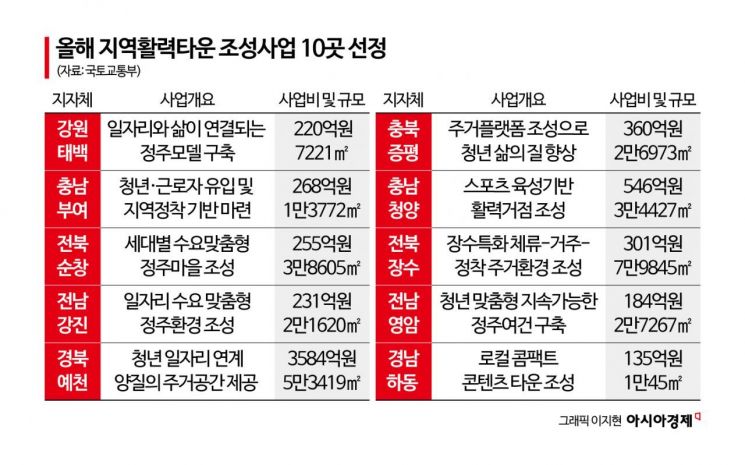
In Taebaek, Gangwon Province, 44 rental housing units will be constructed near a clean energy industrial complex, along with the establishment of a senior-friendly National Sports Center. In Jeungpyeong, North Chungcheong Province, 50 multi-family housing units and 20 townhouse units will be provided in connection with a nearby industrial complex, and living services will be offered through a local creator development program. In Buyeo, South Chungcheong Province, 100 worker-assured stay units and an integrated support center with a National Sports Center will be built to ensure stable working conditions.
In Gangjin, South Jeolla Province, 60 apartment units, 10 townhouse units, and a living support center will be developed on the former Seonghwa University campus. In Yeongam, South Jeolla Province, 44 detached townhouse units and an eco-friendly smart residential complex will be constructed on the designated land. In Yecheon, North Gyeongsang Province, rental housing for young people and newlyweds, a child-friendly National Sports Center, and a care cluster will be provided near an urban high-tech industrial complex to expand the local living infrastructure.
In Cheongyang, South Chungcheong Province, a family-stay residential complex with 35 units and a multi-purpose welfare center with a dedicated table tennis training facility will be established, with a focus on nurturing elementary, middle, and high school table tennis teams. In Jangsu, North Jeolla Province, 80 residential units will be supplied utilizing the mountainous natural environment, and a community shared kitchen and rest center will be created to support settlement and retention.
In Sunchang, North Jeolla Province, 78 public rental detached houses will be built, and the area will be developed into a village that guarantees quality of life by linking customized senior care jobs with youth employment and entrepreneurship support programs. In Hadong, South Gyeongsang Province, the region’s specialty?strawberries?will be utilized to create an eco-pool village with 26 units and a four-season berry farm strawberry processing support center, along with a residential complex for return-to-farming and rural settlement in connection with a rural care farm project.
The selected projects in these 10 locations will receive up to 2 billion won in national funding over a maximum of four years. After finalizing agreements between central government ministries and local governments by the end of the year, the plan is to develop the necessary infrastructure in phases by 2028. Kim Jiyeon, Director of Land Policy at the Ministry of Land, Infrastructure and Transport, stated, "Now is the time for the government and local governments to collaborate in order to overcome the crisis of regional extinction and revitalize local areas," adding, "The Ministry will actively promote regional revitalization by working together with relevant ministries, focusing on the projects selected for the Regional Vitality Town initiative."
© The Asia Business Daily(www.asiae.co.kr). All rights reserved.
![Clutching a Stolen Dior Bag, Saying "I Hate Being Poor but Real"... The Grotesque Con of a "Human Knockoff" [Slate]](https://cwcontent.asiae.co.kr/asiaresize/183/2026021902243444107_1771435474.jpg)















