Hyundai Steel Raises Rebar Prices for the First Time in Three Years
Construction Industry Strongly Protests Unilateral Notice
Material Price Hikes Add to Cost Burden Amid Construction Slump
Another 'Price Conflict' After Three Years... Vicious Cycle Repeats in Downturn
Amid an unprecedented slump in the construction industry, tensions are once again escalating between construction companies and steelmakers over a notice of rebar price hikes. Construction firms have launched a collective protest against Hyundai Steel's decision to raise the standard price of rebar for the first time in three years. The construction industry, stating that it "cannot accept the price increase," is in a standoff with Hyundai Steel and other steelmakers, who argue that they "can no longer delay a price hike."
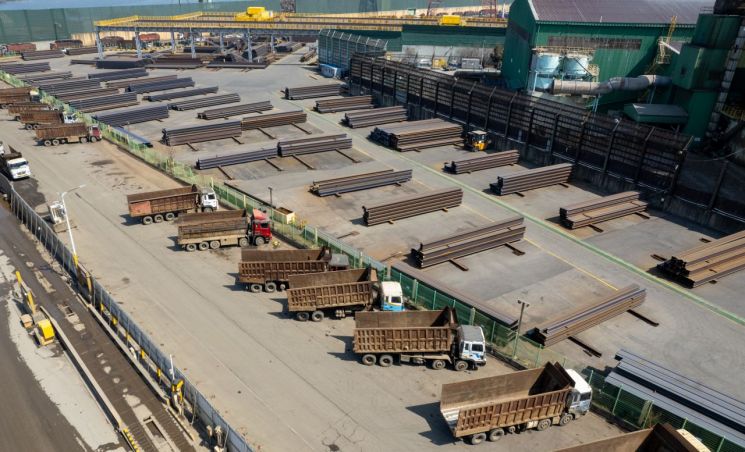
According to the construction industry on May 21, Hyundai Steel recently announced an increase in the standard price of rebar (SD400, 10mm) from 892,000 won per ton to 918,000 won per ton. This is the first time in three years since 2022 that the standard price has been raised. Following this announcement, purchasing managers from more than 10 construction companies, including Lotte Construction, visited Hyundai Steel on May 19 to protest. Hyundai Steel has not made any official statement on the matter.
An official from one construction company commented, "While we managed to achieve a dramatic 2.45% reduction in ready-mixed concrete prices after four months of negotiations, rebar prices are repeatedly raised unilaterally through notices." In the Seoul metropolitan area, the price of ready-mixed concrete was agreed upon at 91,400 won per cubic meter in March, down from 93,700 won, after 11 rounds of collective negotiations. A Hyundai Steel representative explained, "Losses in the long steel segment have been accumulating, and with low operating rates, normalizing prices became inevitable. The announcement of the standard price is simply a routine information procedure, and individual negotiations with construction companies are ongoing."
The construction industry interprets Hyundai Steel's announcement of the standard price as a de facto signal for a rebar price increase, given its leading role in setting the market price. In South Korea, rebar is produced by seven companies: Hyundai Steel, Dongkuk Steel, Korea Steel, Daehan Steel, YK Steel, Hwanyoung Steel, and Hankook Steel. Among them, Hyundai Steel holds the largest market share at approximately 30%. When Hyundai Steel raises its standard price, other steelmakers typically follow suit. Rebar, along with ready-mixed concrete and cement, is considered a core material at construction sites. Price increases have a significant impact on the cost ratio (the ratio of cost to sales).
The root cause of this 'price conflict' lies in the downturn of the construction industry. In the first quarter of this year, the value of construction work performed (measured by progress payments) in South Korea fell by 20.7% year-on-year to about 27.012 trillion won, marking the largest quarterly drop since the 1998 foreign exchange crisis. The industry is caught in a vicious cycle of declining demand, followed by production cuts or price hikes for materials, leading to increased construction costs, a rise in unsold properties, and further demand contraction.
As a result, downstream industries such as rebar, cement, and furniture are also being hit hard. Hyundai Steel has recorded losses for two consecutive quarters. Dongkuk Steel and Daehan Steel, which together with Hyundai Steel are considered the 'big three' in rebar, also reported operating profits in the first quarter of this year that were down 91.9% and 41.5%, respectively, compared to the previous year. The steel industry maintains that "it is no longer possible to endure at current prices."
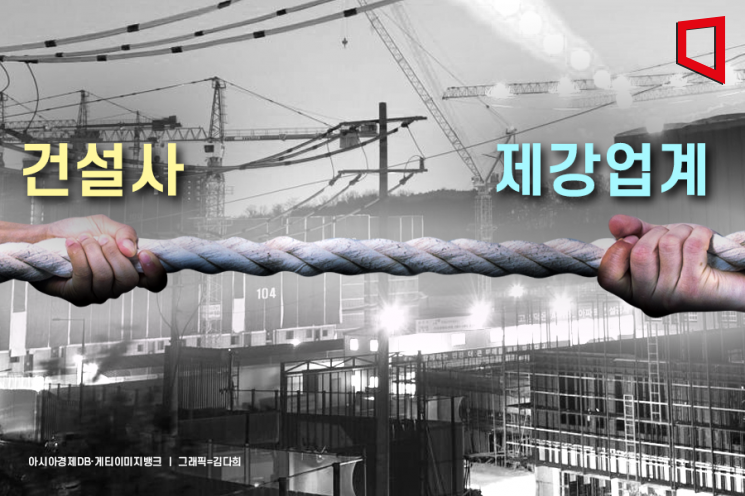
The conflict between the two industries has been recurring periodically. Three years ago, when the standard price was last raised, purchasing managers from 30 construction companies held a rally in front of Hyundai Steel's headquarters, demanding a reversal of the "unilateral price hike." A construction industry official stated, "Many construction companies are still burdened by material costs and operating at a loss, just as they were three years ago. Since both sides are facing difficulties, it is time to come together and seek mutual survival."
© The Asia Business Daily(www.asiae.co.kr). All rights reserved.
![Clutching a Stolen Dior Bag, Saying "I Hate Being Poor but Real"... The Grotesque Con of a "Human Knockoff" [Slate]](https://cwcontent.asiae.co.kr/asiaresize/183/2026021902243444107_1771435474.jpg)
















