Korean Pediatric and Adolescent Hospital Association:
"Pilot Project Shows Positive Results,
But Structural Inequality Must Be Addressed"
Calls on Presidential Candidates:
"Present Promises to Revitalize Pediatric Medical Care"
Pediatric and adolescent hospitals that participated in the "Pediatric Care Regional Cooperation Network Pilot Project" found it easier to transfer patients to advanced medical institutions compared to those that did not participate. However, some in the field argued that while the pilot project has had positive effects, a comprehensive review is necessary to address structural inequalities.
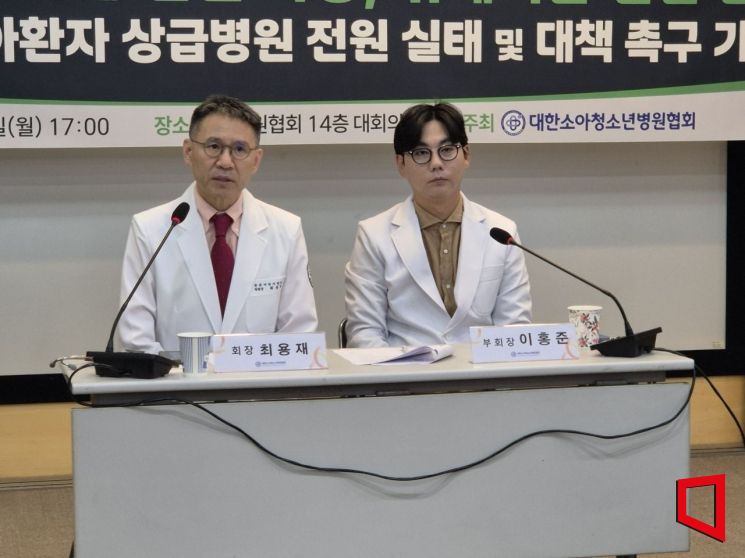 Yongjae Choi, president of the Korean Pediatric and Adolescent Hospital Association (left), held a press conference on the 19th at the Korean Hospital Association's main conference room in Mapo-gu, Seoul, explaining the difficulties of transferring pediatric patients to advanced medical institutions. Photo by Taewon Choi
The Korean Pediatric and Adolescent Hospital Association held a press conference on the 19th at the Korean Hospital Association's main conference room in Mapo-gu, Seoul, where it released the results of a survey on the status of pediatric patient transfers from pediatric and adolescent hospitals to advanced medical institutions. The association argued that in order to vitalize the Pediatric Care Regional Cooperation Network Pilot Project, the network should be restructured based on medical service areas rather than administrative districts.
The Pediatric Care Regional Cooperation Network Pilot Project is a Ministry of Health and Welfare initiative that establishes a network centered on secondary hospitals, such as pediatric and adolescent hospitals, within a region, enabling hospitals at various levels to collaborate in providing care. Currently, 20 hospitals nationwide are participating in the pilot project.
According to a perception survey conducted by the association from May 1 to 16, dividing hospitals into two groups?those participating in the pilot project and those not participating?only 1% of the 202 doctors working at non-participating pediatric and adolescent hospitals responded that transfers are "always accepted." The response "generally accepted" accounted for 38%, "accepted intermittently" was 43%, and 18% answered "rarely accepted."
In contrast, among the 20 pediatric and adolescent hospitals participating in the pilot project, 15% responded that transfers are "always accepted," and 75% said they are "generally accepted." The responses "accepted intermittently" and "rarely accepted" were both 5% each.
There was generally a negative view regarding the Ministry of Health and Welfare's ongoing measures to improve the pediatric medical care system. Yongjae Choi, president of the Korean Pediatric and Adolescent Hospital Association (and director of Ttuntun Children's Hospital in Uijeongbu), stated, "It is true that the pilot project has had positive effects, but there is a limitation in that it is set up based on administrative districts and does not take into account the actual demand for care within medical service areas." He added, "A comprehensive review of the policy direction is necessary."
Choi further pointed out, "The fact that 61% of doctors at non-participating hospitals answered that transfers are 'virtually impossible' clearly reveals the structural inequality that arises, where the survival chances of pediatric patients differ depending on whether their hospital participates in the project."
Lee Hongjun, vice president of the association (and director of Ijeil Hospital in Gimpo), who was also present, said, "It is fortunate that the issue of transferring pediatric patients to advanced medical institutions has been somewhat resolved through the pilot project, but pediatric and adolescent care remains in crisis." He emphasized, "Along with the development of the pilot project, it is urgent to develop policies and measures that can rationally and efficiently normalize pediatric care."
On this day, the association also called on presidential candidates to strengthen the pediatric medical care system. Choi said, "Although there is growing public opinion that urgent action is needed to resolve the issue of pediatric patients being bounced around emergency rooms, the inability to transfer pediatric patients to advanced medical institutions is becoming a chronic problem in the medical field." He continued, "Judging from the pledges announced by the candidates so far, it seems that pediatric medical care is once again being neglected." He appealed, "Please establish a system so that young doctors can apply for pediatrics and adolescent medicine."
© The Asia Business Daily(www.asiae.co.kr). All rights reserved.
![Clutching a Stolen Dior Bag, Saying "I Hate Being Poor but Real"... The Grotesque Con of a "Human Knockoff" [Slate]](https://cwcontent.asiae.co.kr/asiaresize/183/2026021902243444107_1771435474.jpg)















