Focus on Six Key Areas Including Balanced Trade and Non-Tariff Measures
Related Ministries Including Ministry of Economy and Finance and Ministry of Agriculture Participate, Led by Ministry of Trade, Industry and Energy
Jang Seonggil, Director General for Trade Policy, Ministry of Trade, Industry and Energy: "We Will Respond with the National Interest as Our Top Priority"
With approximately 50 days remaining until July 8, the deadline set by the United States for the mutual tariff grace period and the target date for the so-called "July Package" to be finalized between South Korea and the United States, a South Korean government working-level negotiation team will depart for the United States on May 20. The two countries plan to focus their discussions on six key areas agreed upon at the ministerial level, including balanced trade and non-tariff measures.
The Ministry of Trade, Industry and Energy announced that it will visit Washington, D.C. from May 20 to 22 to hold the second technical consultation with the United States Trade Representative (USTR) regarding U.S. tariff measures. This round of consultations will take place over three days, from the afternoon of May 20 (local time), when the South Korean delegation arrives, through May 22. In addition to the Ministry of Trade, Industry and Energy, which oversees negotiations with the United States, other relevant ministries such as the Ministry of Economy and Finance, Ministry of Agriculture, Food and Rural Affairs, Ministry of Oceans and Fisheries, Ministry of Science and ICT, and Ministry of Employment and Labor will also participate. This is likely to be the last in-person consultation before the South Korean presidential election scheduled for June 3.
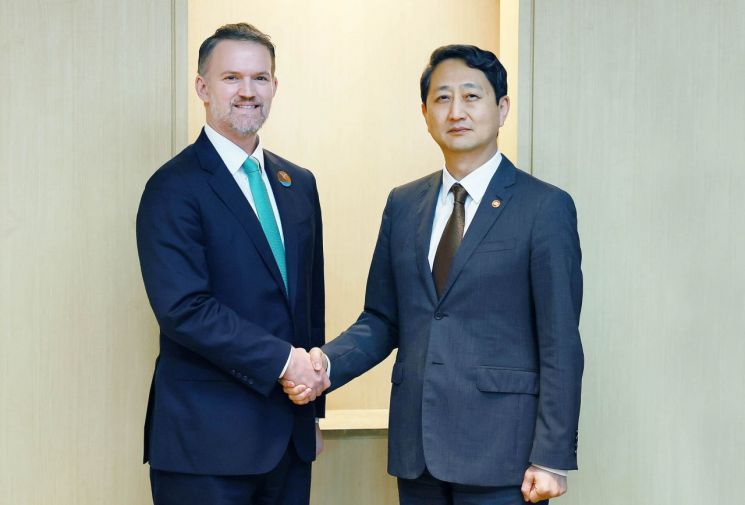 On the 16th, Minister of Trade, Industry and Energy Andok Geun (right) and Ambassador Katherine Tai, United States Trade Representative (USTR), took a commemorative photo during a meeting at the Jeju International Convention Center in Seogwipo, Jeju, on the occasion of the APEC Trade Ministers' Meeting. (Photo by Ministry of Trade, Industry and Energy)
Previously, on April 2 (local time) of this year, the Trump administration in the United States announced reciprocal tariffs targeting countries worldwide. For South Korea, a reciprocal tariff rate of 25% was set, consisting of a 10% base tariff and an additional 15% country-specific differential tariff. In response, on April 24, South Korea and the United States held a "2+2 consultation" in Washington attended by their finance and trade ministers, where they agreed to negotiate the July Package within the 90-day U.S. tariff grace period.
Based on this agreement, the two countries held their first technical consultation in the United States on May 1, and on May 16, during the Asia-Pacific Economic Cooperation (APEC) Trade Ministers' Meeting in Jeju, Minister of Trade, Industry and Energy Ahn Dukgeun and USTR Representative Jamieson Greer held a separate bilateral meeting. Meeting again just three weeks after the Washington 2+2 consultation, Minister Ahn and Representative Greer held a 30-minute discussion, during which they set six agenda items for the second round of consultations: balanced trade, non-tariff measures, economic security, digital trade, and commercial considerations regarding rules of origin. They also agreed on the schedule for future consultations.
After his meeting with Representative Greer, Minister Ahn told reporters, "Most countries are conducting negotiations with the United States based on these six templates," adding, "South Korea is able to pursue industrial cooperation in areas such as shipbuilding, energy, and advanced industries, which other countries cannot. However, we are not making industrial cooperation between South Korea and the United States a condition for the tariff negotiations."
Accordingly, the second technical consultation is expected to focus on specifying the negotiation terms for the six agenda items. Given that the Trump administration's primary goal for its tariff measures is to reduce the trade deficit, the United States may specifically request that the South Korean government increase its purchases of U.S. goods. In addition, non-tariff barrier issues that the U.S. side has previously raised in trade barrier reports, such as restrictions on beef imports over 30 months old and limitations on the export of Google’s high-precision mapping data, may also be included on the agenda.
Jang Seonggil, Director General for Trade Policy at the Ministry of Trade, Industry and Energy, who is overseeing the technical consultations, stated, "Through this technical consultation, we will respond with the national interest as our top priority, aiming to establish a mutually beneficial direction for the areas discussed so far."
© The Asia Business Daily(www.asiae.co.kr). All rights reserved.
![Clutching a Stolen Dior Bag, Saying "I Hate Being Poor but Real"... The Grotesque Con of a "Human Knockoff" [Slate]](https://cwcontent.asiae.co.kr/asiaresize/183/2026021902243444107_1771435474.jpg)















