The Korea Forest Service will establish an additional 20,000 hectares of nectar-producing forests over the next five years.
On May 20, the Korea Forest Service announced that it would expand nectar-producing forests to protect honeybees and support the beekeeping industry.
Since 2018, the United Nations has designated May 20 each year as "World Bee Day" to raise global awareness of the importance of honeybee protection. The announcement of the domestic plan to expand nectar-producing forests coincided with World Bee Day.
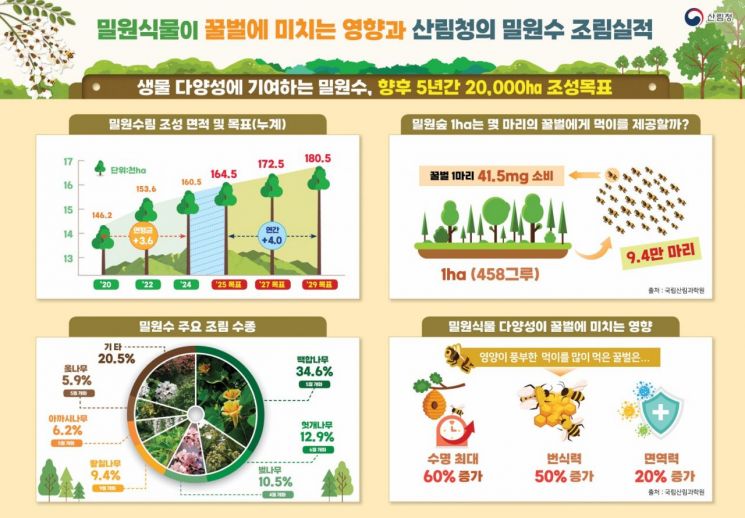
Nectar-producing trees are the source of food activity directly linked to the survival of honeybees, as they provide nectar and pollen. The diversity of nectar-producing trees is also considered a key factor in honeybee health. To provide a diverse and continuous food supply, it is necessary to plant a variety of nectar-producing trees that are rich in nectar and have different blooming periods.
From 2020 to 2024, the Korea Forest Service established an average of 3,600 hectares of nectar-producing forests nationwide each year, mainly planting tulip trees (which bloom in May, 34.6%), Hovenia trees (which bloom in June, 12.9%), and cherry trees (which bloom in April, 10.5%). These species serve as nectar sources while also having multipurpose uses and landscape value.
The annual area of nectar-producing forests established was 3,000 hectares until last year. However, starting this year, the Korea Forest Service plans to increase the annual area to 4,000 hectares and expand the total to 20,000 hectares by 2029. New species such as Ailanthus, linden, and Schisandra will also be included in the nectar-producing forests.
Additionally, research on nectar resources will be strengthened, including the discovery of new nectar-producing tree species, to protect the honeybee ecosystem and establish a sustainable foundation for beekeeping.
Park Eunsik, Director General of Forest Industry Policy at the Korea Forest Service, said, "Honeybees help maintain the health of the ecosystem and contribute to increasing the income of forestry and agricultural workers through beekeeping. The Korea Forest Service will expand the area of nectar-producing forests and work with related organizations to revitalize the beekeeping industry."
© The Asia Business Daily(www.asiae.co.kr). All rights reserved.
![Clutching a Stolen Dior Bag, Saying "I Hate Being Poor but Real"... The Grotesque Con of a "Human Knockoff" [Slate]](https://cwcontent.asiae.co.kr/asiaresize/183/2026021902243444107_1771435474.jpg)















