Kim Unsu, Vice President and Head of Hyundai Motor’s India, Africa, and Middle East Region
"Blending Indian Locality with Hyundai’s Globality"
Jung Jooncheol, Vice President and Head of Hyundai Motor and Kia Manufacturing Division
"Continuous Collaboration with Local Saudi Companies... Strengthening the Supply Chain"
Hyundai Motor Company has set a goal to establish a production system capable of manufacturing 1 million vehicles in India in the second half of this year, with plans to sell 800,000 units locally. The company’s strategy is to secure market competitiveness by establishing local production systems ahead of competitors in emerging markets such as India, the Middle East, and Africa.
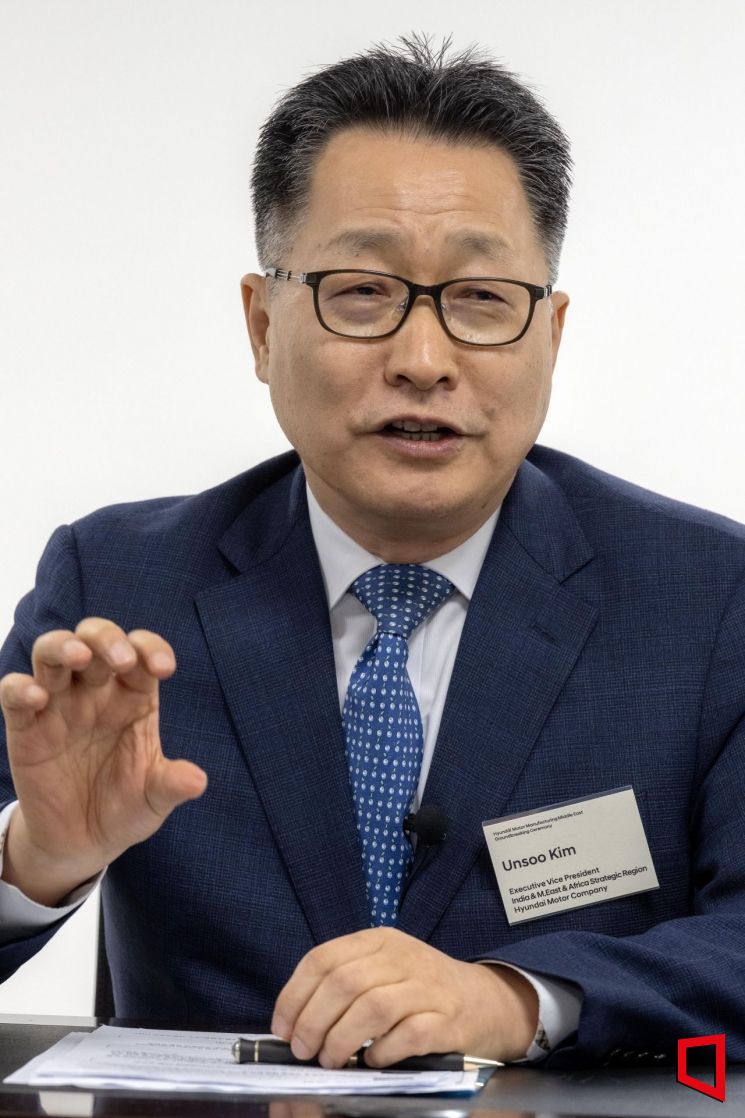 Kim Unsu, Vice President and Head of Hyundai Motor Company India, Africa, and Middle East Region, held a press briefing with reporters on the 14th (local time) at King Abdullah Economic City in Saudi Arabia. Hyundai Motor Company
Kim Unsu, Vice President and Head of Hyundai Motor’s India, Africa, and Middle East Region, stated at a press briefing with reporters on the 14th (local time) at King Abdullah Economic City near Jeddah, Saudi Arabia, “The Chennai Plant 1 and 2 in India have a combined production capacity of 820,000 units, and if we add the 250,000-unit capacity of the Pune plant, the total exceeds 1 million units. Of these, 80% will be sold in the Indian domestic market, and more than 20% will be exported.”
The production capacity of Hyundai’s Chennai plant was expanded from 770,000 to 820,000 units in 2023 through the addition of a new paint line and further facility investments. The Pune Plant 3, currently under construction in Maharashtra’s Pune region, is scheduled for completion in the second half of this year. Last year, Hyundai sold 605,433 vehicles in India, achieving the second-largest market share. Since recording sales of 423,642 units in 2020, the company has grown by 42.9% over five years. However, sales in the first quarter of this year reached 153,550 units, marking a 4.2% decline compared to the same period last year.
Vice President Kim emphasized, “Unlike the global market, the Indian market is centered on small cars. The Indian subsidiary has developed products based locally, from the i10 to the Creta, and by blending India’s ‘locality’ with Hyundai’s unique ‘globality,’ we will become a company that is even more loved in the future.”
Regarding the recent India-Pakistan conflict, he commented, “This is one of the ongoing situations that have continued since India’s independence. We have responded well to such changes in international affairs and supply chains, and we will continue to do our best to ensure the safety of our employees and the satisfaction of our customers.”
Additionally, Vice President Kim explained that Hyundai will implement a strategy to expand its regional export network from Saudi Arabia, which will house Hyundai’s first production base in the Middle East, to other Gulf Cooperation Council (GCC) countries and further into Africa. On this day, Hyundai broke ground on its ‘Hyundai Motor Manufacturing Middle East (HMMME)’ plant, a joint venture with the Saudi Public Investment Fund (PIF), at the King Salman Auto Park within King Abdullah Economic City.
Vice President Kim noted, “Of the 3.2 million vehicle demand in the Middle East and Africa, about 800,000 units, or a quarter, are in Saudi Arabia. Considering factors such as the pace of economic development and population density, the Saudi automotive market has significant growth potential.”
Jooncheol Jung, Vice President and Head of Hyundai Motor and Kia Manufacturing Division, who also attended the briefing, added, “In the initial phase, more than 90% of the parts for the Saudi plant will be supplied from domestic or overseas sources. However, we will continuously collaborate with local companies to increase the local procurement ratio.”
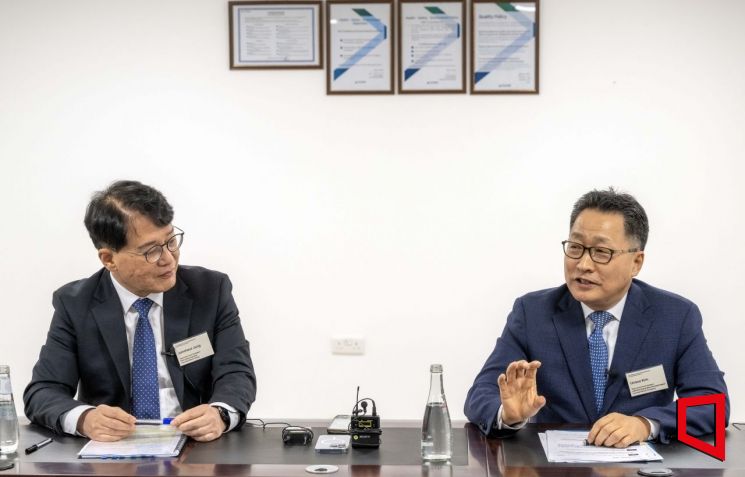 Eunsu Kim, Vice President and Head of Hyundai Motor's India-Middle East-Africa Region (right), and Jooncheol Jung, Vice President and Head of Hyundai Motor and Kia Manufacturing Division, held a press briefing with reporters on the 14th (local time) at King Abdullah Economic City in Saudi Arabia. Hyundai Motor
Vice President Kim pointed out that emerging markets like India, the Middle East, and Africa require a different approach from advanced markets such as the United States or Europe, which have become saturated ‘red oceans.’ He said, “The US and Europe are already mature markets where companies take market share from each other, or where certain segments drive growth, but the overall market will not expand further. In contrast, emerging countries are markets where volumes continue to grow.”
He continued, “Currently, the number of vehicles per 1,000 people is about 800 in the US, 600 in Korea, and 200 in China, but only about 60 in India. As emerging economies continue to develop, their automotive markets will inevitably expand, making them even more important in the future.”
© The Asia Business Daily(www.asiae.co.kr). All rights reserved.
![Clutching a Stolen Dior Bag, Saying "I Hate Being Poor but Real"... The Grotesque Con of a "Human Knockoff" [Slate]](https://cwcontent.asiae.co.kr/asiaresize/183/2026021902243444107_1771435474.jpg)
















