Editing 'Defective DNA' with Gene-Editing Scissors
First Successful Case of Treating Severe CPS I Deficiency in an Infant
Based on Nobel Prize-Winning Technology
A team of researchers in the United States has saved the life of a baby born with a rare genetic disorder using gene-editing therapy. This marks the first case in which a severe genetic disease has been treated with customized gene-editing therapy.
According to the Guardian and AP on May 15 (local time), a baby named KJ Muldoon, born in Pennsylvania, was diagnosed with severe CPS I deficiency immediately after birth 10 months ago. Individuals with severe CPS I deficiency lack the enzyme needed to convert ammonia, which is produced during the natural breakdown of proteins in the body, into a form that can be excreted in urine. As a result, ammonia accumulates in the body, becoming toxic and posing a risk of damaging other organs such as the liver or brain. Some cases can be treated with a liver transplant, but for those born with severe CPS I deficiency, by the time they are old enough for surgery, irreversible damage may have already occurred.
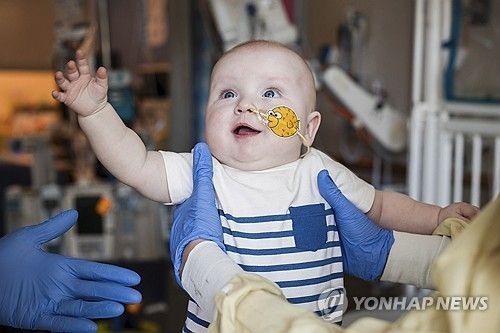
KJ's parents considered a liver transplant but ultimately decided to pursue gene therapy. The research team at Children's Hospital of Philadelphia and the University of Pennsylvania, who were responsible for KJ's care, spent six months developing a treatment to correct the defective gene. They based their approach on CRISPR, the gene-editing technology that won the Nobel Prize in 2020, but instead of cutting DNA, they used a method called "base editing," which precisely corrects only the defective DNA base sequence.
KJ received the gene-editing therapy by injection for the first time in February, followed by additional treatments in March and April. Before treatment, KJ had to remain in the hospital and follow a restricted diet, but after the therapy, KJ was able to increase protein intake and reduce medication use.
The Guardian explained that this is the first case in which a severe genetic disorder, which claims the lives of about half of affected infants when it develops in early infancy, has been treated with customized gene-editing therapy. International researchers highly praised the achievement, noting that it demonstrates the potential to rewrite defective DNA and treat life-threatening genetic diseases. Kiran Musunuru, a professor at the University of Pennsylvania, said, "The promise of gene therapy we've heard about for decades has come to fruition," and added, "This will completely change the way we approach medicine in the future."
However, the medical team explained that while the initial results of KJ's treatment are positive, follow-up monitoring is necessary to confirm the effectiveness of the therapy. They also noted that it may take time for customized gene therapy to become commercially available, but expressed hope that this technology will eventually help millions of patients.
The results of this research were presented at the annual meeting of the American Society of Gene and Cell Therapy held in New Orleans.
© The Asia Business Daily(www.asiae.co.kr). All rights reserved.
![Clutching a Stolen Dior Bag, Saying "I Hate Being Poor but Real"... The Grotesque Con of a "Human Knockoff" [Slate]](https://cwcontent.asiae.co.kr/asiaresize/183/2026021902243444107_1771435474.jpg)















