Only Eight Economic Analysts at the Fair Trade Commission... Just 1% of the Organization
Companies Assign One Professor per Case for Economic Analysis
At the Fair Trade Commission, One Staff Member Handles Multiple Cases Simultaneously
In the US, There Are 80 Economic Analysts... Only One-Tenth the Number at the Fair Trade Commission
As the platform economy grows rapidly, the importance of economic analysis within the Fair Trade Commission is also being highlighted. This is because the digital market has a complex transaction structure, and the balance of power between consumers and suppliers often operates differently, making it increasingly difficult to determine whether competition is being restricted using only traditional methods.
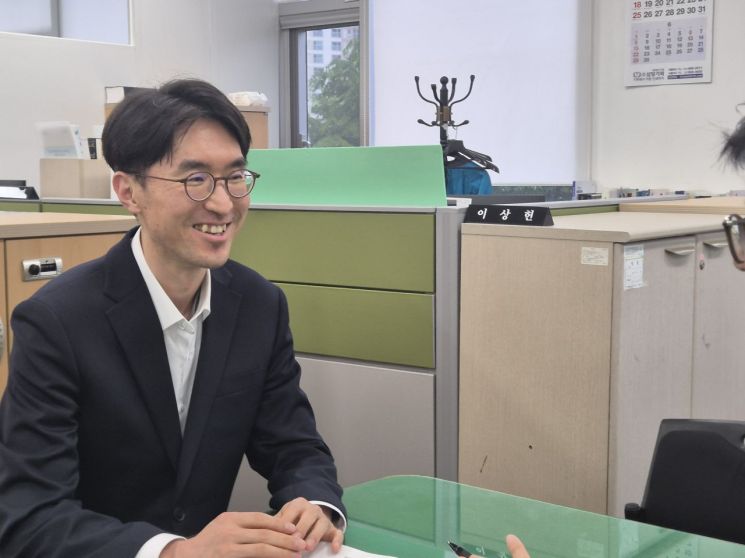 Sanghyun Kim, Director of Economic Analysis at the Fair Trade Commission, is conducting an interview with Asia Economy on the 13th / Photo by Eunju Lee
In February, the Fair Trade Commission appointed Sanghyun Kim, a professor in the Department of Economics at Yonsei University, as Director of Economic Analysis, an open position. This is the first time the Fair Trade Commission has appointed a tenured professor?someone who holds a permanent professorship at a university?to a director-level (Grade 4) position. As economic analysis capabilities are becoming increasingly important in the process of judging corporate cases, Professor Kim's appointment has drawn attention.
Director Kim graduated from the Department of Economics at Yonsei University and earned a PhD in Economics from the University of Michigan in the United States. He has since worked as a professor at the University of East Anglia in the United Kingdom and at Yonsei University, researching industrial organization, which analyzes how market structures affect companies in the process of competition. In the field of fair trade, he has focused on research into how bundling?one of the main business strategies of platforms?affects market competition.
In an interview with Asia Economy on the 13th, Director Kim emphasized that expanding the Fair Trade Commission's analytical capabilities is urgent. He said, "If the market definition is incorrect, the Fair Trade Commission's review could end there; economic analysis, including market definition, is extremely important." He added, "Companies are also bringing in professors to improve their economic analysis capabilities." He continued, "However, each Fair Trade Commission staff member is handling multiple cases at the same time, and compared to major competition authorities in other countries, we have very few personnel."
The following is a Q&A.
-What does the Economic Analysis Division at the Fair Trade Commission do?
▲We support the economic analysis needed in the process of reviewing cases involving unfair corporate practices, abuse of market dominance, and mergers. Economic analysis here means analyzing data related to a case to prove the effects of restricting competition.
A representative example of economic analysis is 'market definition.' Let me simplify with an example. If a soju company and a beer company report a merger to the Fair Trade Commission, the Commission may decide that competition would be weakened and prices could rise, and thus may disallow the merger.
However, to determine whether competition will be weakened, it is first important to define the boundaries of the market. This means identifying who the competitors are and what the scope of the market is where competition occurs. If, when the price of soju rises, consumers switch to beer as a substitute, it can be judged that soju and beer are competing in the same market. In this case, if the two companies merge, two major competitors become one, which could weaken market competition.
The Economic Analysis Division analyzes consumers' preferences and choices to determine whether there is a sufficient substitutive relationship between soju and beer. We analyze sales data and sometimes conduct surveys. Recently, economic analysis has often been used as key evidence. In major cases, the respondent side also sometimes submits economic analysis to support their legal arguments.
-How important is economic analysis capability?
▲Companies also conduct very thorough economic analysis regarding market definition. For this reason, there are cases where the Fair Trade Commission's review ends because the market definition was incorrect. We cooperate when other divisions request support for analytical capabilities.
-It is known that economic analysis is more difficult in platform cases than in traditional industries. Why is that?
▲In traditional industries, products are simple and consumer groups are uniform. For example, in the automotive industry, the main issue might be whether there is a substitutive relationship between small and large cars. Once such issues are resolved, it is relatively easy to determine the market dominance of a particular company.
However, in the case of platforms, they may have different market dominance on both the consumer and seller sides, and sometimes provide services for free on one side to capture the market early. With traditional economic analysis methods, it is difficult to assess market dominance. Often, it is ambiguous to determine the boundaries of the market. For example, video platforms and webtoon platforms are not competitors in terms of substitutive products. However, they do compete for users' attention.
-As the platform economy has become part of everyday life, the Fair Trade Commission's economic analysis capabilities seem more important than ever. What efforts are needed, both individually and organizationally, to enhance these capabilities?
▲From the Fair Trade Commission's perspective, we need to increase our personnel. Currently, including myself, there are eight people in the Economic Analysis Division. The proportion of economic analysts in the entire Fair Trade Commission is about 1%. In major countries, 7-8% of the staff at competition authorities are economic analysts.
(As I mentioned earlier) Because the importance of economic analysis is increasing, on the respondent side, there are cases where two professors work on analyzing a single case. However, our staff members must handle several cases at the same time. Attention to detail is most important, but we lack the manpower to gather data together, set the direction for economic analysis, discuss, and organize theories. Although Fair Trade Commission analysts generally have more relevant experience, so the Commission is not always at a disadvantage, we inevitably face tough battles. On a personal level, I try to keep my skills sharp by reading and analyzing many cases handled by the Fair Trade Commission in the past and cases currently under review by competition authorities overseas.
-This is the first time a tenured professor has been appointed to a director-level (Grade 4) position at the Fair Trade Commission. Previously, this position was mostly held by PhDs from the Korea Development Institute (KDI). What is the background behind a tenured professor joining the Economic Analysis Division as an open position?
▲My major is industrial organization. It is a field that has developed alongside competition law. Industrial organization has evolved as a field that discusses ways to stimulate competition and promote healthier economic growth. However, when I was only in academia, I tended to become detached from reality and focused on solving math problems. As I built models and conducted analyses, I began to think more about how I could make a real contribution to society. Earning tenure was also a good opportunity for me personally. Becoming a full professor and having job security enabled me to take on the challenge of the open position of Director of Economic Analysis.
-How do you feel now that you are working in the field? Any regrets?
▲I have no regrets. There is much more to do and I am much more stimulated than when I was at the university. Most researchers search for good questions and problems. You need to ask good questions to do good research. The biggest attraction of working in the field is that there is no shortage of questions and problems. From all over the country and in every industry, a variety of issues come to the Fair Trade Commission, and being here gives you the opportunity to think deeply about them. In that sense, most researchers would want to gain field experience. In my case, I think my desire for that experience was a bit stronger than average.
© The Asia Business Daily(www.asiae.co.kr). All rights reserved.
![Clutching a Stolen Dior Bag, Saying "I Hate Being Poor but Real"... The Grotesque Con of a "Human Knockoff" [Slate]](https://cwcontent.asiae.co.kr/asiaresize/183/2026021902243444107_1771435474.jpg)















