Notable Changes at the Osaka Expo
Once a Stage for Unveiling New Civilizations
Now a Trend of Showcasing Each Country's Culture
Regarding the "2025 Osaka·Kansai World Expo (World Exposition)" currently being held in Osaka, Japan, the Japanese newspaper Mainichi Shimbun featured a column titled "Focus on Expo" on the front page of its May 12th issue, covering the exhibition halls of Germany and the Czech Republic, where visitors gathered to drink beer under the headline "Cheers with beer from the homeland." According to the article, in the evening, Germany and the Czech Republic served beer in large glass cups to visitors at their national pavilions. The article reported that many visitors chose to end their day with German or Czech beer after dinner.
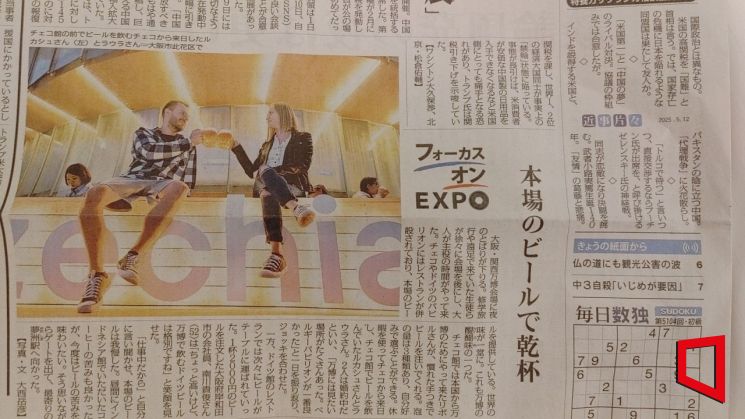 One of Japan's leading newspapers, the Mainichi Shimbun, featured a column titled "Focus on Expo" on the front page of its May 12th issue, covering the exhibition halls of Germany and the Czech Republic, where visitors gathered to drink beer under the headline "Cheers with beer from the homeland." Photo by Kim Hyungmin
Mainichi Shimbun described this scene as "the charm of the Expo." It represents a shift in the way the world views Expos. Traditionally, Expos brought together many countries to introduce new civilizations and offered a glimpse into how our industries might change in the future. At the very first event, held in London in 1851, the Crystal Palace made of iron and glass, steam locomotives, microscopes, and artworks attracted the attention of visitors. However, at this year’s Osaka Expo, it was difficult to find any truly groundbreaking new inventions or technologies. The Indonesia Pavilion served coffee and entertained visitors with dance and music performances, while the pavilions of European countries such as Belgium and Italy featured rooftop gardens that caught the eyes of many. Among the corporate pavilions, which only admitted visitors with advance reservations, the most popular was the Gundam Pavilion, featuring the famous Japanese animation character Gundam.
The theme of this year’s Osaka Expo is "Designing Future Society for Our Lives." Sub-themes included "protecting all living beings," "enriching individual lives," and "building and enriching society through the participation of all." However, only a few countries actually designed their pavilions in accordance with these themes. Park Younghwan, director of the Korea Pavilion at the Osaka Expo, said, "In the past, Expos were an opportunity to unveil new inventions for the first time and confirm humanity’s new future, but recent Expos seem to have truly transformed into festivals to be enjoyed in every sense of the word."
Due to this shift in trends, Korea, which has traditionally focused on showcasing advanced technologies such as displays and hydrogen energy in line with the Expo’s theme, is now facing new challenges. There is even uncertainty about whether the Expo to be held in Riyadh, Saudi Arabia, in 2030 should also strictly adhere to its designated theme. One official on site commented, "If it’s about culture, we could make full use of K-pop and dramas, but I am not sure if that would truly align with the value and authenticity of the Expo."
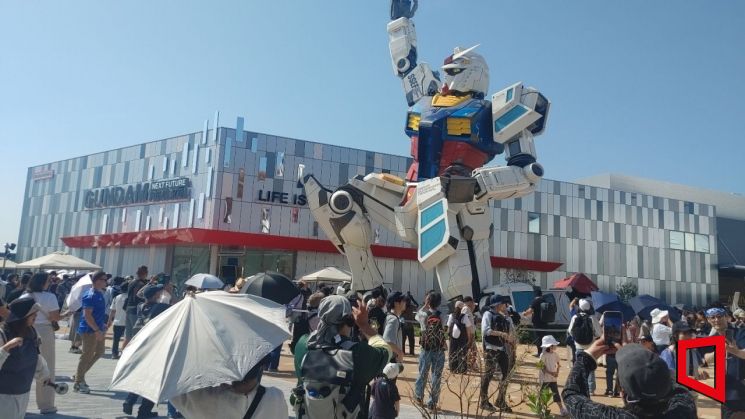 The 'Gundam Pavilion' has established itself as the most popular attraction at this year's Osaka Expo. Photo by Kim Hyungmin
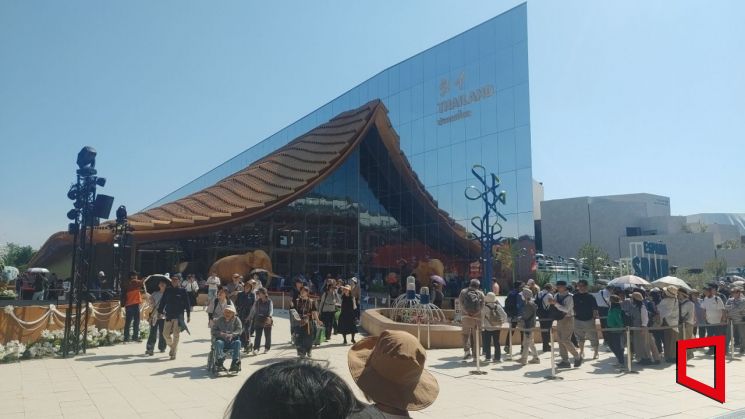 The Thailand pavilion, designed in the shape of an elephant, a symbolic figure, and traditional houses. Most countries created their national pavilions to showcase their unique cultures. Photo by Kim Hyungmin
Regardless of these changes in trends, the Osaka Expo is now on a smooth course, dispelling initial concerns. The positive effects are beginning to appear not only at the Expo site but also in commercial facilities throughout the city. According to Nihon Keizai Shimbun, the number of visitors to the Takashimaya Osaka store increased by 10% around the opening of the Expo. At Rihga Place, a hotel in Osaka, both the number of reservations and room rates during the May holidays rose by 30% compared to the previous year. In terms of transportation, Kansai International Airport is expected to reach a record high in passenger numbers this year, and Kintetsu Railway reported a 9% increase in weekend passengers after the Expo opened, compared to the same period last year. Riding this momentum, Japan’s Ministry of Economy, Trade and Industry recently announced that the Osaka Expo is expected to generate an economic effect of approximately 29 trillion yen. KOTRA, which operates the Korea Pavilion at the Expo, also forecasts that Korea will enjoy an economic effect of about 8 trillion won from this event. This economic effect includes all aspects such as export consultations and contracts made at the Expo, the increase in trade volume before and after the event due to promotion and exhibitions, and the revitalization of Korean companies' entry into the Japanese market.
© The Asia Business Daily(www.asiae.co.kr). All rights reserved.
![Clutching a Stolen Dior Bag, Saying "I Hate Being Poor but Real"... The Grotesque Con of a "Human Knockoff" [Slate]](https://cwcontent.asiae.co.kr/asiaresize/183/2026021902243444107_1771435474.jpg)

















