Superintendents to Be Appointed Instead of Directly Elected
Teachers Accused of Child Abuse May Avoid Prosecution
Universities and Local Communities to Grow Together, Public Education to Be Strengthened
On May 15, the People Power Party announced its education pledges, centered on abolishing the direct election of superintendents, strengthening teachers' authority, and integrating kindergartens and daycare centers. The party's goal is to normalize public education and foster a healthy school environment, creating "schools where students can learn freely and teachers can teach with enthusiasm."
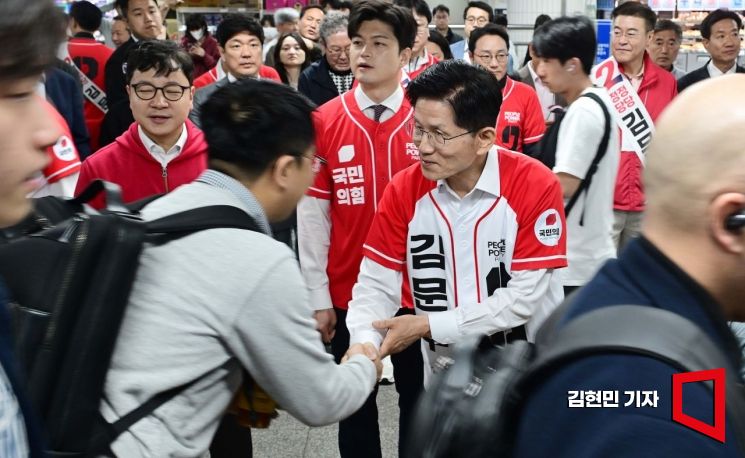 Kim Moonsoo, the presidential candidate of the People Power Party, is greeting commuters and appealing for support at Sindorim Station in Guro-gu, Seoul on May 15, 2025. Photo by Kim Hyunmin
The People Power Party's Policy Headquarters, in an education pledge released on Teachers' Day, promised to change the current method of electing superintendents from a "direct election by residents" to either a "running mate system with city/provincial governors" or an "appointment by metropolitan government heads." The party stated that this would strengthen political neutrality and transparency.
The superintendent election system was changed from an indirect to a direct election in 2006, with the aim of achieving educational autonomy involving residents. However, there has been criticism that directly electing superintendents has turned schools into political arenas and increased the number of "corrupt superintendents" due to the high costs of elections.
The People Power Party also announced plans to strengthen teachers' authority, considering the increasing number of early-career teachers leaving the profession due to the decline in teacher authority. The party will revise the system so that if a teacher is reported for child abuse and an investigation or inquiry is underway, but the superintendent submits a legitimate opinion that the teacher's actions were appropriate guidance, the case will not be referred for prosecution.
If a teacher is involved in a lawsuit, the system will be improved so that the education office provides primary support for the case through a designated law firm, and after the final ruling, the education office can claim compensation from the opposing party.
Shin Dongwook, chief spokesperson for the People Power Party, stated in a commentary on the same day, "The decline in teachers' authority has severely undermined their standing," and added, "If the authority of teachers, who are supposed to guide students uprightly, collapses, there is no future for South Korea."
The party also plans to strengthen public education. Personalized education for students will be implemented using artificial intelligence (AI) digital textbooks, and edutech education utilizing AI, virtual reality (VR), and augmented reality (AR) will be introduced.
The party will reduce the burden of private education expenses by strengthening self-directed learning through EBS and self-directed learning centers. The number of college admissions counseling centers will be significantly increased, and the career counseling capabilities of field teachers will be enhanced to provide high-quality admissions consulting.
The People Power Party stated, "We will ensure that even those born into disadvantaged families can climb the social ladder through quality education," and explained, "Through K-Learn, we will provide tailored, high-quality education to low-income students without the burden of private education costs."
The party will also integrate kindergartens and daycare centers to provide high-quality education and childcare services. First, the gap in government funding between kindergartens and daycare centers will be reduced, and integration focusing on infants and young children will be promoted. Free education and childcare for children aged 3 to 5 will also be implemented in stages.
The party also plans to strengthen the competitiveness of vocational high schools. Public institutions will expand hiring of high school graduates, and the local talent system for military civilian positions will be promoted. Continuous career planning and social integration support will be provided for vocational high school graduates.
In addition, the party will promote "regionally tailored education innovation" to revitalize both universities and local communities. By strengthening the competitiveness of regional universities through the Regional Innovation-led University Support System (RISE) policy, the party aims to build an ecosystem for the joint growth of universities and local regions.
The People Power Party explained, "We will attract more international students and establish a systematic management system, and we will promote the activation of joint degree programs between Seoul National University and regional flagship universities."
© The Asia Business Daily(www.asiae.co.kr). All rights reserved.
![Clutching a Stolen Dior Bag, Saying "I Hate Being Poor but Real"... The Grotesque Con of a "Human Knockoff" [Slate]](https://cwcontent.asiae.co.kr/asiaresize/183/2026021902243444107_1771435474.jpg)















