No Progress for Ten Years Since the FTA Took Effect
With the inauguration of a new administration, attention is focused on whether the legal markets of Korea and China will be further opened. In May 2024, the two countries agreed to resume the second-phase negotiations on the Korea-China Free Trade Agreement (FTA) in the fields of services and investment, and announced that they would discuss expanding the opening of their legal markets. However, discussions have effectively come to a halt following the impeachment of former President Yoon Suk-yeol (65, Judicial Research and Training Institute class 23). As demand for legal consulting in both Korean and Chinese law continues to rise, there is growing interest in whether the new administration will actively pursue further market opening.
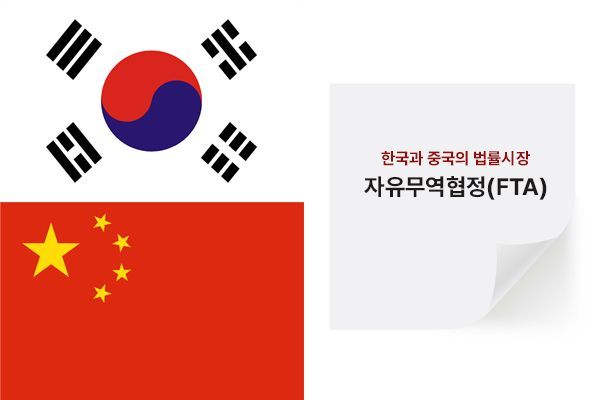 Attention is focused on whether the legal markets of Korea and China will be further opened. Legal Times
The Korea-China FTA came into effect in 2015, but the opening of the legal markets in both countries remains at the first stage. Foreign law firms are only allowed to provide advice on their home country's law, while consulting on the other country's law is prohibited. Hiring lawyers and jointly handling cases are also not permitted. In China, joint operations are exceptionally allowed only within the Shanghai Free Trade Zone (FTZ), but the limited region and scope have been criticized for lacking effectiveness. Korean law firms operate offices in China, and Chinese law firms operate offices in Korea, but both face restrictions in the scope of consulting and case representation. The recent decision by Bae, Kim & Lee LLC to close its Shanghai office is reportedly due to these limitations and the stagnation of profitability resulting from the slow pace of market opening.
Won Jungjae (48, class 34), Chief Representative Attorney of the Beijing office of Shin & Kim LLC, stated, "There are considerable restrictions not only on dispute resolution and government relations under Chinese law, but also on general consulting regarding Chinese law," and added, "The current level of market opening under the Korea-China FTA is excessively low, and at the very least, consulting on Chinese law should be allowed without restriction."
Korean law firms are not the only ones facing difficulties in China. Chinese law firms operating in Korea are encountering similar challenges. As of May 2025, there are four Chinese law firms with offices in Korea: Lifang (2018), Yingke (2019), Zhongxing Chengtai (2023), and Longli & Tenwin Partners (2024). Some of these firms have reduced the scale of their Korean offices.
Kim Yoonkook, head of the Seoul office of Zhongxing Chengtai, said, "Consultations are often discontinued simply because we cannot provide advice on Korean law," and added, "There is clearly demand for legal services between Korea and China, but the inability to respond in practice demonstrates the negative impact of delayed market opening."
Experts believe that opening the legal market goes beyond merely enabling law firms to expand overseas. Park Jaeyoung (45, 4th Bar Exam), attorney at DLG LLC's Beijing Desk, commented, "Currently, we are limited to operating as liaison offices, but if joint ventures or independent law firms become possible, the entry of Korean lawyers into China could also expand." Park added, "Law forms the foundation of corporate management. If the market is opened, Korean companies' access to legal services in China will be greatly improved." Won Jungjae also stated, "If the legal market is opened, the scope of work that Korean law firms can handle independently will broaden, and the opportunities to represent Korean companies in China will increase. It will also become easier to hire Chinese lawyers than it is now." A lawyer at a domestic law firm working in the Shanghai office remarked, "If market opening allows for direct consulting within a certain scope and permits joint case representation with Chinese law firms, work efficiency and service consistency will be greatly improved. Clients will also notice tangible changes, and the quality of legal services will be further elevated."
The Korean Bar Association officially recommended to the Ministry of Justice in 2018 that the legal market be opened further to the third stage. The key points included: permitting the establishment of joint law firms, allowing the employment of Chinese lawyers, permitting consulting on Chinese law except for certain litigation, and expanding the regions where joint management is possible nationwide. A representative of the Korean Bar Association stated, "Korean law firms operating in China have branch offices in Beijing, Shanghai, and other cities, but their actual work is limited to consulting on their home country's law. To achieve substantive legal service cooperation between the two countries, a third-stage opening equivalent to the US and EU models is necessary." Kim Yoonkook also said, "Both countries should move beyond the current first-stage status that has persisted since the Korea-China FTA and begin earnest discussions on third-stage market opening."
Jin-Young Lee, Legal Times Reporter
※This article is based on content supplied by Law Times.
© The Asia Business Daily(www.asiae.co.kr). All rights reserved.
![Clutching a Stolen Dior Bag, Saying "I Hate Being Poor but Real"... The Grotesque Con of a "Human Knockoff" [Slate]](https://cwcontent.asiae.co.kr/asiaresize/183/2026021902243444107_1771435474.jpg)















