Chinese Factories Busy as Supplier Orders Recover
"Factories That Were Once Quiet Now Working Overtime"
With the United States and China agreeing to a truce in their tariff war, Chinese factories have quickly resumed operations. As orders from American companies flood in, factories are running late into the night.
On May 14, China National Radio reported on the busy scenes at Chinese factories following the news of the U.S.-China tariff war truce.
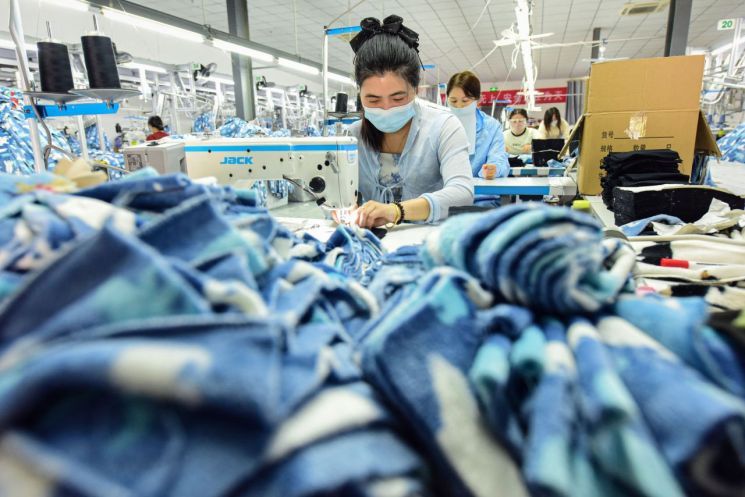 An employee is producing export pajamas at a garment factory in Lianyungang, Jiangsu Province, eastern China. Photo by AFP
According to the report, the manager of Jiangsu Huateng Co., Ltd. in Murong Province, China, checked an order from a major American retailer via email the previous day. The company had previously exported household goods such as toothbrushes and dental floss to U.S. retailers including Walmart and Kroger. However, due to the U.S.-China tariff war that erupted in April, American customers had temporarily suspended their orders from Chinese factories.
The manager said, "If it hadn't been for the tariff dispute, the order that was supposed to be placed in March was delayed by two months." He added, "However, as we went through the U.S.-China tariff war, we have recently started working with other countries such as Europe and Brazil, which has made us extremely busy," according to China National Radio. He predicted that business would become even busier going forward.
The representative of Jiangsu Ailei Garment Co., Ltd., Sun Qing, stated that the factory, which had been quiet for a while due to the tariff war, has recently become so busy that employees are working overtime. He said, "New orders must be shipped by the end of July, but with a preparation period of three to four months, the schedule is extremely tight," and added, "Even if working hours increase, we have to meet the orders, so we are working overtime late into the night." However, he pointed out that because the company still has to bear a 20% tariff related to the fentanyl issue, most companies prioritize placing orders with factories in Southeast Asia over those in the United States.
On the same day, China Business News quoted representatives from export trading companies as saying, "During the period of U.S. tariff adjustments, it appears that most home appliances produced in China will resume shipments." Zhu Xiaomei, marketing director of Xinbao Holdings, said, "Ships bound for the U.S. market are already preparing to set sail."
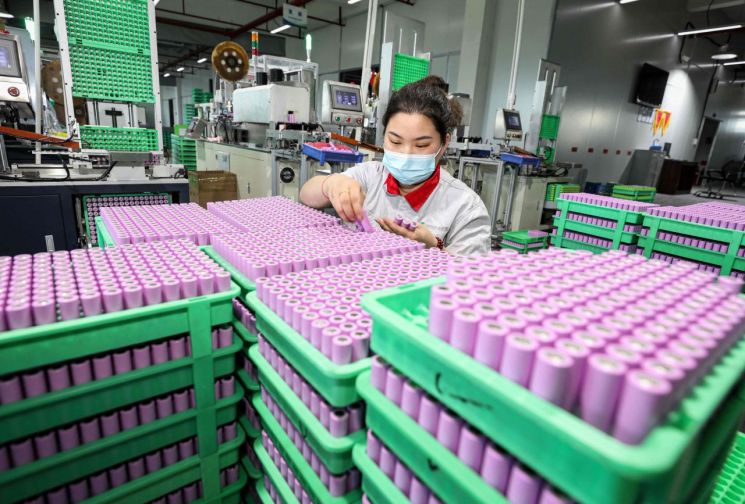 An employee working on a lithium battery production line at a factory in Huaibei, Anhui Province, eastern China. Photo by AFP
An industry official told China Business News, "Since tariffs have been significantly reduced compared to before, companies in both countries should communicate as quickly as possible to ship goods," and added, "Because there are many variables even after the 90-day period, it is expected that American companies will urgently stockpile goods." He emphasized, "Chinese companies should seize this opportunity while also preparing for unexpected changes that may arise."
The United States and China held high-level talks in Geneva, Switzerland, on May 10-11 (local time), and on May 12, the two countries announced in a joint statement that they would each reduce tariffs by 115 percentage points. The United States decided to cancel 91% of the additional 125% tariffs imposed on Chinese goods since April 2, and defer the remaining 24% for 90 days. However, the 20% tariff related to fentanyl, which was imposed at 10% each in February and March this year, will be maintained, resulting in a 30% tariff rate on Chinese goods.
© The Asia Business Daily(www.asiae.co.kr). All rights reserved.
![Clutching a Stolen Dior Bag, Saying "I Hate Being Poor but Real"... The Grotesque Con of a "Human Knockoff" [Slate]](https://cwcontent.asiae.co.kr/asiaresize/183/2026021902243444107_1771435474.jpg)
















