Lee Joonggeun, Chairman of Booyoung Group, Interview
"Establishing a Housing Planning Committee Is Essential for Policy Consistency"
"Booyoung's Land Selection Criteria?... Transportation Networks Are the 'Vital Spot' of Location"
"Optimum Over Best... I Aim to Build a Long-Lasting Company"
"100 Million Won Childbirth Incentive, Will Continue Until Fertility Rate Reaches 1.5"
Lee Joonggeun, the 84-year-old chairman of Booyoung Group who drew attention for his "100 million won childbirth incentive per child" policy, urged that "permanent rental housing should be expanded to account for up to 30% of all housing so that citizens can live with peace of mind for their entire lives," just about 20 days before the presidential election. This is the first time that Chairman Lee, who has consistently raised his voice on the issues of aging and low birth rates, has directly expressed his stance on housing policy. He stated, "If permanent rental housing reaches 30%, the problem of elderly poverty can also be resolved," adding, "This is an important policy that directly connects to elderly welfare."
In an interview with Asia Economy at Booyoung Group’s headquarters in Jung-gu, Seoul, on the 13th, Chairman Lee, drawing on his decades of experience supplying rental housing in the private sector, said, "The current rental system is merely a 'conditional pre-sale waiting type' for 5 or 10 years," and emphasized, "Ownership and rental should be clearly separated." He explained, "Currently, about 60% of all housing is owner-occupied, while 40% is rented, but up to 30% of that should be supplied as permanent rental housing." The government designed public rental housing to be converted to ownership after a certain period, in order to help low-income households build assets and reduce the long-term fiscal burden. However, there are concerns that this approach reduces rental stability and increases the burden at the time of conversion to ownership. Chairman Lee pointed out, "Public rental housing accounts for only about 1% of all housing, or about 220,000 units," and "most of these are small units of 9 or 12 pyeong, which are not sufficient to meet actual demand, and in many cases, they only count as numbers on record."
"Need to Establish a Housing Planning Committee"
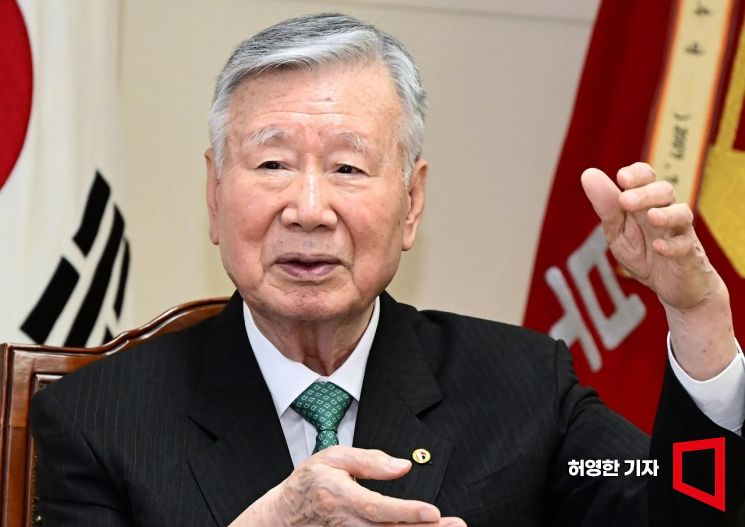 Lee Joonggeun, chairman of Booyoung Group, is meeting with reporters on the 13th at the company headquarters in Jung-gu, Seoul, discussing corporate management and social responsibilities. Photo by Huh Younghan
He stated that incentives for private sector participation are necessary to expand permanent rental housing. "It is realistic for the government to subsidize by guaranteeing minimum returns," he said, "Currently, the housing fund is operated only by the public sector, but private funds such as insurance companies and pension funds should also be able to invest in rental housing." He plans to continuously propose such measures to the government. He also raised the need for a separate national organization to ensure consistency in housing policy. "It takes at least five years to build housing, but the officials in charge change frequently," he said, "We need an organization like a 'Housing Planning Committee' that can design and take responsibility for long-term plans."
Regarding the contraction of the real estate market, he said, "Now is an era where only houses that can be sold are sold." Chairman Lee emphasized, "From now on, we need to build houses that last 100 years, not just 30 years." He explained that companies like Samchully and Eugene Corporation, which produce ready-mixed concrete and cement, are developing high-durability materials for this very reason. "Going forward, what matters is not how many houses are built, but how long they last and how good the quality is," he said, "National policy should also shift in that direction."
Regarding the favorable locations of Booyoung’s land holdings, he said, "When selecting land, 'transportation' is the most important factor," adding, "Even the 'hyeol' (vital spot) mentioned in feng shui ultimately comes down to transportation networks. Only connected places survive."
On the subject of Booyoung’s advertising, he said, "Some say it’s old-fashioned, but we haven’t changed our advertising models," adding, "Housing is not an industry that changes rapidly like finance or AI. It’s a conservative business that deals with the basic spaces where people live and go about their daily lives." He continued, "If people say Booyoung builds 'livable, usable homes,' that’s enough for me. Optimum lasts longer than best. I’m satisfied if Booyoung comes to mind when people think of homes." He added, "My goal is to leave behind a stable company so that Booyoung can continue its housing business into my grandchildren’s and great-grandchildren’s generations, even after I’m gone."
The total amount he has donated to society so far exceeds 1.2 trillion won. He said, "I never set out to become a 'donation king.' I don’t even really know how much I’ve given," adding, "I just helped whenever someone needed it." When asked about plans to acquire domestic universities, including Chung-Ang University, he briefly replied, "I am still interested in acquiring domestic universities. I continue to keep an eye on it."
"Raising the Senior Age Standard to 75 Is Appropriate... Discussion Needed on Unifying Retirement Age at 65"
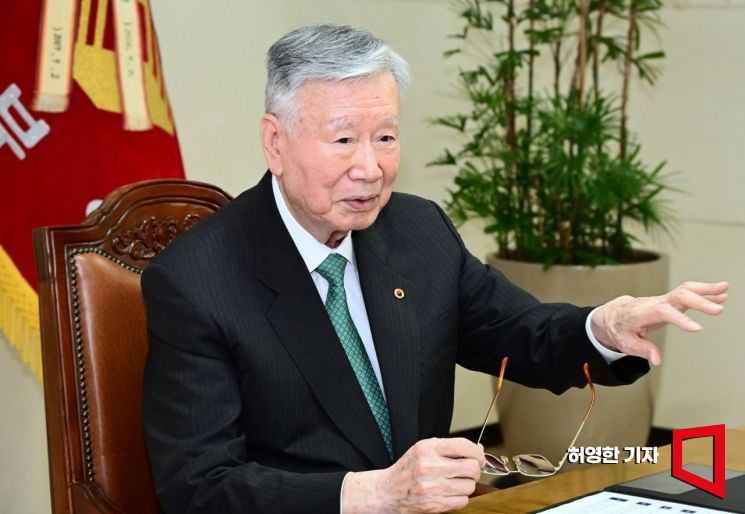 Lee Joonggeun, chairman of Booyoung Group, is meeting with reporters on the 13th at the company headquarters in Jung-gu, Seoul, discussing corporate management and social responsibilities. Photo by Huh Younghan
After being inaugurated as president of the Korean Senior Citizens Association last October, his first priority was to expand membership. He said, "Out of 10 million seniors, only 3 million are members," and "To have true representation, more than half need to join." The membership fee was a hurdle. He proposed a compromise by distinguishing between regular members (who pay dues) and general members (who are exempt from dues), and this is now being implemented in consultation with local chapters. In Yeosu, Gwangyang, and his hometown Suncheon alone, membership has increased by over 10,000. "However, due to the Personal Information Protection Act, we cannot receive the national list of seniors, so our staff have to meet people one by one and explain, which takes a lot of time," he explained.
Regarding the government’s review of raising the senior age standard, he said, "Since my candidacy, I pledged to raise it to 75, and after taking office, I discussed it with local chapter presidents and made it the official position of the Korean Senior Citizens Association." He emphasized, "This is not just my personal opinion, but the official stance of the Association." He added, "Some suggest raising it gradually to 70, but once a national policy is set, it’s hard to change. When we do it, we should go straight to 75." He also said, "I suggested to the Ministry of Health and Welfare that we raise it by one year each year and assess whether 75 is appropriate around 2035." On extending the retirement age, he said, "I agree with raising the retirement age in five-year increments," but noted, "For vertically structured occupations like military generals, where there are limited positions, careful consideration is needed." Regarding the employment of older workers within Booyoung Group, he said, "We don’t let go of capable employees just because they’re older. Some have worked for 40 years, and some families have two generations working together. We need a culture, like in the United States, where people are not forced to retire because of age."
He also mentioned the need to expand "home-based end-of-life care," where people can spend their final days at home. "The government should set the direction first, and the private sector should share roles within that framework," he said. "If we shift the budget allocated to nursing facilities to home-based end-of-life care and reinforce personnel, it is entirely feasible." He argued that it is a national loss for the working-age population to be tied up in caregiving, and that, like Japan, foreign workers should be institutionalized for home care so that families can focus on their livelihoods.
Childbirth Incentive: "It Has to Be a Billion to Make an Impact"
Regarding the "100 million won childbirth incentive" program, the first of its kind among domestic companies, Chairman Lee explained, "Just as a market transaction only happens when the price is right, childbirth incentives also need to be set at a realistic level. That’s why I set it at 100 million won." He continued, "The total fertility rate needs to reach at least 1.5 for national anxiety to subside somewhat. I plan to continue the program until that point."
He said, "Some employees have told me they don’t regret staying with Booyoung even though they could have gone to bigger companies, and some have even sent handwritten letters. I don’t know if we’re over-promoting ourselves, but it’s true that our popularity among young people has increased somewhat."
On the national response to low birth rates and elderly welfare, he said, "The national budget deficit now reaches 1,000 trillion won. Instead of letting the 50 trillion won childbirth incentive budget and the 20 trillion won elderly welfare budget be spent on administrative or indirect costs, they should be converted to direct support." He added, "If we give 100 million won per child, it would only take 30 trillion won a year for 300,000 births. The amount has to be big enough for people to really feel it and be motivated to act."
© The Asia Business Daily(www.asiae.co.kr). All rights reserved.
![Clutching a Stolen Dior Bag, Saying "I Hate Being Poor but Real"... The Grotesque Con of a "Human Knockoff" [Slate]](https://cwcontent.asiae.co.kr/asiaresize/183/2026021902243444107_1771435474.jpg)
















