Guaranteeing the Rights of "Resident-Type Living Populations" in Depopulated Areas
Preparing with a Living Registration System Before Introducing a Multiple Address System
A government-funded research institute has proposed the introduction of a "Living Registration System" to address the issue of so-called "resident-type living populations" in depopulated areas?people who actually live in these regions but are not officially registered as residents?being unable to properly access basic welfare and other public services.
On May 13, the Korea Research Institute for Human Settlements stated in the 1012th issue of its National Land Policy Brief, titled "Introduction Plan for a Living Registration System for Resident-Type Living Populations," that "an average of 33% of people actually living in depopulated areas are resident-type living populations who are not officially registered as residents in those areas." The institute emphasized, "As a transitional measure prior to the introduction of a multiple address system, a 'Living Registration System' should be implemented to provide a legal basis for individuals to receive local public services in their area of activity, separate from the official resident registration."
 Exterior view of the Sejong office of the Korea Research Institute for Human Settlements. Korea Research Institute for Human Settlements
An Sohyun, Associate Research Fellow at the National Land Policy and Regional Planning Center of the Korea Research Institute for Human Settlements, who led the study, explained, "The Living Registration System allows individuals to register their daily activity area, in addition to their official address, separately from resident registration." She added, "This is an effective way to address the issue of restricted access to public services caused by the mismatch between one's official address and actual area of activity." The public services that living populations are unable to access include basic welfare services (creating welfare blind spots), exclusion from daily life-oriented services, exclusion from youth support services, and restrictions on the use of local resources.
The institute also noted, "The legal concept of 'living population' has already been introduced through the Special Act on Support for Depopulated Areas. Now, it is urgent to move away from uniform policies centered on the officially registered population and to establish concrete systems that reflect the diverse needs of people who actually reside and are active in local communities."
According to the Korea Research Institute for Human Settlements, 80.2% of the general public and 64.7% of local government officials agree on the need to provide public services in areas where people are active, even if these are not their official registered addresses. Regarding the introduction of the Living Registration System, 29.6% of the public and 33.0% of local government officials expressed a high level of preference.
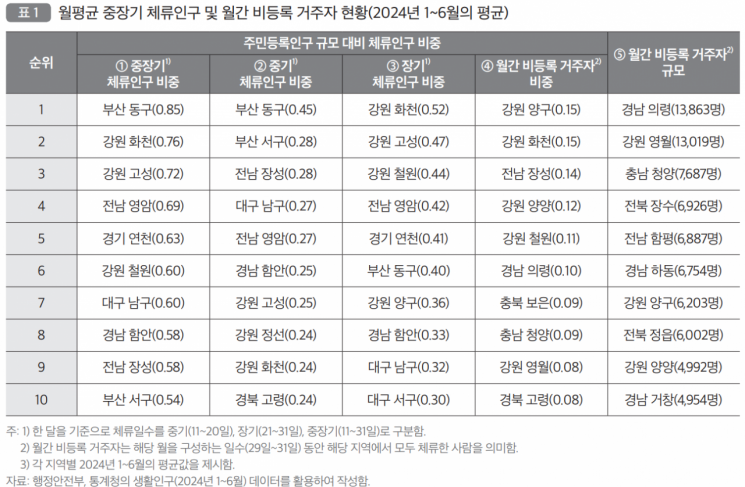 Status of Average Monthly Mid- to Long-Term Residents and Monthly Undocumented Residents from January to June Last Year. Korea Research Institute for Human Settlements Report
However, Associate Research Fellow An advised that a gradual approach is needed in introducing the Living Registration System, taking into account potential administrative and financial burdens, issues of fairness with the officially registered population, and concerns about possible misuse of the system. She also stated that, for the implementation of the Living Registration System, concrete action plans should be developed, including the categorization and conceptual definition of living populations, establishment of relevant legal and institutional frameworks, pilot implementation at the local government level, and the development of a system of rights and obligations for living populations across different regions.
Additionally, Associate Research Fellow An emphasized, "Based on the results of operating the Living Registration System, the need to fundamentally resolve the mismatch between actual residence and official registration, and to grant legal status to multi-regional living, should be considered from a long-term perspective through the introduction of a 'Multiple Address System.'"
© The Asia Business Daily(www.asiae.co.kr). All rights reserved.
![Clutching a Stolen Dior Bag, Saying "I Hate Being Poor but Real"... The Grotesque Con of a "Human Knockoff" [Slate]](https://cwcontent.asiae.co.kr/asiaresize/183/2026021902243444107_1771435474.jpg)
















