Seoul Discusses Tourism Cooperation with Beijing Delegation
Plans for Foreign Festival Collaboration... Anticipating Growth in Tourist Numbers
Oh Sehoon Visited Beijing Last Year to Discuss Economic Exchange
For the first time in six years since the COVID-19 pandemic, Seoul and Beijing have sat down together to discuss ways to revitalize tourism between the two cities. With both countries working toward visa-free entry and visa exemptions for tourists, the number of Chinese visitors to Korea is expected to increase further.
According to the Seoul Metropolitan Government, the "Seoul-Beijing Tourism Policy Meeting" was held on May 12 at Seoul City Hall with a delegation from the Beijing Municipal Bureau of Culture and Tourism. The meeting was organized to discuss practical cooperation measures for the exchange of tourism resources and attracting tourists between Korea and China. Policy officials from both cities, including Koo Jongwon, Director General of Tourism and Sports at the Seoul Metropolitan Government, and Sun Jian, Deputy Director of the Beijing Municipal Bureau of Culture and Tourism, attended the meeting.
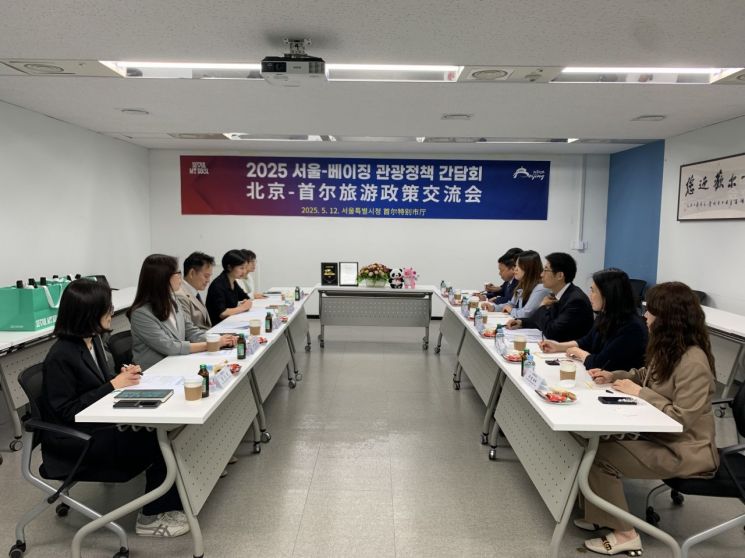 On May 12, the Seoul Metropolitan Government held the "Seoul-Beijing Tourism Policy Meeting" with the delegation from the Beijing Municipal Bureau of Culture and Tourism at Seoul City Hall. Photo by Seoul Metropolitan Government.
Since signing a tourism cooperation agreement in 2013, Seoul and Beijing have actively organized joint tourism briefings and collaborative promotion and marketing activities. Although official exchanges were temporarily suspended after 2019 due to the pandemic, tourism exchanges between Korea and China have recently shown a rapid recovery, making this the first face-to-face meeting in six years.
Notably, in July of last year, Seoul Mayor Oh Sehoon visited Beijing and met with Mayor Yin Yong, announcing the resumption of high-level city diplomacy and pledging to strengthen exchanges in areas closely related to citizens' lives, such as the economy.
Even during the pandemic, Seoul and Beijing maintained their cooperative ties through ongoing communication, including mutual support for quarantine supplies. Since establishing a sister-city relationship in 1992, the year after Korea-China diplomatic relations were established, the two cities have engaged in active exchanges across various fields for more than 30 years. In 2013, the Seoul-Beijing Joint Committee, a permanent cooperation body, was launched to build a sustainable foundation for cooperation. At that time, Mayor Oh and Mayor Yin discussed ways to strengthen exchanges in youth and young adult sectors. They agreed on the importance of fostering an environment where the next generation, who will lead the future of both countries, can understand each other's cultures and social atmospheres, and expressed their commitment to laying the groundwork for joint development and prosperity.
At this meeting to strengthen tourism cooperation, Director General Koo introduced a variety of festivals held throughout Seoul in which foreign visitors can participate, such as the "Relaxed Hangang Triple Festival," with the goal of making Seoul a "fun city" all year round. He also congratulated Beijing on the recent inscription of the Central Axis (Zhongzhouxian) as a UNESCO World Heritage site. Deputy Director Sun Jian remarked that Seoul's inbound tourism performance and overseas promotion strategies are highly impressive. He also expressed Beijing's intention to refer to Seoul's unique experiences and strategies as it seeks to become the leading city in China's inbound tourism market.
According to government data, last year 4.6 million Chinese tourists visited Korea, accounting for the highest proportion (28%) of all foreign visitors to Korea and representing a 127% increase from the previous year. The number of Korean tourists visiting China also showed a recovery, increasing by 115% from the previous year to 2.31 million. In response, the Chinese government resumed visa-free entry for Korean tourists visiting China for tourism purposes in November of last year, and the Korean government is also planning to implement a temporary visa waiver for Chinese group tourists during the third quarter as a reciprocal measure.
The Seoul Metropolitan Government plans to continue aggressive marketing efforts to attract more foreign tourists to Seoul, including those from China. The city has set a vision for the future of tourism, called the "3-3-7-7 Tourism Era," which aims to attract 30 million overseas tourists annually, achieve an average spending of 3 million won per person, a seven-day average stay, and a 70% revisit rate. Director General Koo stated, "Starting with Beijing, we will identify and pursue practical cooperation with leading overseas cities from multiple angles to promote Seoul's appeal worldwide and accelerate the realization of the 3-3-7-7 Tourism Era."
© The Asia Business Daily(www.asiae.co.kr). All rights reserved.
![Clutching a Stolen Dior Bag, Saying "I Hate Being Poor but Real"... The Grotesque Con of a "Human Knockoff" [Slate]](https://cwcontent.asiae.co.kr/asiaresize/183/2026021902243444107_1771435474.jpg)















