Revisiting the Spirit of Resistance of Tokiko Matsuda on the Anniversary of May 18
International Academic Symposium at Hajeongwoong Art Museum on the 18th
Two-Day "Hanaoka Story" Exhibition on May 17-18
 Poster for the international academic symposium "The Literature and Life of Tokiko Matsuda." Provided by Gwangju City
The Gwangju Museum of Art announced on May 12 that it will host the 2025 International Academic Symposium "The Literature and Life of Tokiko Matsuda" at 2 p.m. on May 18 in Exhibition Room 1 of the Hajeongwoong Art Museum.
This academic symposium has been organized to commemorate the 45th anniversary of the May 18 Gwangju Democratization Movement. By highlighting the resistance history of Asian peoples through the writer Tokiko Matsuda, who exposed to the world the discrimination, forced conscription, and massacres of Koreans and Chinese during the era of imperialism, the event aims to honor the noble spirit of the May 18 Gwangju Democratization Movement.
The event is co-hosted by the Gwangju Museum of Art, the Japan Society for History Education, the Gwangju-Jeonnam Writers’ Association, and the Moon Byung-ran Poet Memorial Project. The May 18 Memorial Foundation, the Korea-Japan Society for National Issues, and the History Teachers’ Association have also collaborated on the symposium.
The symposium will feature a keynote lecture by Takahashi Hideharu, Vice President of Akita Prefectural University, on "The Literature and Life of Resistance of Tokiko Matsuda." Jun Ezaki, head of the Tokiko Matsuda Society, will present on the truth behind the "Nanatsudate Incident" and the "Hanaoka Incident."
Following this, Chatani Jurouku, President of the Akita Prefecture History Educators’ Association, will present on the expansion of Tokiko Matsuda’s literature and life into Korea. Professor Kim Junghoon of Jeonnam Science University will compare and analyze the spirit of resistance in the works of Moon Byungran and Tokiko Matsuda, revisiting the traditions of resistance among literary figures in both Korea and Japan.
Tokiko Matsuda was born in 1905 in Akita Prefecture, Japan, and devoted her life to human rights activism. After graduating from elementary school, she worked at a mining office, where she witnessed the harsh realities faced by mine workers and developed a social consciousness. In 1928, she received recognition for her short story "Childbirth" in the Reading Newspaper and joined the Japanese Proletarian Writers’ League in the same year.
During World War II, she focused on the issues faced by Korean laborers in the Hanaoka Incident and the Nanatsudate Incident, which triggered the former, dedicating herself to uncovering the truth behind these events and exposing the reality of oppression by those in power. Through her efforts, Tokiko Matsuda brought global attention to the discrimination, forced conscription, and massacres of Koreans and Chinese during the era of imperialism.
This academic symposium is particularly significant as it is held in conjunction with the "Hanaoka Story" exhibition from the Hajeongwoong Collection, which documents the history of forced conscription and sacrifice of Koreans and Chinese by the Japanese Empire. The event is expected to provide a meaningful opportunity to reexamine these historical events through both art and literature.
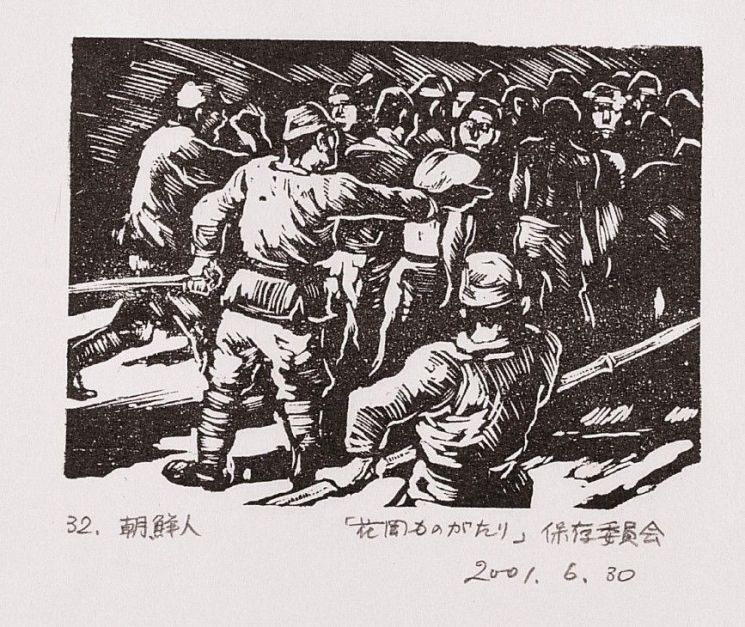
The Hajeongwoong Art Museum, the venue for the academic symposium, will also host the "Hanaoka Story" exhibition for two days, May 17 and 18. The "Hanaoka Story" series consists of woodblock prints created in 1951 by Ni Hiroharu, Takadaira Jiro, and Maki Daisuke, documenting the history of forced conscription and sacrifice of Koreans and Chinese by the Japanese Empire. The works were donated by Honorary Director Hajeongwoong in 2001.
The Hanaoka Incident was a tragic event in June 1945, near the end of the Pacific War, in which hundreds of Korean and Chinese laborers, forcibly taken by the Japanese Empire, suffered severe abuse and harsh forced labor, eventually revolted, but 419 were massacred by the Japanese military and police.
The Nanatsudate Incident, in which 11 Koreans and 11 Japanese were buried alive, shocked Japanese society, and inspired writer Tokiko Matsuda to write "People Underground."
Yoon Ik, Director of the Gwangju Museum of Art, stated, "It is meaningful to hold an academic symposium in Gwangju, a city of democracy, human rights, and peace, to shed light on the pain and resistance in the history of Asian peoples on the 45th anniversary of the May 18 Gwangju Democratization Movement." He added, "The Gwangju Museum of Art will continue to remember and carry on the Mecenat spirit of Honorary Director Hajeongwoong by consistently organizing academic symposiums in the future."
© The Asia Business Daily(www.asiae.co.kr). All rights reserved.
![Clutching a Stolen Dior Bag, Saying "I Hate Being Poor but Real"... The Grotesque Con of a "Human Knockoff" [Slate]](https://cwcontent.asiae.co.kr/asiaresize/183/2026021902243444107_1771435474.jpg)
















