A New Term Symbolizing a Changed World: Vibe Coding
The Magic Formula Created by AI: '1 Developer = 10 Developers'
The Future of Korea's Economy Lies in AI Startups...
"I estimate that it must have cost at least 200 million won."
This was the assessment given by Jung Kyuyeong, CEO of the video production company C7 Plannings, after watching a video themed around Jeju Island. But how much did it actually cost to produce this video? The answer is "virtually zero." The video was created as a class project by students taking the "Data-Based Next-Generation Digital Healthcare AI Solution (AI Healthcare)" course at the Asia Economy Education Center. The entire video was produced using AI. Naturally, there were no production costs. AI Healthcare is a government-funded, tuition-free vocational training program (K-Digital Training, KDT) supported by the Ministry of Employment and Labor.

Jung's estimated cost refers to the amount required if the video were shot, edited, and enhanced with computer graphics and audio without using AI. How much do experts think it would cost if AI were used? Jung Juhun, CEO of another video production company, RSMID, said, "It looks like about four AI programs were used for the project," and estimated the cost at "between 3 million and 10 million won." Four students actually worked on the project, majoring in life sciences, sports medicine, microbiology, and resource environmental engineering. None of them had studied computer programming or video production.
Um Soonhyun, the lead instructor for the AI Healthcare course, said, "When using AI, there is little difference between someone who majored in Korean literature and someone who majored in computer engineering." He added, "There is no real difference between a developer with ten years of experience and one with just one year. In a way, it's like developing with a thousand assistants. In development work, programming skills are no longer as important as logical and integrative thinking abilities."
He also said, "Now, the person who can program best is the company president." The reason is that the president is the one who knows exactly what is needed and can give precise instructions. "For developers, logical and integrative thinking abilities are now more important than math or programming skills." The Asia Economy Education Center used to teach how to follow instructions well, but now it has begun teaching how to give effective instructions. The education policy has changed to nurture the kind of talent the times demand. People have been saying for the past year or two that AI will change the world. However, AI has already changed the world?we just haven't fully realized it yet.
Vibe Coding: A New Term Symbolizing a Changed World
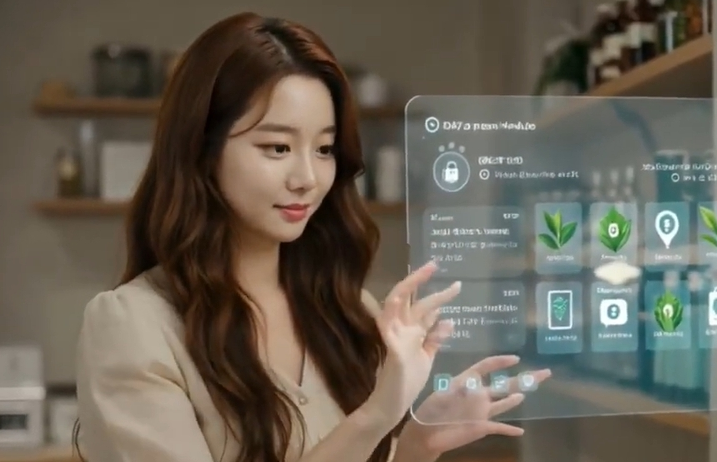
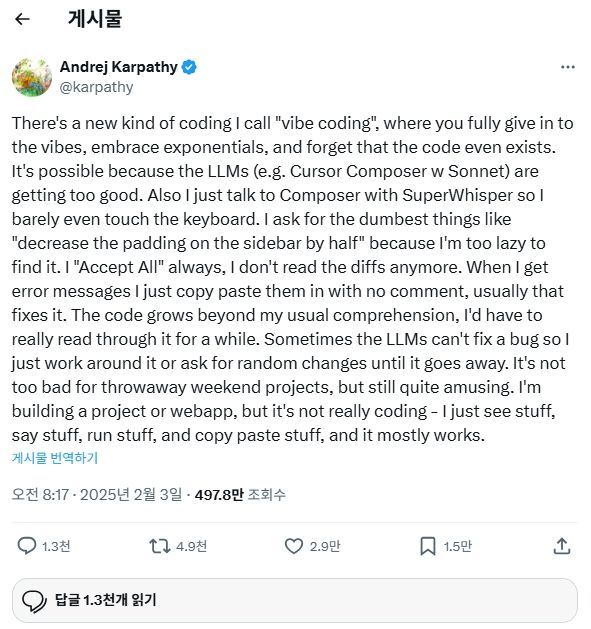
There is a new term that symbolizes the changed world: "vibe coding." This neologism, which emerged early this year, is shaking up the global software, content, and startup ecosystems. In February, Andrej Karpathy, co-founder of OpenAI and former head of AI at Tesla, posted on X (formerly Twitter), "There is a new way of software coding (software development) that I call vibe coding." The word "vibe" comes from "vibration" in English and is generally used to mean atmosphere, feeling, or aura. For example, one might say, "That cafe has a vibe you can't find anywhere else."
Up until now, coding meant that a developer learned a programming language and typed it into a computer using a keyboard. To program, you first had to learn a computer language based on mathematics. Of course, it took a lot of experience to use it properly. Only after countless nights spent hunched over a keyboard could you finally produce something worthy of being called a program.
But vibe coding is about simply telling the AI what you want to create, as if speaking or texting a friend, and having it generate the program. In other words, you program using natural language?the way you normally speak. Karpathy said, "You completely surrender yourself to the AI's vibe, even forgetting the code exists." He added, "If there’s a problem, you just have it redo the work," and "these days, I hardly ever touch the keyboard." If traditional programming was about mathematics, vibe coding is a combination of rhetoric and logic. Put simply, it's about developing programs using everyday language?natural language.
In the Book of Genesis, God says, "Let there be light," and there was light. Now, when a developer says, "Let there be a program," a program is created. The most important qualities for a developer now are creativity, imagination, sensibility, and intuition. The painstaking process of writing flawless code is disappearing. Instead, you must imagine a new concept?like light in a world of darkness?and logically explain it to the AI. This is why creativity is now considered even more important.
The Magic Formula Created by AI: '1 Developer = 10 Developers'
Has the programming environment really changed this much? When Karpathy first posted about it, many thought he was exaggerating and being a bit hopeful. But about a month after his post on X, the term "vibe coding" was all over the news again.
In March, Garry Tan, CEO of Y Combinator, said that thanks to vibe coding, "ten people can now do what used to take fifty to one hundred developers." Y Combinator is the world's most famous startup accelerator. Sam Altman, CEO of OpenAI, also once led Y Combinator. Accelerators, also known as startup planners, invest in promising early-stage startups, provide workspaces, and teach business skills. In short, they're like a mother to startups?the organization that knows startups best.
At a showcase event for startups under its care, Tan said that 25% of participating companies do 95% of their coding with AI. In other words, a significant number of top startups now create programs not by having developers write code themselves, but by simply conversing with the computer. The human role is to check if things turned out as instructed and, if not, to keep explaining until a satisfactory result is achieved. Naturally, fewer people are needed. The days when people with ideas couldn't start a business because they lacked programmers are rapidly disappearing.
The Korean software industry has also jumped on the massive wave created by AI. Oh Chiyoung, founder of Jiran Jikyo Group?one of Korea's leading software companies?solved a problem that had plagued his company since its founding in 1994 thanks to AI. Jiran Jikyo Group, which has more than 20 domestic and overseas subsidiaries and affiliates, has suffered from a shortage of developers for 30 years. The world is big and there is much to develop, but Korea has always lacked software engineers. However, Oh said, "After actively utilizing AI, productivity increased by 30%."
With more development manpower available, the first thing they did was to handle development requests from their Japanese subsidiary in-house. Previously, they often had to outsource development to external firms due to a lack of personnel. But now, the situation has changed. The Japanese subsidiary, which knows the local market well, assigns a project manager, while Korean group engineers and AI handle the development.
The future looks even brighter. Oh explained, "If you apply AI to existing work, productivity increases by 1.3 times, but if you design and work with AI from the very beginning, productivity increases by two to three times." This means that work that would normally require two or three people can now be done by one person and AI. Jiran Jikyo's motto is "Dream, Challenge, Relentless Progress." From the company's perspective, there are no longer idle hands, so they can now pursue dreams that previously seemed out of reach.
The English Barrier in Vibe Coding
Of course, AI is not positive in every respect. There is a catch to the idea that you can develop just by speaking. In 2023, Karpathy said, "The most popular programming language is English." The natural language he uses for vibe coding is English. Um Soonhyun, the lead instructor, shares a similar view. "When it comes to vibe coding, your major doesn't matter much. Sometimes, those who majored in Korean literature use AI better than those who majored in computer engineering. But there is a difference in results between those who are good at English and those who are not."
The natural language that AI understands best is, strictly speaking, English. The main developers of AI use English. Programming languages like Python, C++, and Java, which are used to develop AI, are also in English. Naturally, communicating with AI is easier in English. Korean is also a natural language, but AI translates Korean into English before processing. This creates a difference in "vibe." Some say this is a problem that can be solved as AI advances. However, there is still a significant gap between native speakers and those who learned a foreign language.
There are also employment issues for software majors. According to the global job portal Indeed, if the number of job postings for software developers in the United States in 2022?the year ChatGPT was first released to the public?is set at 100, the number in 2024 dropped to 35.8. The number of job postings for US developers has been declining ever since the AI development boom peaked in 2022. The current number of postings is less than one-third of the peak.
The same thing is happening in Korea. According to analysis by the recruitment platform Jinhaksa Catch, the number of new job postings for IT development positions in Korea dropped from 995 in the first half of 2023 to 684 in 2024, and to 564 this year. Oh Chiyoung advised software majors, "Study and research programming at school, but learn AI for employment." Since AI is ultimately software, you need to understand programming for in-depth development. It's similar to how English majors study English literature but learn business or conversational English for employment.
Korea's Future Lies in AI Startups
However, industry insiders evaluate the impact of AI on Korea as positive. Oh Chiyoung recalls the time when Korea served as the global testbed for internet technology during the internet boom. The core technology for the internet was developed by the US Department of Defense. However, in various applied technologies, Korea achieved outstanding results, earning the title of IT powerhouse.
The IT companies born during that era elevated the Korean economy to a new level. The same could happen again in the AI era. Oh said, "After productivity increased with AI, a Japanese startup even inquired about establishing a research center in Korea." Korea's proven strength in applied technology is already seen as attractive by foreign companies.
Another noteworthy point is that many people who have experienced AI first are considering starting their own businesses. Um, the lead instructor, said, "While teaching AI, I also thought about starting a business." After working at the Electronics and Telecommunications Research Institute (ETRI) and serving as CTO of Korea Fujitsu, Um retired from industry to nurture younger talent, but began to dream of starting a business. The reason is simple: "After just two or three months of learning AI, you can produce talent ready for the field. The money, manpower, and time needed for startups have dropped dramatically. Now is the time."
© The Asia Business Daily(www.asiae.co.kr). All rights reserved.
![Clutching a Stolen Dior Bag, Saying "I Hate Being Poor but Real"... The Grotesque Con of a "Human Knockoff" [Slate]](https://cwcontent.asiae.co.kr/asiaresize/183/2026021902243444107_1771435474.jpg)

















