D-Wave's Q1 Revenue Soars Over 500%
Stock Price Surges, Leading Quantum Industry Rally
The share price of D-Wave, a Canadian quantum computing company, surged by 50% in a single day. As the company's revenue soared year-on-year and its losses were significantly reduced, investors who had previously viewed quantum computing with skepticism appear to be changing their perspective.
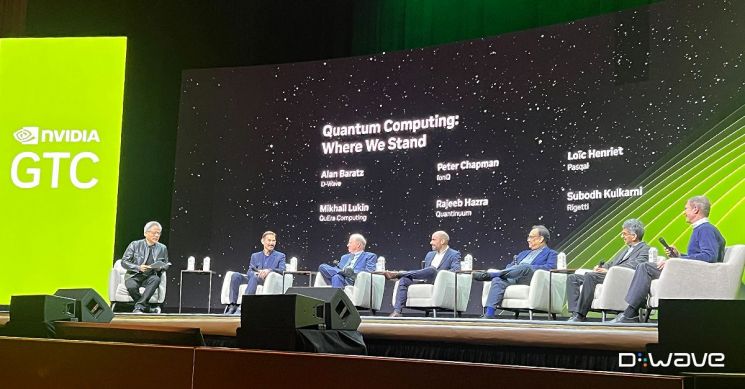 Jensen Huang (left in the photo), CEO of NVIDIA, is having a discussion with representatives from major quantum computing companies including D-Wave at the GTC 2025 event last March. Photo by D-Wave X
On May 8 (local time), D-Wave announced that its revenue for the first quarter (January to March) reached $15 million, a 509% increase compared to the same period last year. Net loss per share was $0.02. These results far exceeded market expectations, which were $2.55 million in revenue and a net loss per share of $0.06.
Immediately following the announcement of these results, which far surpassed market forecasts, D-Wave's share price closed at $10.42 on the New York Stock Exchange, up 51.23%. Its market capitalization reached $30 billion. Boosted by D-Wave's performance, the share prices of other quantum computing companies such as IonQ, Quantum Computing, and Rigetti Computing also showed strong gains, rising by over 10%.
D-Wave's earnings surprise and sharp stock price increase are seen as evidence that expectations for the success of the quantum computing industry are materializing in tangible results.
In March, D-Wave published in the scientific journal Science that its quantum annealing-based quantum computer had demonstrated "quantum supremacy," showing superior performance compared to conventional computers. According to D-Wave, it solved a complex magnetic material simulation in just a few minutes?a task that would have taken millions of years on a traditional supercomputer.
During a conference call following the earnings announcement, D-Wave CEO Alan Baratz projected, "We could become the first publicly traded quantum computing company to achieve sustainable profitability." He also stated, "We can achieve our goals with less funding than other publicly traded quantum computing companies require."
Unlike conventional computers, which process information using only 0s and 1s, quantum computers utilize the superposition and entanglement properties of qubits, enabling parallel computation. They are expected to play a significant role in fields that require vast amounts of data and complex calculations, such as artificial intelligence, finance, chemistry, and logistics.
As integration with AI accelerates, expectations are growing that the practical realization of quantum computers will come sooner. While Jensen Huang, CEO of NVIDIA, poured cold water on such hopes in January by stating that it would take 20 years for quantum computers to become practical, he moderated his view in March by inviting representatives from quantum computing companies such as D-Wave for a discussion, saying, "My outlook may have been wrong."
© The Asia Business Daily(www.asiae.co.kr). All rights reserved.
![Clutching a Stolen Dior Bag, Saying "I Hate Being Poor but Real"... The Grotesque Con of a "Human Knockoff" [Slate]](https://cwcontent.asiae.co.kr/asiaresize/183/2026021902243444107_1771435474.jpg)















