KDCA Detects Over 17,000 Latent Tuberculosis Cases... Blocking Community Transmission
Higher Infection Rates in Social Welfare Facilities Such as Elderly Care Homes
The health authorities conducted epidemiological investigations last year on the families and group facility contacts of tuberculosis patients, leading to the early detection of 250 additional tuberculosis cases.
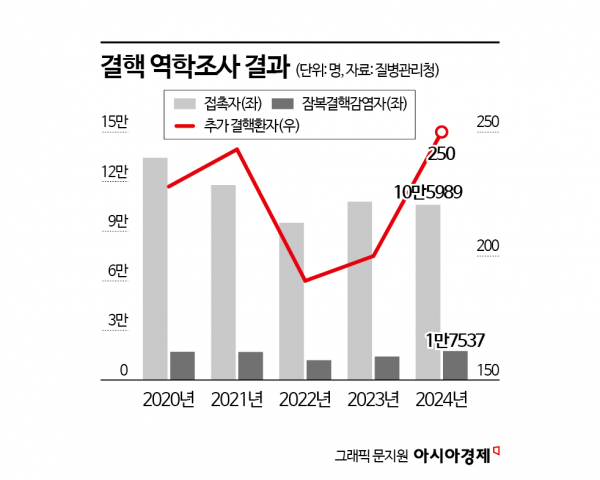
According to the Korea Disease Control and Prevention Agency (KDCA) on May 8, an epidemiological investigation was conducted over the past year on 105,989 contacts of tuberculosis patients. As a result, 235.9 additional cases were found per 100,000 contacts.
Among 59,547 close contacts who underwent latent tuberculosis infection (LTBI) testing, 17,537 individuals (29.5%) were found to have latent infections. Latent tuberculosis infection refers to a condition where a person is infected with the tuberculosis bacterium but has not yet developed the disease, showing no clinical symptoms and not releasing bacteria into the environment, thus posing no risk of transmission.
The number of additional tuberculosis cases and latent tuberculosis infections identified through last year's epidemiological investigations was the highest in the past five years. The KDCA explained that this was due to the proactive use of chest CT (computed tomography) and other screening methods for latent tuberculosis infection in facilities with a high risk of cluster outbreaks, in order to facilitate early detection.
Another contributing factor was the revision of tuberculosis treatment guidelines last year, which allowed contacts aged 65 and older to receive LTBI testing and treatment without restrictions. The number of people aged 65 and older who underwent LTBI testing increased by 103.2% (9,060 individuals) compared to 2023, while the number of LTBI cases in this age group rose by 101.1% (3,836 individuals), making this a major factor in the overall increase in LTBI rates.
Among the additional tuberculosis cases identified through last year's epidemiological investigations, 108 were family contacts, corresponding to 571.6 cases per 100,000 contacts, and 142 were group facility contacts, corresponding to 163 cases per 100,000 contacts. The LTBI rates among family contacts and group facility contacts were 30.1% and 29.2%, respectively.
In epidemiological investigations targeting group facilities, social welfare facilities had the highest rate of additional tuberculosis cases, with 227.9 cases per 100,000 contacts, and also the highest LTBI rate at 37.9%.
Most of the social welfare facilities investigated were nursing homes for the elderly. The KDCA analyzed that the high risk of infection was due to prolonged close contact between elderly contacts with weakened immune systems and tuberculosis patients.
Ji Youngmi, Commissioner of the KDCA, stated, "Contacts of tuberculosis patients have about seven times higher risk of developing tuberculosis compared to the general population, so it is very important to actively participate in epidemiological investigations." She added, "Among contacts of infectious tuberculosis patients, those confirmed to have latent tuberculosis infection are considered a high-risk group for developing tuberculosis. Completing treatment for latent tuberculosis infection can prevent the onset of tuberculosis by up to 90%."
© The Asia Business Daily(www.asiae.co.kr). All rights reserved.
![Clutching a Stolen Dior Bag, Saying "I Hate Being Poor but Real"... The Grotesque Con of a "Human Knockoff" [Slate]](https://cwcontent.asiae.co.kr/asiaresize/183/2026021902243444107_1771435474.jpg)















