Bank of Korea New York Office Report:
Market Participants View Fed's Policy as Neutral,
But Stagflation Concerns Rise
Rate Cut Expectations Pushed Back Further
The United States Federal Reserve (Fed) held its policy rate steady on May 7 (local time), as widely expected by the market. Major international investment banks (IBs) assessed Chairman Jerome Powell's remarks as neutral, but also noted that he signaled concerns about stagflation?a combination of high inflation and economic stagnation. With the Fed maintaining a cautious stance, it is now expected that the timing of a rate cut could be pushed back further.
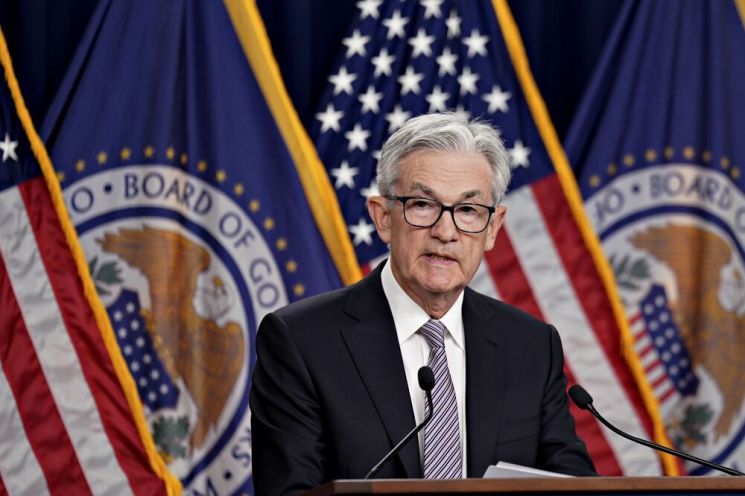
According to a report released on May 8 by the Bank of Korea's New York office, titled "Market Participants' Assessment of the May Federal Open Market Committee (FOMC) Meeting Results and Financial Market Reactions," most local market participants viewed both the policy statement and Chairman Powell's remarks as neutral, without any clear hawkish or dovish signals.
This policy statement included new language indicating that uncertainty regarding the economic outlook had "further" increased, and that "the risks of rising unemployment and inflation have increased." However, the assessment that economic activity remains solid was maintained, and the negative growth in the first quarter was attributed to specific factors such as net exports, cautioning against overinterpretation.
Chairman Powell also stated during a subsequent press conference that the U.S. economy remains solid. However, given that uncertainty regarding the economic outlook has increased due to new government policies such as tariffs, he maintained a cautious approach, indicating that the Fed would not rush to make further policy adjustments until the situation and its ripple effects become clearer.
The market had initially expected Chairman Powell to either clarify that progress on inflation was a prerequisite for rate cuts (a hawkish scenario) or, conversely, to signal policy flexibility in response to the recent sharp deterioration in sentiment indicators (a dovish scenario). However, Powell was seen as striking a balance in his response. In particular, by emphasizing increased tariff-related uncertainty and maintaining the Fed's wait-and-see stance, his remarks were viewed as overall neutral.
Morgan Stanley commented, "The key takeaway from this FOMC is that the economic situation is on solid footing, with no signs of sudden slowdown, but uncertainty surrounding both unemployment and inflation is increasing." The firm added, "Chairman Powell did not mention a recession, but he will face the difficult task of balancing inflation and employment going forward." Morgan Stanley also noted, "In this environment, the likelihood of a large-scale rate cut appears low."
Bank of America (BoA) assessed, "While the press conference was overall neutral, the fact that Chairman Powell did not support a preemptive rate cut was somewhat hawkish."
Some market participants interpreted this FOMC as revealing concerns about stagflation arising from trade policy. JP Morgan noted, "The most notable change in the statement was the addition of language stating that 'the risks of rising unemployment and inflation have increased.' This does not signal a hawkish or dovish shift, but rather highlights the risk of stagflation due to trade policy." Daiwa similarly stated, "The additional language in the policy statement suggests that concerns about stagflation are being discussed more seriously."
There was also an interpretation that, in future rate decisions, more weight will be given to inflation than to unemployment. BNP Paribas commented, "Generally, market participants believe the Fed will avoid actions that negatively impact employment. However, Chairman Powell's remarks left open the possibility that if inflation emerges as the main risk, the Fed may need to shift its focus."
The timing of a rate cut is now expected to be further delayed. UBS noted, "Chairman Powell's comment that the impact of tariffs on inflation is uncertain increases the likelihood that the Fed's rate cut will be delayed beyond expectations." The Wall Street Journal (WSJ) also reported, "Chairman Powell said the cost of waiting for additional information on the economy is 'quite low,' which has somewhat dampened expectations for a rate cut in June."
© The Asia Business Daily(www.asiae.co.kr). All rights reserved.
![Clutching a Stolen Dior Bag, Saying "I Hate Being Poor but Real"... The Grotesque Con of a "Human Knockoff" [Slate]](https://cwcontent.asiae.co.kr/asiaresize/183/2026021902243444107_1771435474.jpg)















