Current Overtime System with Weekly Limits
"Unrealistic for Advanced Industries... Hurts Competitiveness"
Concerns That Extending Retirement Age Will Worsen Labor Market Duality
"Tax Reform Directly Tied to Management Stability"
The reason the business community requested on May 8 that Lee Jae Myung, the presidential candidate of the Democratic Party, "reflect the voices from the field" was due to concerns that business activities could contract after a change in administration. They believe that labor-related pledges put forward by the Democratic Party, such as the introduction of a 4.5-day workweek and the extension of the retirement age, are disconnected from the realities of industrial sites.
Recently, as the political sphere has made "shortening working hours" and "extending the retirement age" presidential campaign issues, companies have strongly expressed their concerns about the practical shocks that institutional changes could bring. With additional pressures from supply chain restructuring, high interest rates and inflation, US-China tensions, and the need for industrial transformation, companies have become more sensitive than ever to policy uncertainty and cost risks. On this day, the business community used the meeting with candidate Lee, held at the Korea Chamber of Commerce and Industry in Jung-gu, Seoul, not as a mere formality, but as a channel to deliver their urgent concerns.
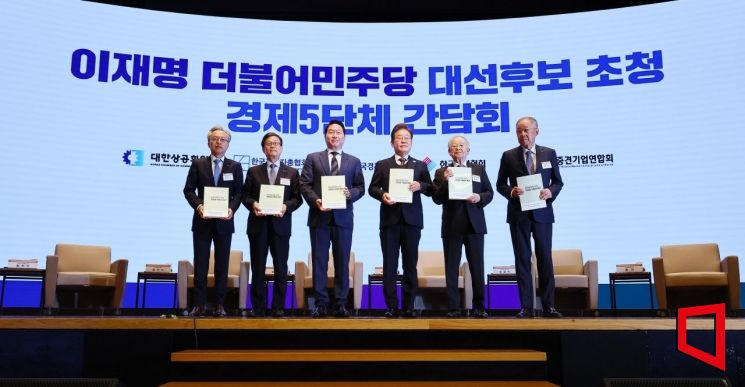 Lee Jae Myung, the presidential candidate of the Democratic Party, is receiving a policy proposal book and posing for a commemorative photo at the meeting with the heads of five major economic organizations invited to the presidential candidates, held at the Korea Chamber of Commerce and Industry in Jung-gu, Seoul, on the morning of the 8th. From the left, Choi Jin Sik, chairman of the Korea Federation of Medium-sized Enterprises; Yoon Jin Sik, chairman of the Korea International Trade Association; Choi Tae Won, chairman of the Korea Chamber of Commerce and Industry; candidate Lee; Sohn Kyung Shik, chairman of the Korea Employers Federation; and Ryu Jin, chairman of the Korea Economic Association. Photo by the National Assembly Press Photographers Group
These concerns are not unfounded. As discussions on reducing working hours have become more active in the political sphere, the business community's sense of caution has increased. Not only the Democratic Party, but also the People Power Party, which represents the conservative side, is pushing to abolish the current 52-hour workweek and instead introduce a 4.5-day workweek. However, the industrial sector argues that the current system is already rigid, and any further reduction in working hours could negatively impact industrial sites.
Sohn Kyung Shik, chairman of the Korea Employers Federation, pointed out, "The current system of overtime, which is strictly limited on a weekly basis, is difficult to apply to rapidly changing management situations and to advanced industries that require creativity and autonomy." He added, "Labor productivity is already lower than that of competing countries, and small and medium-sized enterprises have difficulty securing manpower. If the statutory working hours are uniformly reduced, it will undermine the competitiveness of companies."
Chairman Sohn also addressed the retirement age extension issue, explaining that after the legal retirement age was set at 60 in 2013, companies faced increased labor costs and were forced to increase early retirements among employees in their 40s and 50s, which in turn reduced their ability to hire young people. He expressed concern that if the retirement age is uniformly extended to 65 while maintaining the current seniority-based personnel system, the dual structure of the labor market would worsen and intergenerational conflict could intensify. He suggested that reemployment after retirement or flexible work arrangements would be more suitable solutions for senior employment issues.
Tax reform, which is directly linked to management stability for companies, also emerged as a major proposal. Choi Jin Sik, chairman of the Korea Federation of Medium-sized Enterprises, stated, "More than half of medium-sized companies are run by founders or first-generation managers, so it is highly likely that a large-scale succession of management will occur within the next 10 years." He emphasized that the issue of succession is not simply about asset transfer, but a matter of survival that affects employment, technology transfer, and the maintenance of local economies.
There are also criticisms that the current inheritance and gift tax system is too rigid to support this. Chairman Choi explained that even companies with 100% ownership face a structural limitation in which the stake can drop to around 16% after just two generations, causing many companies to worry about management rights or consider relocating overseas. He stressed that the current system, which imposes a maximum inheritance and gift tax rate of up to 60% including premium valuation, is unprecedented globally, and that lowering it to the OECD average of 30% would enable companies to establish sustainable management strategies.
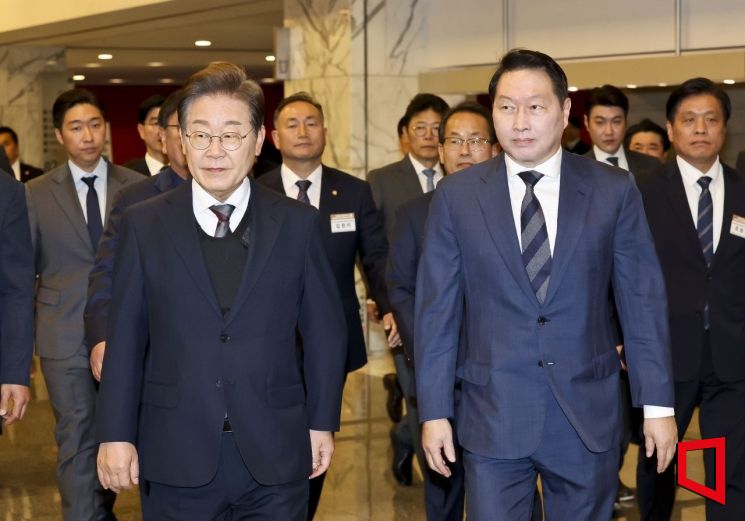 Democratic Party presidential candidate Lee Jae Myung and Chairman Choi Tae Won of the Korea Chamber of Commerce and Industry are attending the meeting with the heads of five major economic organizations invited for presidential candidates at the Korea Chamber of Commerce and Industry in Jung-gu, Seoul on the 8th. Photo by National Assembly Press Photographers Group
On this day, the heads of the five major economic organizations delivered a "presidential policy proposal book" containing 14 tasks in four key areas?artificial intelligence (AI), new industries, trade, and labor?to candidate Lee Jae Myung. This was to propose flexible and effective policies that reflect the realities faced by companies.
Choi Tae Won, chairman of the Korea Chamber of Commerce and Industry, diagnosed that "the Korean economy has entered a phase of structural low growth," and emphasized that a fundamental shift in the growth model, rather than short-term measures, is needed. Ryu Jin, chairman of the Korea Economic Association, urged that in order to foster future industries such as aerospace, robotics, defense, and biotechnology as new growth engines, the government must provide both infrastructure and tax support.
Yoon Jin Sik, chairman of the Korea International Trade Association, expressed concerns about potential damages from a worsening trade environment. He requested, "The private sector and the government must jointly strengthen channels for consultation with the United States, and in particular, direct support through policy finance is needed for small and medium-sized enterprises facing financial pressure due to trade risks."
© The Asia Business Daily(www.asiae.co.kr). All rights reserved.
![Clutching a Stolen Dior Bag, Saying "I Hate Being Poor but Real"... The Grotesque Con of a "Human Knockoff" [Slate]](https://cwcontent.asiae.co.kr/asiaresize/183/2026021902243444107_1771435474.jpg)
















