hy Posts 64.5 Billion KRW Operating Loss Last Year
Subsidiaries' Poor Performance Amid Core Business Slump
"Actively Targeting Overseas Markets"
"Breaking Free from Domestic Business Limitations"
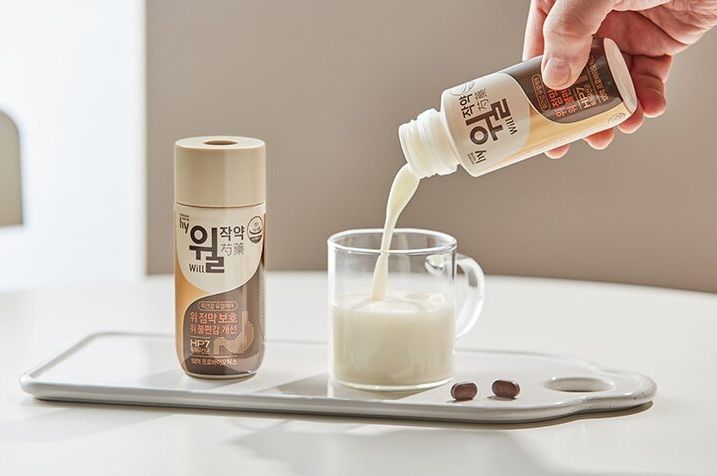
hy's equity-method losses surpassed 100 billion KRW last year. The poor performance of companies invested in as part of business diversification efforts has led to a widening deficit. hy has announced plans to overcome the limitations of being a domestic-focused company by strengthening its core business competitiveness through exports of its flagship products.
According to the Financial Supervisory Service's electronic disclosure system on May 8, hy (formerly Korea Yakult) posted consolidated sales of 1.6826 trillion KRW last year, up 10.8% from 1.5191 trillion KRW the previous year. However, despite this top-line growth, operating losses more than doubled to 64.5 billion KRW from 27.4 billion KRW the previous year, and net losses grew even more sharply, nearly tripling to 72.8 billion KRW from 28.6 billion KRW the previous year.
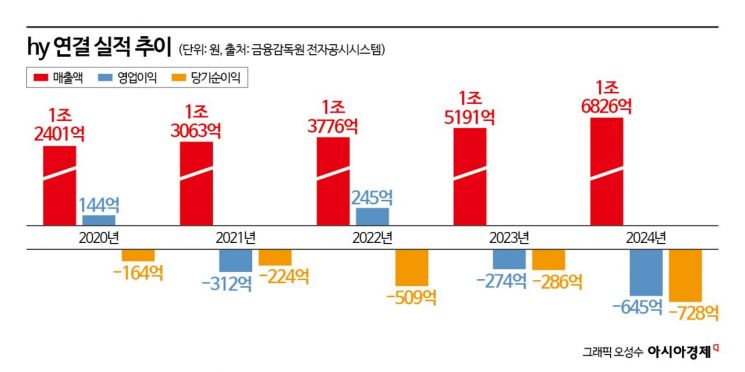
The main reason hy is struggling with continued deficits is the poor performance of its subsidiaries. As of the end of last year, hy owned a total of 16 subsidiaries, including NE Neungyule (book publishing and online education), J Leisure (golf course business), and Think Surgical (medical and biotechnology research and sales). Of these, 10 subsidiaries posted losses. Losses at these subsidiaries have led to a deterioration in consolidated profitability.
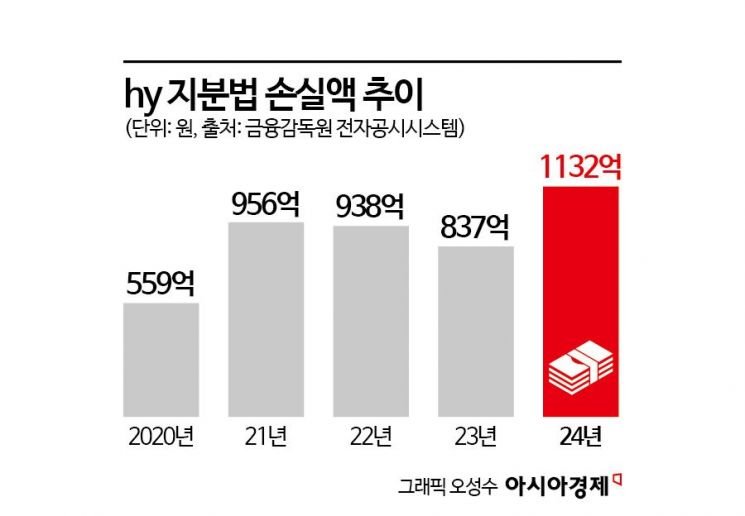
As subsidiaries continue to underperform, hy's equity-method losses have been increasing year after year. In 2020, hy's equity-method losses stood at 55.9 billion KRW, which jumped to 95.6 billion KRW the following year. Although the figure had been gradually declining, last year it surged more than 30% to 113.2 billion KRW from 83.7 billion KRW the previous year, exceeding 100 billion KRW for the first time. Equity-method losses refer to losses recognized by an investor company in proportion to its ownership stake in an investee company's net losses. However, equity-method losses are accounting losses that reflect a decline in the value of an investment and are not directly related to actual cash outflows.
Among these, Think Surgical, a medical surgical robot company, and its Singapore-based intermediate holding company HYSG, recorded the largest losses at 69.5 billion KRW and 63.5 billion KRW, respectively. Established in 2006, Think Surgical succeeded in commercializing 'Robodoc,' the world's first robot used for joint replacement surgeries such as knee (knee joint) replacements. However, due to the nature of the medical business, which requires a long period and significant capital to generate profits, the company has continued to post net losses for several years.
The losses at Vroong, a delivery service platform, also more than doubled to 26.4 billion KRW from 10.7 billion KRW in 2023, increasing the burden. hy acquired Vroong in April 2023 for a total of 85 billion KRW, initially expecting synergy between Vroong's approximately 20,000 delivery riders and over 10,000 so-called 'Yakult Ajummas' (Fresh Managers). However, nearly two years later, the acquisition has yet to yield significant results.
hy's poor performance last year was not solely due to its subsidiaries. On a standalone basis, hy's sales fell 4.7% year-on-year to 1.0355 trillion KRW, and operating profit declined 14.9% to 58.2 billion KRW. While the company reduced key selling and administrative expenses such as sales promotion and advertising costs, it was unable to prevent a decline in profitability due to rising costs for raw and subsidiary materials and other expenses.
Most importantly, growth has stagnated due to the limitations of being a domestically focused food company, with operating profit on a downward trend since peaking at 108.2 billion KRW in 2017.

hy plans to break free from the constraints of being a domestic-focused company this year by actively targeting overseas markets. Since the main subsidiaries' overseas medical businesses are expected to be profitable from a mid- to long-term perspective rather than in the short term, the company aims to strengthen its competitiveness and gradually improve profitability by fundamentally improving its core business.
Leading the charge is the flagship fermented milk product, 'Helicobacter Project Will.' In September last year, Will became the first fermented milk product from a Korean dairy company to enter overseas markets by being listed on online malls in China. In March this year, Will expanded its sales channels by entering 2,200 FamilyMart stores and 600 7-Eleven stores across Shanghai and other regions in China.
In February, Will also entered the US market by being stocked at 'H Mart,' the largest Asian supermarket chain in North America. In addition, the company is working with Thai dairy company Dutch Mill to launch locally produced products. hy plans to export Will in bulk powder form from Korea as a semi-finished product, which will then be blended with milk and other ingredients locally for production and sale. Once production is fully underway, the export region is expected to expand throughout Southeast Asia.
The company has also begun producing coffee products on an OEM (Original Equipment Manufacturer) basis. In March, hy launched 'Hybrew,' an export-only product, in Indonesia and began sales through major local distribution channels such as 'Indomaret' and 'Alfamart.' These two companies account for more than 70% of the local convenience store market share. The initial shipment of 23,000 boxes has already sold out, and the company has begun production and sales of a second batch. hy plans to expand its distribution network to other Asian countries, starting with Malaysia and then moving into Japan, China, and the Philippines.
© The Asia Business Daily(www.asiae.co.kr). All rights reserved.
![Clutching a Stolen Dior Bag, Saying "I Hate Being Poor but Real"... The Grotesque Con of a "Human Knockoff" [Slate]](https://cwcontent.asiae.co.kr/asiaresize/183/2026021902243444107_1771435474.jpg)

















