Press Conference on the "Comprehensive Financial Policy Package to Support Market Sentiment"
On May 7, China, which is currently engaged in a "trade war" with the Donald Trump administration in the United States and facing a 145% tariff, announced that it would lower the reserve requirement ratio (RRR) and inject 1 trillion yuan (approximately 193 trillion won) of long-term liquidity into the market. This move aims to boost domestic demand by releasing a large amount of cash into the economy.
Pan Gongsheng, Governor of the People's Bank of China, made this announcement during a press briefing on the "Comprehensive Financial Policy Package to Support Market Sentiment," which was hosted by ministerial-level officials from the People's Bank of China, the National Financial Regulatory Administration, and the China Securities Regulatory Commission.
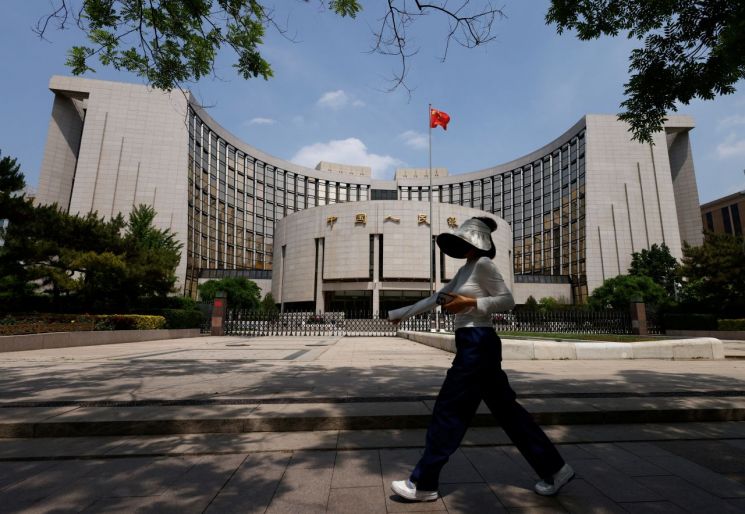
Governor Pan stated that, starting from May 8, the interest rate on 7-day reverse repurchase agreements (reverse repos) would be reduced from 1.5% to 1.4%. He added that, as a result, the Loan Prime Rate (LPR), which serves as the de facto benchmark interest rate, is also expected to be lowered by 0.1 percentage point.
He explained that the reserve requirement ratio would be cut by 0.5 percentage point, thereby injecting 1 trillion yuan of long-term liquidity into the market. The reserve requirement ratio is the proportion of deposits that banks are required to hold at the central bank. Lowering the RRR increases liquidity in the financial system.
The People's Bank of China will apply the reduced RRR starting from May 15. The current average RRR in China stands at around 6.6%. Although Chinese authorities have not lowered the RRR since September of last year, they have consistently indicated that there is room to cut both interest rates and the RRR. At the Central Politburo meeting chaired by President Xi Jinping on April 25, the need for a "more proactive fiscal policy" and a "moderately accommodative monetary policy" was emphasized, with calls to lower the RRR and interest rates in a timely manner and maintain liquidity to support the real economy.
Referring to this, Governor Pan said, "We will implement a more appropriately accommodative monetary policy, and the People's Bank of China plans to strengthen macro-level controls and introduce a comprehensive monetary policy package."
In addition to quantitative policies that supply liquidity to the market, he announced that a comprehensive monetary policy package would also include price-based policies and structural policy measures.
As a price-based policy, the plan is to reduce interest rates by 0.25 percentage point. This includes lowering the interest rates on various special structural tools and on relending for rural and small business support from 1.75% to 1.5%, as well as reducing the interest rate on Pledged Supplementary Lending (PSL) from 2.25% to 2%.
The interest rate on housing provident fund loans (a long-term savings scheme jointly funded by companies and workers for home purchases) will be reduced by 0.25 percentage point, and the interest rate on first-time home mortgage loans with a five-year maturity will be cut from 2.85% to 2.6%, a reduction of 0.25 percentage point. This is expected to reduce annual interest payments by 20 billion yuan.
As a structural policy, a new 500 billion yuan relending facility will be established to stimulate consumption and support elderly care, thereby boosting domestic demand. In addition, the relending quota for science and technology innovation and technological transformation will be increased from 500 billion yuan to 800 billion yuan, the relending quota for small businesses will be raised by 300 billion yuan, and a risk-sharing mechanism for science and technology innovation bonds will be established to further support the capital market.
Furthermore, two major policy tools for supporting the capital market will be improved, providing liquidity totaling 800 billion yuan: 500 billion yuan in swaps for securities, fund, and insurance companies, and 300 billion yuan in relending for stock buybacks and capital increases.
Li Yunze, head of the National Financial Regulatory Administration, said that the government would stabilize the real estate market and increase insurance funds. He stated that a financial system aligned with the new development model for real estate would be announced soon to stabilize the market. In addition, the scope of pilot long-term investments by insurance companies in the stock market and other areas will be expanded, including the recently approved 60 billion yuan investment. He also indicated that additional policies would be announced in eight areas, including support for financing by small and private enterprises and support for companies affected by tariffs.
Wu Qing, Chairman of the China Securities Regulatory Commission, said that the U.S. tariff policy has put pressure on the Chinese market, but it has demonstrated strong resilience. He stated that efforts would be made to stabilize the market and enhance market vitality, while expanding the inflow of medium- and long-term capital to encourage improvements in the corporate governance of listed companies.
© The Asia Business Daily(www.asiae.co.kr). All rights reserved.
![Clutching a Stolen Dior Bag, Saying "I Hate Being Poor but Real"... The Grotesque Con of a "Human Knockoff" [Slate]](https://cwcontent.asiae.co.kr/asiaresize/183/2026021902243444107_1771435474.jpg)















