Labeled as an "unpopular politician" since his candidacy
Historic defeat in the first vote... Succeeds on the second attempt
Facing challenges from the United States, Russia, immigration, and more
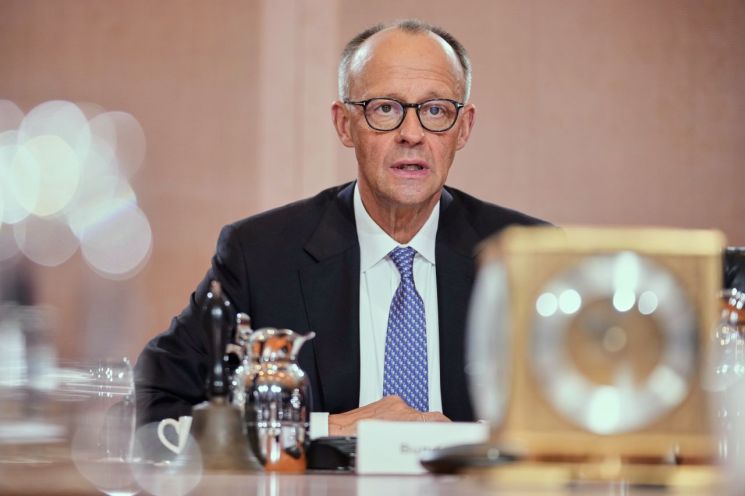 Friedrich Merz, the newly elected Chancellor of Germany from the Christian Democratic Union (CDU), is attending his first cabinet meeting held in Berlin, Germany, on the 6th (local time). Photo by AP Yonhap News
Friedrich Merz of the Christian Democratic Union (CDU) was officially inaugurated as the new Chancellor of Germany on the 6th (local time). After suffering a historic defeat in the first round of voting, he barely passed the confidence vote on his second attempt, raising concerns that the "Merz leadership" is exposed to political vulnerability from the very beginning of his term.
To be elected Chancellor of Germany, a candidate must secure a majority of at least 316 votes out of a total of 630. According to reports from DPA and AFP, Chancellor Merz was elected after receiving 325 votes in the second confidence vote held in the German Bundestag that afternoon. In the first vote held that morning, he received 310 votes, falling short of the majority by six votes, which led to a second round. Since the confidence vote is considered a formal procedure after coalition negotiations and before official inauguration, this unexpected development drew attention.
This is the first time since World War II that a pre-agreed chancellor candidate has failed to pass the Bundestag in a single vote. Given that the new coalition government, composed of the CDU-Christian Social Union (CSU) alliance and the Social Democratic Party (SPD) and led by Merz, holds a total of 328 seats, at least 18 members must have defected. The Washington Post noted, "He was already seen as an unpopular politician even before taking office," and pointed out that "the failure in the first vote has further destabilized his political standing." Alice Weidel, co-leader of the far-right Alternative for Germany (AfD), which has rapidly risen as the main opposition party, seized on this atmosphere and called for a general election re-run, saying, "It is a good day for Germany."
Germany faces a plethora of domestic and international challenges. The New York Times reported that the German economy contracted last year, and tariffs imposed by U.S. President Donald Trump are threatening the export-dependent manufacturing sector. The security alliance with the United States is also being shaken, while Russia continues its war with Ukraine. Domestically, the influx of immigrants over the past decade has led to social division. Taking advantage of this situation, the AfD has established itself as the main opposition party with a high vote share of 20%, expanding its influence to the point of threatening the traditionally dominant centrist parties in Germany.
Following President Trump's inauguration in January, as transatlantic (Europe-U.S.) relations undergo rapid changes, the European Union (EU) and the North Atlantic Treaty Organization (NATO) expressed relief at Chancellor Merz's inauguration. Germany, as the largest economy in Europe, plays a pivotal role in supporting Ukraine and in the process of European rearmament. During his candidacy, Chancellor Merz pledged to prioritize the recovery of the German economy, curb illegal immigration, and strengthen Germany's role within Europe. In March, the German Bundestag also approved a plan to dramatically increase spending on defense and infrastructure by up to 1 trillion euros (approximately 1,580 trillion won) over the next decade. Ursula von der Leyen, President of the European Commission, congratulated Merz on X (formerly Twitter), stating, "We will work together to build a stronger and more competitive Europe."
Meanwhile, Chancellor Merz will visit Paris, France, on the 7th for his first overseas trip since taking office, where he will meet with President Emmanuel Macron. He is also scheduled to visit Poland, Ukraine, Belgium, and the United States. President Macron welcomed him in a post on X, saying, "It is our mission to make Franco-German relations stronger than ever and to accelerate the agenda of European sovereignty, security, and competitiveness. Let's meet in Paris tomorrow and work together."
© The Asia Business Daily(www.asiae.co.kr). All rights reserved.
![Clutching a Stolen Dior Bag, Saying "I Hate Being Poor but Real"... The Grotesque Con of a "Human Knockoff" [Slate]](https://cwcontent.asiae.co.kr/asiaresize/183/2026021902243444107_1771435474.jpg)















