Voting Continues Until Over Two-Thirds Support
White Smoke Signals Papal Election Success
A Record 133 Cardinals Participate
"The world awaits a smoke signal."
The conclave, a secret papal election meeting to choose a new pope who will lead 1.4 billion Catholics worldwide, begins on May 7 (local time) at the Sistine Chapel in the Vatican. The conclave is conducted under strict security, and voting continues until a candidate receives support from more than two-thirds of the electors. The outcome of the vote is signaled by smoke: if the election fails, black smoke rises from the chimney; if successful, white smoke is released to announce the birth of a new pope to the world.
The New York Times (NYT) reported on this day, "A total of 133 cardinals representing 70 countries around the world will gather under Michelangelo's frescoes to begin voting for the spiritual leader of 1.4 billion Catholics," adding, "This is the largest number of cardinals ever to participate in a papal election."
This conclave, the largest in history, is also the most diverse in terms of the composition of the College of Cardinals. According to foreign media such as the Associated Press (AP), the cardinal electors come from 70 countries, the highest number in conclave history. In the 2013 conclave that elected Pope Francis, cardinals from 48 countries entered the Sistine Chapel. While more than 50 cardinals are from Europe, the number of non-European cardinals exceeds that of Europeans, with 23 from Asia, 21 from Central and South America, 17 from Africa, 16 from North America, and 4 from Oceania.
The conclave is conducted under thorough security. The cardinals move from the Santa Marta guesthouse to the Sistine Chapel, with anti-eavesdropping devices installed inside the chapel to completely block external contact. The Italian news agency ANSA reported that signal jamming devices will be installed around the Sistine Chapel to prevent electronic surveillance or communication from outside the conclave. All participants take an oath of secrecy, and with the command "Extra omnes" (everyone out), all non-cardinals leave and the doors are firmly locked.
Each cardinal receives a ballot inscribed with the phrase "Eligo in Summum Pontificem" (I elect as Supreme Pontiff), writes the name of their chosen candidate, and places it in a bronze urn. The first vote is usually symbolic, serving to gauge the support base of each candidate. Thereafter, voting takes place four times a day?twice each in the morning and afternoon. Voting continues until a candidate receives support from more than two-thirds of the electors. The Guardian reported, "The conclave can last from several hours to several weeks. The longest conclave in history, in the 13th century, lasted two years and nine months. However, since the 20th century, most conclaves have concluded within a week." Pope Francis was elected on the second day of the conclave.
To know the result of the vote, one must watch the Vatican chimney closely. Jason Horowitz, Rome bureau chief for the New York Times, explained, "Once the cardinals enter the Sistine Chapel, almost no information gets out to the outside world. However, the smoke from the chimney allows people to indirectly gauge the progress of the proceedings."
If only black smoke continues to rise through the day after the conclave begins, it means the cardinals are struggling to reach consensus. The moment the smoke turns white, it signifies the birth of a new leader.
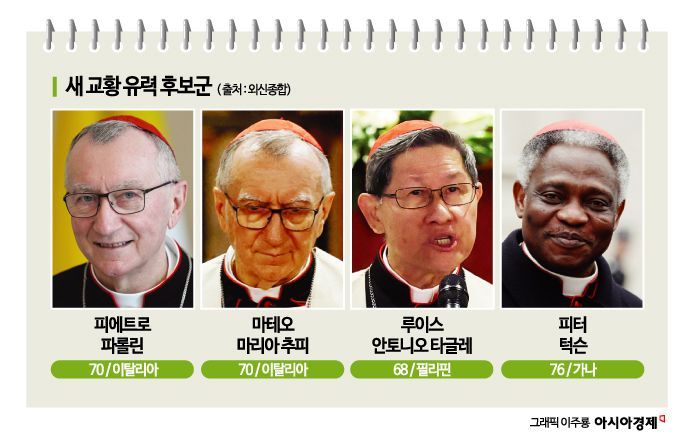
Major foreign media and the Catholic community expect the successor to Pope Francis to carry on his open and inclusive approach. This is because about 100 out of the 133 cardinals attending this conclave (approximately 75.2%) were appointed by Pope Francis. Among them, Cardinal Pietro Parolin (70) and Cardinal Matteo Maria Zuppi (70), both from Italy, are considered leading candidates, while Cardinal Luis Antonio Tagle (68) from the Philippines is mentioned as the first Asian papal candidate.
According to an analysis by The Economist on May 6 of major betting site trends, global gamblers see Cardinal Parolin as the most likely to be elected the new pope, with a probability of 27%. He is followed by Cardinal Tagle (19%) and Cardinal Zuppi (10%).
© The Asia Business Daily(www.asiae.co.kr). All rights reserved.
![Clutching a Stolen Dior Bag, Saying "I Hate Being Poor but Real"... The Grotesque Con of a "Human Knockoff" [Slate]](https://cwcontent.asiae.co.kr/asiaresize/183/2026021902243444107_1771435474.jpg)















