Regulatory Abolition Performance Report Held; New Director-General Level Organization Established
Wide Public-Private Participation Recognized as a Model for Local Government Innovation
Private-Sector "Regulatory General Officers" Appointed for Innovative Advisory Roles
For the first time among local governments nationwide, the Seoul Metropolitan Government will establish a dedicated regulatory innovation organization at the director-general level. As a third-grade director-general organization, it will include the Creative Regulation Officer and the Regulation Improvement Officer under its umbrella, with the goal of institutionalizing regulatory innovation on a permanent basis.
On the afternoon of May 7, 2025, the Seoul Metropolitan Government held the "100-Day Regulatory Abolition Performance Report" at the main conference hall of Seoul City Hall and announced this regulatory reform policy direction.
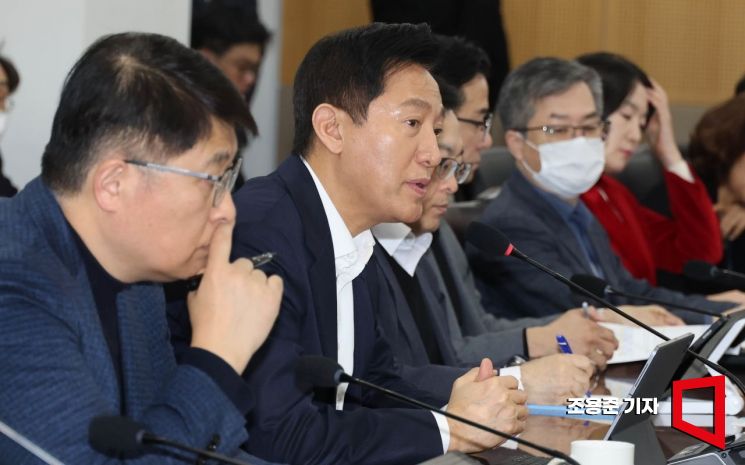 Seoul Mayor Oh Sehun is attending and speaking at the meeting on the abolition of regulations on investment and affiliated institutions held at the Seoul City Hall in Jung-gu, Seoul on February 13, 2025. Photo by Jo Yongjun
Previously, from January to April 2025, Seoul operated a "100-Day Regulatory Abolition Intensive Implementation Period," during which it received more than 2,500 proposals for regulatory abolition from citizens, businesses, public officials, and affiliated organizations. After an in-depth review by the Regulatory Abolition Expert Deliberation Committee, a total of 127 regulatory abolition items have been presented to date.
At the performance report, major achievements and representative cases of regulatory abolition were introduced. While the initiative initially focused on economic regulations such as those in construction and housing, its most notable feature was the expansion of targets to include various unreasonable elements that inconvenience citizens in their daily lives. The "100-Day Regulatory Abolition Intensive Implementation Period" was also notable for its broad participation from both the public and private sectors. Rather than unilateral implementation by public officials, the process maximized the incorporation of feedback on actual inconveniences and situations experienced by citizens and businesses in the field.
To this end, in January 2025, Seoul held a "Regulation Relief for Livelihoods Grand Debate" with the participation of 100 citizens. Prior to this, from December 2024, the city also held six "Emergency Economic Meetings" with representatives from economic organizations, construction, tourism, and foreign-invested companies. It is also noteworthy that the entire process?from assessing the feasibility of abolishing received proposals, to concretizing implementation plans, and to actual execution?was carried out swiftly. This was the result of intensive review by all Seoul departments and the effective operation of bodies such as the "Regulatory Abolition Expert Deliberation Committee" and the "Construction Sector Regulatory Abolition Task Force."
The 128th regulatory abolition item, "Improvement of the Good Light Committee Deliberation," announced additionally on this day, is a representative example. Currently, for large buildings and multi-family housing facilities above a certain size, the installation of outdoor lighting requires deliberation by the Good Light Committee. However, this deliberation has been causing delays in construction permits and approvals. In response, the city plans to relax the deliberation requirement to focus mainly on large buildings and to introduce standardized checklists and documents to reduce unnecessary deliberations.
The abolition of restrictions on recruitment activities around corporate taxi training centers was also cited as a highly effective improvement. Previously, due to concerns about excessive recruitment advertisements by some corporate taxi companies targeting new drivers, Seoul had restricted recruitment activities by corporate taxi operators within 100 meters of training centers for new taxi qualification holders, such as the Transportation Hall, Korea Transportation Safety Authority, and Driver Aptitude Test Centers. However, the legal basis for this regulation was ambiguous, and it overlapped with the Ministry of Employment and Labor’s regulations on "false recruitment advertisements," resulting in double regulation. Accordingly, the city shifted from mandatory regulation to a self-regulatory system managed by the Corporate Taxi Association by abolishing the restriction on recruitment activities around training centers.
On this day, Seoul also presented its direction for sustainable regulatory innovation at the local government level. Song Kwangnam, Director of Policy Planning for Seoul, announced that a dedicated organization would be established as of July 1, 2025, as a measure to build a sustainable regulatory innovation system. Through the establishment of this dedicated organization, Seoul plans to further strengthen regulatory innovation by focusing on four key pillars: the Regulatory Innovation Director (overall command and coordination), the Regulatory Reform Committee (deliberation on new and strengthened regulations), the Regulatory General Officer (expert advisory), and the Seoul Institute Regulatory Innovation Research Group (investigation and research).
As the first third-grade director-general organization among local governments, the "Regulatory Innovation Director" will serve as the control tower for regulatory innovation in Seoul. Under this director, the city will also establish the Creative Regulation Officer and the Regulation Improvement Officer, aiming to maximize synergy by combining creative administration with regulatory innovation and to institutionalize and make permanent regulatory reform throughout all aspects of city governance. In addition, the city announced plans to build an innovative regulatory advancement system by appointing private-sector experts with field experience and expertise as "Regulatory General Officers." These experts, appointed as Regulatory General Officers, will provide ongoing advice on the overall direction of Seoul’s regulatory innovation, the identification of regulations, and the development of improvement measures, based on their extensive experience.
© The Asia Business Daily(www.asiae.co.kr). All rights reserved.
![Clutching a Stolen Dior Bag, Saying "I Hate Being Poor but Real"... The Grotesque Con of a "Human Knockoff" [Slate]](https://cwcontent.asiae.co.kr/asiaresize/183/2026021902243444107_1771435474.jpg)
















