Moon Hyungbae Meets Mentor Kim Jangha from His School Days
"Cannot Persuade the Public If Justices Disagree"
"Coordinated to Reflect Even Minority Opinions in the Verdict"
Moon Hyungbae, former Acting Chief Justice of the Constitutional Court who read the verdict in the impeachment trial of former President Yoon Sukyeol, explained the delay in the Constitutional Court's ruling by saying, "The reason it took so long was, quite literally, because we tried to achieve unanimity," and added, "Personally, I thought it would be better to have a unanimous decision, even if it meant taking a bit more time." On May 7, local media outlets such as MBC Gyeongnam and Gyeongnam Domin Ilbo reported that on May 2, Moon visited his mentor from his school days, known as 'Elder' Kim Jangha, and shared the behind-the-scenes story of the impeachment verdict against former President Yoon.
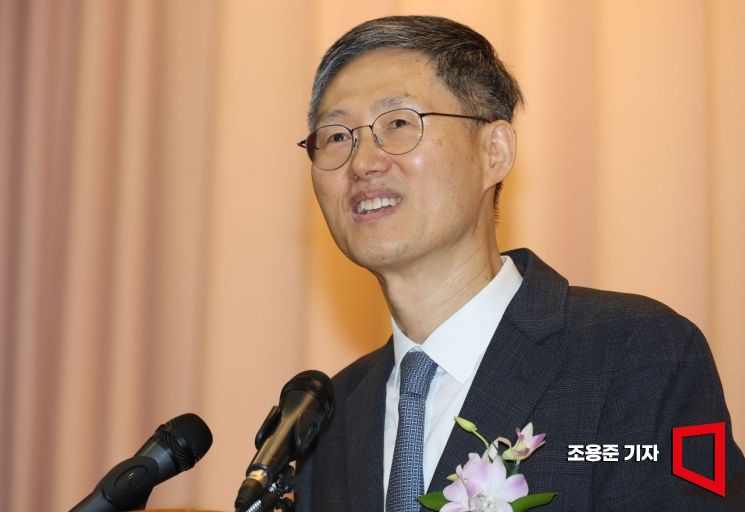 Moon Hyungbae, Acting Chief Justice of the Constitutional Court, is delivering a farewell speech at the retirement ceremony held at the Constitutional Court in Jongno-gu, Seoul on the 18th. 2025.4.18 Photo by Jo Yongjun
The impeachment verdict for former President Yoon was delivered after 38 days, marking the longest deliberation period compared to the cases of former President Roh Moo-hyun (14 days) and former President Park Geun-hye (11 days).
According to the reports, Moon stated, "I thought it would be difficult to persuade the public if the justices had differing opinions on an issue like a presidential impeachment, and I believed that unanimity was possible in this case." He continued, "If the decision had been split, say by a certain margin, the minority opinion would inevitably have to attack the majority opinion. That's why I tried to coordinate so that even the minority view could be reflected in the verdict."
He also remarked, "Some people reach a conclusion as soon as they see a case, while others need to review everything before deciding," and emphasized, "In such cases, of course, those who are quicker must wait for those who are slower. Those who are fast and impatient need to exercise patience."
Earlier, in a lecture at Inha University on April 17, he stated, "The rights applied to the opposition party must also apply to the ruling party, and the restraint recognized for the ruling party must also be recognized for the opposition. Only then can there be unity," and added, "If the principles that apply to me and those that apply to you are different, how can unity be achieved?" He continued, "Let us try to uphold that unity. That is the title of the impeachment verdict," explaining, "That is why it took so long."
On that day, the Elder Kim whom Moon met is a local philanthropist who has run a herbal medicine shop in Jinju for about 60 years, continuing a life of giving and good deeds. His life of generosity has become known to the public through documentaries and books. Moon received a scholarship as a so-called 'Kim Jangha Scholar' from his second year of high school until his fourth year of university. During his confirmation hearing at the National Assembly in 2019 for the Constitutional Court Justice position, Moon expressed his gratitude to Kim, saying, "When I passed the bar exam and went to thank him, Kim Jangha said, 'There's no need to thank me. If you wish to repay, do so to society, not to me.' I have never forgotten those words even for a moment."
On this day, Kim asked Moon, "They say majority rule is the flower of democracy, but sometimes a loud minority dominates a quiet majority. How should we interpret this?" Moon replied, "I believe a leader will emerge who can persuade the loud minority and establish the will of the majority. Such a system is what democracy is about, and I think this impeachment was conducted in that context."
Regarding why he became a lawyer, Moon explained, "Actually, when I was at the Judicial Research and Training Institute, I wanted to become a human rights lawyer. But after serving three years in the military, I saw that society had changed; the country where Roh Tae-woo was elected had become one governed by Kim Youngsam, and I thought being a human rights lawyer would be too difficult." He added, "I lacked confidence. I believe that when you take on something you're not equipped to handle, it doesn't end well."
He continued, "Among the options I could choose, what was the best? So I thought of becoming a local judge," and added, "I decided to go to Busan and stay there, doing things my own way. I felt that culture, politics, and administration should also be developed in the provinces, not just in Seoul, and I was dissatisfied with everything being concentrated in Seoul."
He noted, "Although the conflict between progressives and conservatives may be less severe, one of the biggest problems in our society is that regions are being marginalized," and added, "People from Seoul and people from Jinju are all valuable, but they are being treated as less important. And even this discussion is taking place in Seoul."
© The Asia Business Daily(www.asiae.co.kr). All rights reserved.
![Clutching a Stolen Dior Bag, Saying "I Hate Being Poor but Real"... The Grotesque Con of a "Human Knockoff" [Slate]](https://cwcontent.asiae.co.kr/asiaresize/183/2026021902243444107_1771435474.jpg)















