Kashmir at the Headwaters of the Indus River
Ultimately, a War Over Water
Conflict Continues Since Independence in 1947
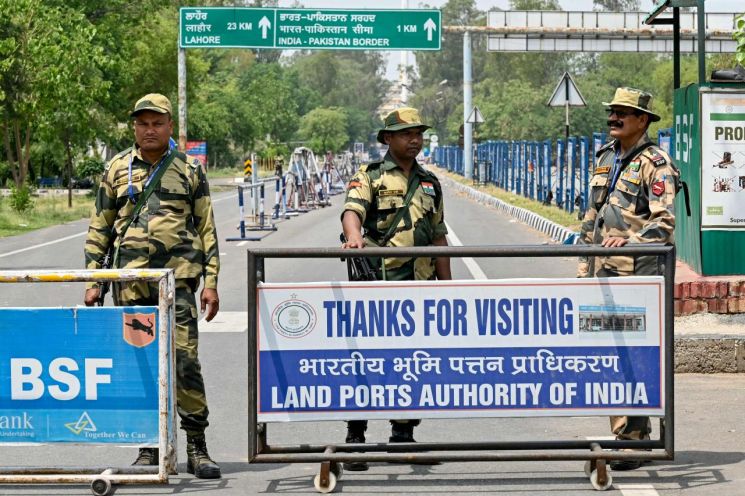 On the 6th (local time), the Indian Border Security Force in Amritsar, India, near the border area with Pakistan, closed the border and strengthened security. Photo by AFP Yonhap News
Military tensions are rising as India and Pakistan engage in retaliatory attacks over Kashmir. The decades-long Kashmir conflict between the two countries, which has persisted for nearly 80 years, has become more frequent since the Indian government declared its intention to make the entire region a directly governed territory. In particular, Kashmir is located in the upper reaches of the Indus River and possesses vast water resources, leading not only India and Pakistan but also China to claim sovereignty over the area, resulting in intensified military clashes among the three countries.
India launches airstrikes on Pakistan-administered Kashmir...Retaliatory attacks between both sides
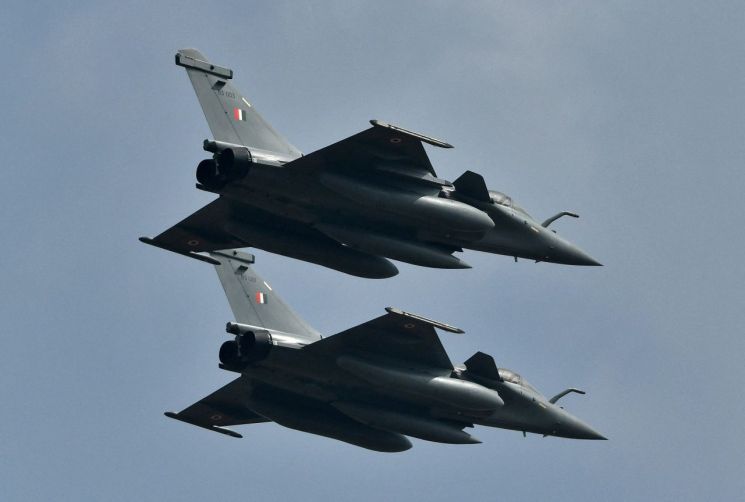
According to CNN, at least 157 casualties have been reported as a result of missile strikes and shelling between Indian and Pakistani forces on the 8th (local time). The Indian government reported 12 deaths and 57 injuries, while the Pakistani government stated that 31 people were killed and 57 were injured.
The conflict has been escalating since the Indian military conducted airstrikes on nine locations across Pakistan-administered Kashmir on the 7th. In a statement released after the attack, the Indian Ministry of Defense said, "This bombing targeted locations where terrorists were plotting attacks against India, and the targets were meticulously selected," adding, "There was no intention to escalate the conflict, and no facilities of the regular Pakistani military were attacked."
However, the Pakistani government claimed that the Indian military had deliberately targeted Pakistan. In a statement, the Pakistani government said, "The Indian military launched missiles at five locations, including Kashmir and Punjab Province, resulting in the deaths of three civilians, including a child, and injuring 14 others," adding, "Our forces carried out retaliatory strikes on targets inside India and shot down two Indian fighter jets."
The exchange of airstrikes between the two sides was triggered by a shooting attack that occurred earlier in Indian-administered Kashmir. On the 22nd of last month, a shooting attack targeting tourists near Pahalgam, a resort area in Indian-administered Kashmir, resulted in 26 deaths and 17 injuries. Immediately after the incident, the Indian government identified Pakistan as being behind the attack and announced plans for retaliatory strikes. The government also suspended the issuance of visas to Pakistani nationals and halted bilateral trade.
Nearly 80 years of conflict since 1947...India unilaterally declares direct governance
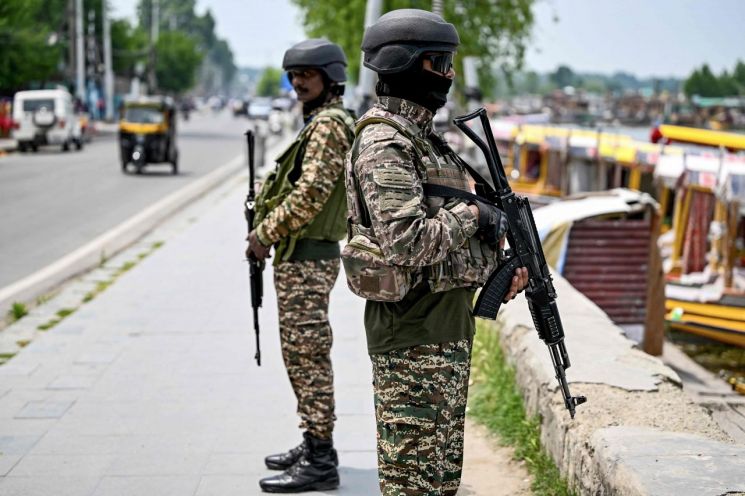 On the 6th (local time), Indian troops are standing guard in the downtown area of Srinagar, the central city of Indian-administered Kashmir. Photo by AFP
India and Pakistan have been at odds over the Kashmir region for nearly 80 years. Since gaining independence from British colonial rule in 1947, the two countries have engaged in both large-scale and small-scale clashes over the sovereignty of Kashmir.
According to The Guardian, before 1947, the Kashmir region was a princely state under British colonial rule, governed by the Kingdom of Jammu and Kashmir. The royal family and elite were Hindu, while the majority of the population was Muslim. After India and Pakistan gained independence in 1947, the royal family wanted to join Hindu-majority India, while the residents wished to join Muslim-majority Pakistan, leading to conflict. Both India and Pakistan have claimed sovereignty over Kashmir and have fought three full-scale wars, yet the dispute continues to this day.
In particular, the conflict has intensified since the Indian government unilaterally declared all of Kashmir as a directly governed territory in 2019. In August 2019, the Indian government abolished Article 370 of the constitution, which granted special autonomy to the Kashmir region, and announced that all of Kashmir would become a directly governed territory of the Indian federation. Since then, Islamic separatist armed groups in Kashmir who wish to join Pakistan have continued to attack Indian military and police forces in protest.
India, Pakistan, and China compete over the source of the Indus River
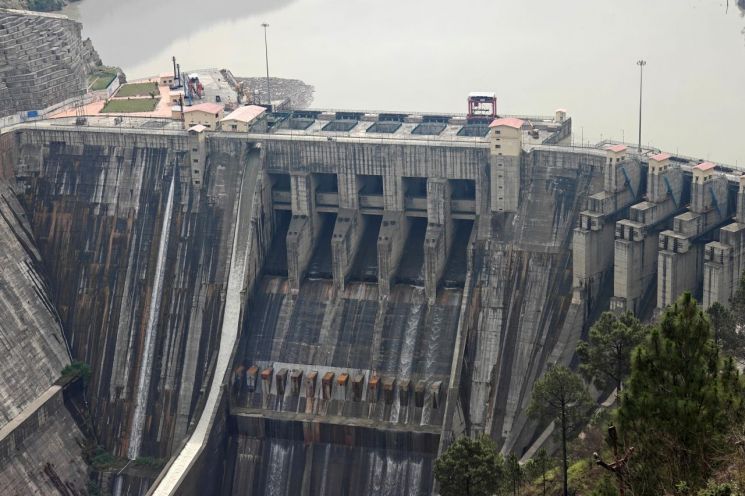 Baglahar Dam built on the Chenab River, a tributary of the Indus River flowing from Kashmir to Pakistan. The Indian government blocked the dam and stopped the water flow to Pakistan starting from the 5th (local time). Photo by Reuters Yonhap News
The main reason India and Pakistan are unwilling to make any concessions over Kashmir is believed to be water resources. Because Kashmir is located in the upper reaches of the Indus River, which is considered the lifeline of western India and all of Pakistan, neither side can afford to give up the territory due to the need to secure water resources. Since the 1960s, China has also become involved in the Kashmir sovereignty dispute, resulting in a rivalry among three nuclear-armed powers.
According to the Indian local media Hindustan Times, the Indian government announced that starting from the 5th of this month, it would block the flow of the Chenab River, a tributary of the Indus River that runs from Indian-administered Kashmir to Pakistan. The Baglihar Dam, built by India, is located on the Chenab River, and Indian authorities have closed the dam gates to block the river's flow. It has also been reported that India is planning to block the Kishanganga Dam, another dam on a tributary of the Indus River.
The Pakistani government immediately protested. Following India's move to block the water flow, the Pakistani government warned, "Any attempt to take, block, or divert water from the Indus River basin is an act of war against Pakistan," adding, "We will respond with all our might, including all available resources."
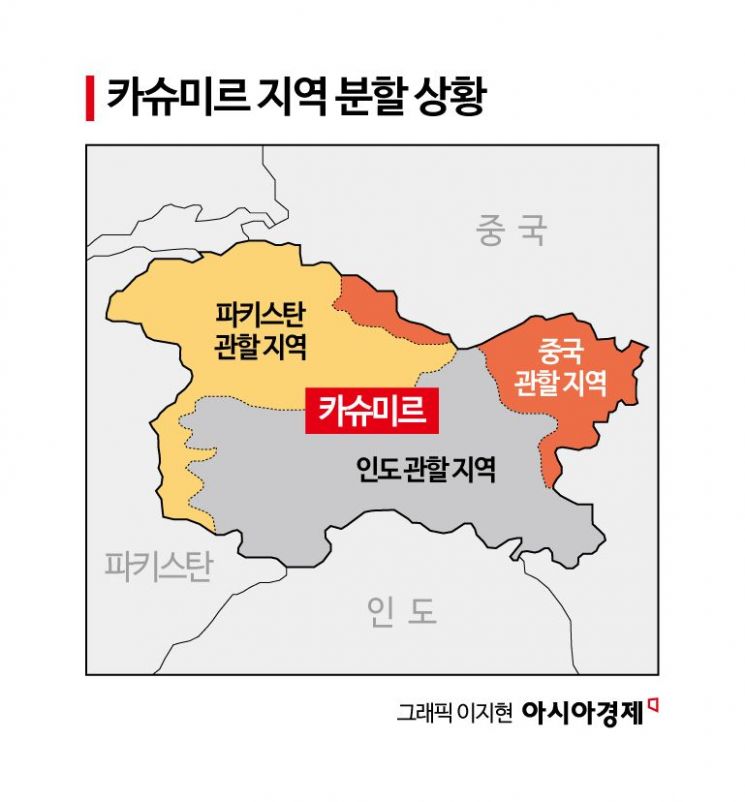
India's move to block the water flow has rendered the 'Indus Waters Treaty,' a water-sharing and allocation agreement signed by the two countries under the mediation of the World Bank (WB) in 1960, effectively null and void. The treaty guaranteed Pakistan's rights to use the Indus River and its tributaries and stipulated that India could not unilaterally block the water flow.
The situation has grown even more complicated as China has become involved in the Kashmir sovereignty dispute amid ongoing tensions between India and Pakistan. Following the Sino-Indian War in 1962, which broke out over a border dispute, China occupied the Aksai Chin region in eastern Kashmir and continues to claim sovereignty over it. In the current India-Pakistan conflict, China is supporting Pakistan, a key participant in its Belt and Road Initiative (the land and maritime Silk Road), to put pressure on India.
On the 28th of last month, Wang Yi, Director of the Office of the Central Foreign Affairs Commission of the Communist Party of China, spoke by phone with Ishaq Dar, Pakistan's Deputy Prime Minister and Foreign Minister, stating, "China fully understands Pakistan's legitimate security concerns and supports Pakistan in safeguarding its sovereignty and security interests," adding, "We hope that both India and Pakistan will exercise restraint and work together to stabilize the situation."
© The Asia Business Daily(www.asiae.co.kr). All rights reserved.
![Clutching a Stolen Dior Bag, Saying "I Hate Being Poor but Real"... The Grotesque Con of a "Human Knockoff" [Slate]](https://cwcontent.asiae.co.kr/asiaresize/183/2026021902243444107_1771435474.jpg)

















