Seoul National University Graduate School of Public Health,
"Survey on Mental Health Promotion and Crisis Preparedness Among the General Public"
48% Rate Overall Mental Health in Society as "Not Good" vs. 11% as "Good"
Need for Efforts to Prevent Mental Health Crises Amid Rising Domestic and Global Uncertainty
It was found that nine out of ten South Koreans believe that mental health problems or disorders can arise due to social factors such as rapid changes in politics, society, or the economy. Although one out of two adults experienced stress significant enough to affect their health in the past year, only a very small number actually sought medical care.
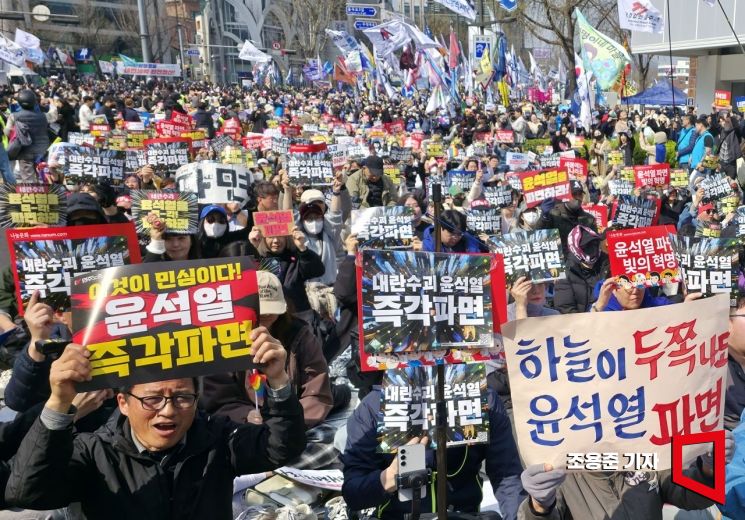 On the 4th of last month, the day of President Yoon Sukyeol's impeachment verdict, citizens and organization members supporting the impeachment shouted slogans at a rally near the Constitutional Court in Anguk-dong, Seoul. Photo by Jo Yongjun
The 'BK21 Education and Research Group for Integrated Response to Health Disasters' at the Graduate School of Public Health, Seoul National University, announced on the 7th that it had analyzed the results of a survey conducted from April 15 to 21, targeting 1,500 men and women aged 18 or older nationwide.
When asked whether they believe that individual mental health problems or disorders can be caused by social factors such as rapid political, social, or economic changes or major disasters, 91.1% of respondents answered 'strongly agree' or 'agree,' indicating a very high level of agreement. Regarding the statement that "the occurrence of mental illness or psychotic disorders is due to individual genetic factors," about half of the respondents (51.3%) agreed. For the statement, "If I were mentally ill, I would be worried or afraid of prejudice or stigma, so I would not disclose my condition to others or seek professional help," 56.2% of all respondents answered 'yes.'
In the survey asking about "the overall level of mental health among members of our society," the average score was 2.59 out of 5, falling short of the "average level" (3 points). Among the respondents, 48.1% chose "not good," 40.5% chose "average," and 11.4% chose "good." When 722 people who answered that the mental health of members of society is "very poor" or "somewhat poor" were asked which social atmosphere they thought had an impact, 49.9% (multiple responses) cited "a social atmosphere that emphasizes competition and achievement," and 42.4% cited "a social atmosphere where the gaze and judgment of others or groups become the standard and norm."
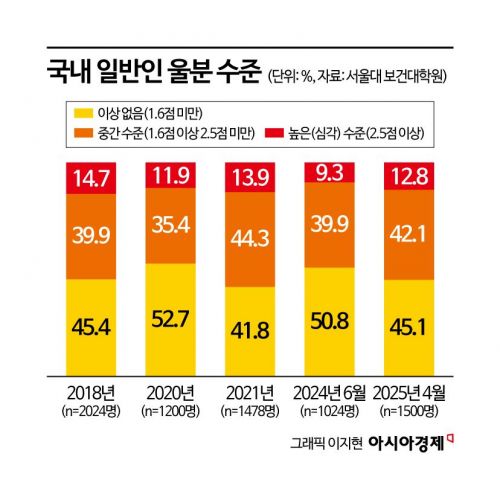
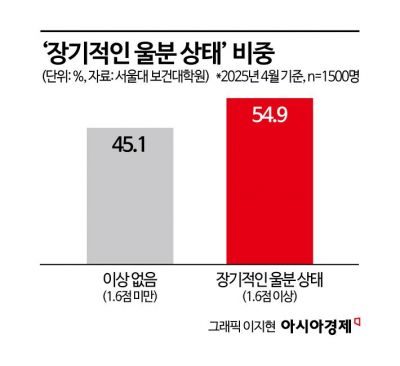
The proportion of people experiencing a high level of anger (anger measurement score of 2.5 or higher) was 14.7% in 2018, 11.9% in 2020, 13.9% in 2021, 9.3% in 2024, and rose again to 12.8% this year. In addition, the proportion of those experiencing a "prolonged state of anger" (score of 1.6 or higher) was 54.6% in 2018, 47.3% in 2020, 58.2% in 2021, 49.2% in 2024, and 54.9% in 2025, also showing an increase compared to last year's results.
When asked, "Have you experienced serious stress in the past year that affected your health?" 47.1% answered "yes" and 52.9% answered "no." Among those who answered "yes" (706 people), the main stress factors at the personal and family level were changes in health (42.5%), changes in economic status (39.5%), and separation or loss (20.7%). At the social level, such as school or workplace, the main factors were changes in relationships (30.2%), employment status (23.7%), and work overload (21.4%). At the environmental level, including politics and society, the main factors were changes in the political environment such as corruption or abuse of power by national authorities (36.3%), cracks or disruptions in the operation of the national system or maintenance of social order (33%), and social disasters such as major safety accidents, serious industrial accidents, or social catastrophes (23.1%).
When asked, "In the past year, have you ever faced a major mental health crisis that made it difficult to fulfill your usual roles or responsibilities?" 27.3% (409 people) answered "yes." Among them, 51.3% said they had "seriously considered making an extreme choice," 20.5% said they had "planned an extreme choice," and 13.0% said they had "attempted an extreme choice."
However, only 39.4% of these respondents said they "asked for help" from those around them, while 60.6% did not seek help. The most common reason was "worry and fear (stigma, others' views, etc.)" at 41.9% (multiple responses), followed by "not knowing how to ask for help" at 22.6%, and "economic issues (cost, insurance, etc.)" at 19.4%.
Only 13.1% (196 people) of all respondents said they had used medical services related to mental health. Among them, 69.4% said they hesitated before visiting a medical institution. The reasons included "concerns about negative perceptions from others and disadvantages due to treatment records" (25.7%), "the symptoms were not yet severe and would resolve over time" (16.9%), "thinking they should overcome it themselves and that hospital treatment would not be effective," and "worry about treatment costs" (both at 13.2%).
Yoo Myungsoon, a professor at the Graduate School of Public Health, Seoul National University, who oversaw the survey, explained, "The emotional and affective state of a population is an important prerequisite and requirement for mental health," adding, "Macro-environmental changes such as the climate crisis or economic instability can also negatively affect the mental health of individuals and groups."
Lee Yunkyung, who co-led the research, pointed out, "About 47% of respondents experienced stress significant enough to affect their health in the past year, and 27% faced a major mental health crisis that made it difficult to fulfill their usual roles or responsibilities, but the actual rate of using medical institutions was only 13%. The fact that 69% of them hesitated to visit a medical institution shows that, going forward, there is a need for both a general improvement in social awareness regarding mental disorders and active government intervention to address mental health issues."
© The Asia Business Daily(www.asiae.co.kr). All rights reserved.
![Clutching a Stolen Dior Bag, Saying "I Hate Being Poor but Real"... The Grotesque Con of a "Human Knockoff" [Slate]](https://cwcontent.asiae.co.kr/asiaresize/183/2026021902243444107_1771435474.jpg)

















