Overseas Investment by Chinese and Japanese Firms Intensifies
Essential Raw Material for Molten Iron Production Process
POSCO Secures 7 Million Tons Through Overseas Purchases
Supply Chain Expansion Beyond Australia and Canada to Asia and More
Concerns Over Moving Away from Eco-Friendly Production
Strengthening Competitiveness Through Stable Procurement
POSCO is reviewing plans to expand its investment in premium coking coal as part of efforts to increase its self-sufficiency in steelmaking raw materials. This move is seen as an attempt to establish a stable procurement system in response to global supply chain instability and increased overseas investment by Chinese and Japanese steelmakers. However, some concerns have been raised that this could distance the company from environmentally friendly production, as it signals a reinforcement of blast furnace-based steel production.
According to industry sources on May 7, POSCO is currently considering expanding its coking coal supply chain beyond Australia and Canada to include regions such as Asia and Africa. A company representative stated, "As overseas competitors move to secure coking coal resources, we have found it necessary to respond," adding, "While there are certainly risks from an ESG (environmental, social, and governance) perspective, we believe there are areas where we can approach this strategically within the scope of regulations."
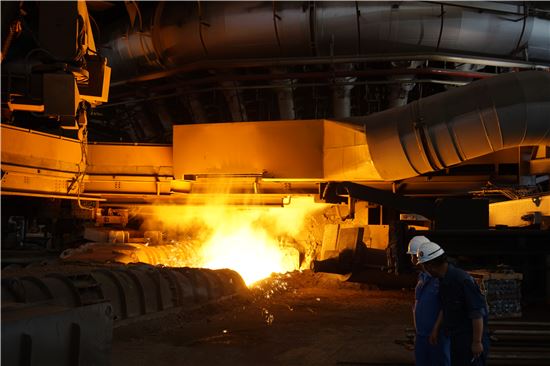 Molten iron is flowing from the Krakatau Posco furnace in Indonesia. Photo by Asia Economy DB
Coking coal is an essential raw material used in the blast furnace reduction process (the core steelmaking process in which oxygen is removed from iron ore at high temperatures to produce molten iron), along with iron ore. Thanks to its high calorific value and reducing power, coking coal plays a key role in removing oxygen from iron ore to obtain pure iron. As it is a decisive material that determines both blast furnace productivity and the quality of final products, securing coking coal of a certain quality level is considered a strategic priority for global steelmakers.
POSCO relies entirely on overseas purchases for coking coal. As of the end of last year, the company had secured about 7 million tons through long-term purchase contracts with major mining companies such as Rio Tinto, BHP, and Whitehaven in Australia, and Teck Resources in Canada. This volume is mainly supplied to blast furnace-based steelworks in Korea and Indonesia.
POSCO has so far maintained a cautious approach to investing in coal resources, taking ESG evaluations and investment risks into account. For this reason, the company has reduced its resource investment ratio in recent years. However, analysts point out that a strategic shift has become inevitable due to the deepening bloc-ization of the raw materials market, the accelerated resource acquisition by Chinese and Japanese steelmakers, and the strengthening of local procurement requirements under the USMCA (United States-Mexico-Canada Agreement) in North America.
This review is strongly intended to diversify the supply chain and reduce dependence on existing suppliers, thereby dispersing risks. POSCO is currently considering expanding its supply chain beyond Australia and Canada. Global steelmakers have already entered into fierce competition to secure raw materials. China’s largest steelmaker, Baowu Steel, is pushing to expand investment and equity in projects in Mongolia and Africa. Nippon Steel of Japan is also preparing investments and joint ventures in Australian and Canadian mines.
Among domestic steelmakers, POSCO is the only one expanding its coking coal supply chain. While Hyundai Steel also operates blast furnace-based steelworks, it has shown no signs of investing in coking coal. An industry official explained, "Hyundai Steel is gradually reducing its blast furnace operations as part of its carbon reduction strategy."
POSCO’s strategy to diversify its raw material supply lines is also linked to its expanded investments in steelworks in major global markets such as India. POSCO is currently investing in an integrated blast furnace-based steel plant in India. Securing premium coking coal is essential for the stable operation of these facilities. An industry official said, "POSCO has a production system that will inevitably maintain blast furnace-based processes for the time being," adding, "It appears the company has determined that it would be difficult to maintain global profitability without a comprehensive strategy for securing raw materials."
© The Asia Business Daily(www.asiae.co.kr). All rights reserved.
![Clutching a Stolen Dior Bag, Saying "I Hate Being Poor but Real"... The Grotesque Con of a "Human Knockoff" [Slate]](https://cwcontent.asiae.co.kr/asiaresize/183/2026021902243444107_1771435474.jpg)














