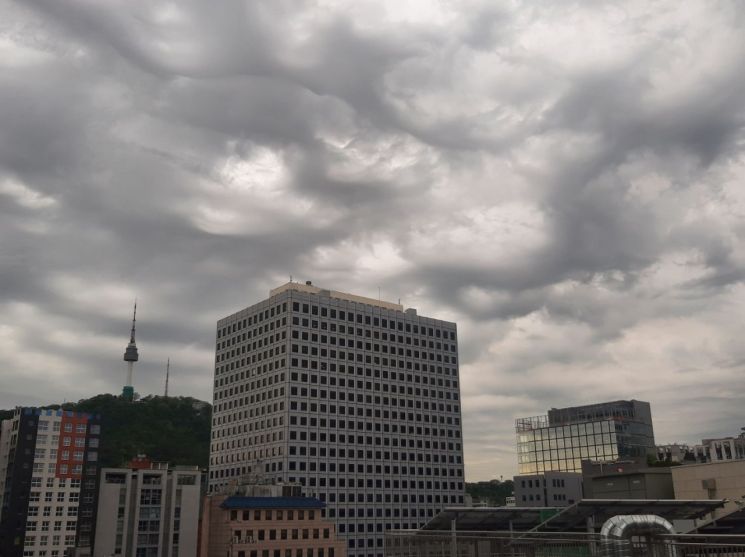
On the morning of the 1st, clouds with bizarre shapes were observed in various parts of the Seoul metropolitan area. Ordinary clouds shine white where they are illuminated by sunlight, while their undersides are dark and flat. However, on this day, the sky resembled a rough sea.Thick clouds, appearing as if waves were crashing, covered the sky.

Clouds can take on various forms: gas, liquid, and solid. When air in its gaseous state rises, the temperature drops and it reaches the dew point, forming water vapor. At this point, tiny droplets of water (liquid) and ice (solid) come together to form clouds. When clouds become heavy, they turn into rain. The average lifespan of a cloud is known to be about 10 minutes.
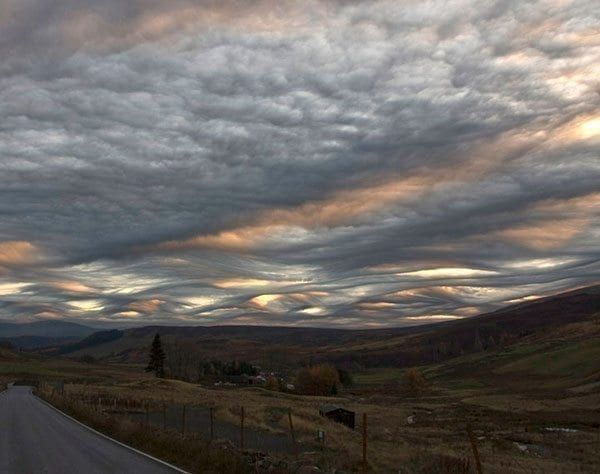 Clouds that look like waves tossing about. This cloud was posted on the Cloud Appreciation Society in June 2009. It was later registered as Asperitas clouds in the International Cloud Atlas.
According to the Korea Meteorological Administration, the clouds observed that day are called "Asperatus," or rough wave clouds. The name comes from the Latin word "asperitas," meaning "rough" or "uneven."
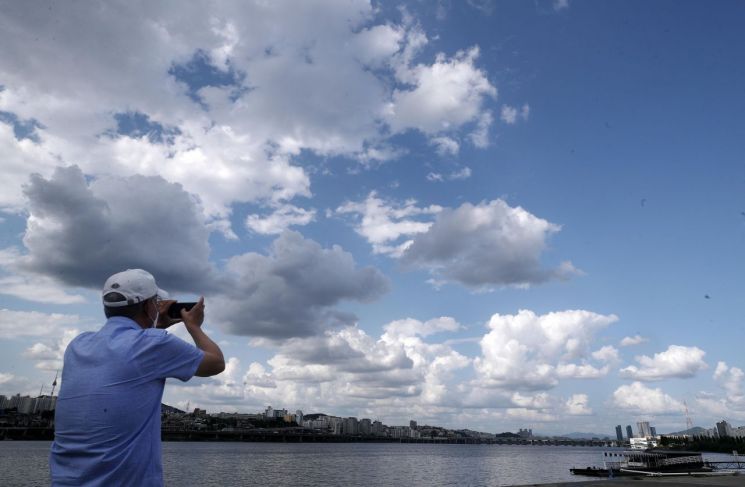 A citizen visiting Banpo Hangang Park is photographing fluffy clouds. These clouds are stratiform clouds. Photo by Asia Economy DB
This is how the name originated. In June 2009, a photo posted as the "Cloud of the Month" on the Cloud Appreciation Society website resembled the surface of a stormy sea.It was nicknamed the "Jacques Cousteau cloud" after Jacques Cousteau, the legendary French diver and ecologist of the 1970s. As similar photos poured in from members and visitors around the world, the cloud was named "undulatus asperatus," using the Latin words for "wavy" and "rough, uneven." In 2017, it was included in the International Cloud Atlas and has since been referred to by the abbreviated name "Asperatus."
© The Asia Business Daily(www.asiae.co.kr). All rights reserved.
![Clutching a Stolen Dior Bag, Saying "I Hate Being Poor but Real"... The Grotesque Con of a "Human Knockoff" [Slate]](https://cwcontent.asiae.co.kr/asiaresize/183/2026021902243444107_1771435474.jpg)

















