Supreme Court En Banc to Deliver Ruling at 3 p.m.
Live Broadcast Scheduled; Lee Jae Myung Not Expected to Attend
The Supreme Court is set to deliver its verdict on May 1 in the public official election law case involving Lee Jae Myung, the presidential candidate of the Democratic Party of Korea.
According to political and legal circles, the Supreme Court en banc will announce its ruling at 3 p.m. in the main courtroom on this day, regarding the appeal trial of Lee, who was indicted for violating the Public Official Election Act. The presiding judge is Supreme Court Chief Justice Cho Hee Dae, and the justice in charge is Justice Park Young Jae.
The sentencing will be broadcast live via the Supreme Court's YouTube channel and television. However, it has been reported that Lee will not attend the session in person.
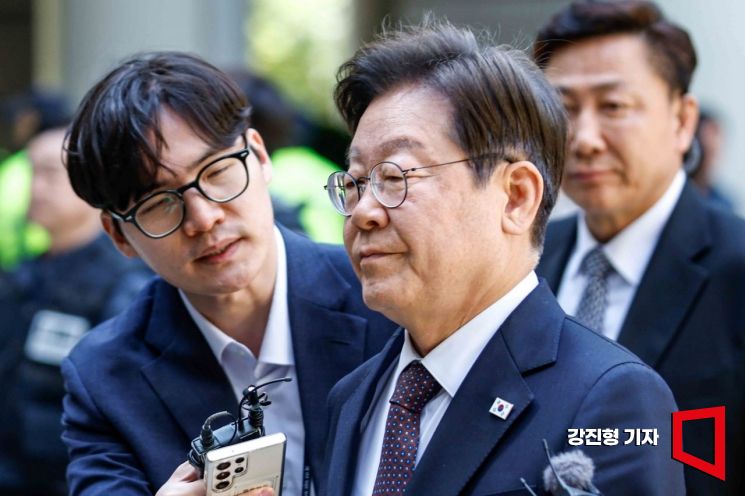 Lee Jae Myung, the presidential candidate of the Democratic Party of Korea, who is accused of breach of trust in Daejangdong and bribery related to Seongnam FC, is attending a trial held at the Seoul Central District Court in Seocho-gu, Seoul on April 29, 2025. Photo by Kang Jinhyung
Previously, in 2021, Lee was indicted on charges of making false statements after he appeared on a broadcast as a presidential candidate and claimed not to know the late Kim Moon Ki, former head of Development Department 1 at Seongnam Development Corporation. He also stated during a parliamentary audit that the Ministry of Land, Infrastructure and Transport had threatened Seongnam City during the process of changing the land use of the Korea Food Research Institute site in Baekhyeon-dong, Seongnam, which was also deemed to be a false statement.
The first trial found Lee guilty and sentenced him to one year in prison, suspended for two years. The appellate court, however, ruled him not guilty, stating that Lee's remarks amounted only to "awareness" or "expression of opinion" and were not punishable.
If the Supreme Court finds Lee not guilty, it is expected that he will be able to resolve the most significant legal risk before the presidential election. However, if the Supreme Court overturns the appellate court's acquittal and rules in favor of guilt, controversy over Lee's eligibility as a candidate may reignite.
The Public Official Election Act stipulates that if a person is convicted of an election-related crime and fined 1 million won or more, their eligibility to run for office is revoked for five years. Without eligibility, a person cannot run in an election.
© The Asia Business Daily(www.asiae.co.kr). All rights reserved.
![Clutching a Stolen Dior Bag, Saying "I Hate Being Poor but Real"... The Grotesque Con of a "Human Knockoff" [Slate]](https://cwcontent.asiae.co.kr/asiaresize/183/2026021902243444107_1771435474.jpg)















