Ministry of Agriculture, Food and Rural Affairs Announces Horse Welfare Enhancement Plan (2025-2029)
Horse Registration System to Shift from Voluntary to Mandatory for Owners
Introduction of Horse Welfare Certification System to Prioritize Support for Excellent Facilities
The government has decided to implement initiatives such as a mandatory horse registration system to improve horse welfare in line with the growth of the horse industry.
The Ministry of Agriculture, Food and Rural Affairs announced on April 30 that it has, for the first time, developed and released the "Horse Welfare Enhancement Plan (2025-2029)" to support the sustainable development of the horse industry and minimize blind spots in horse welfare.
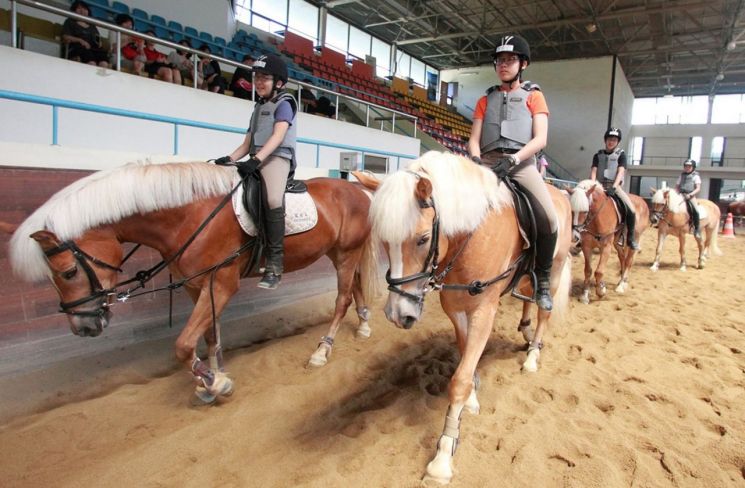
An Yongdeok, Director of Livestock Policy at the Ministry of Agriculture, Food and Rural Affairs, stated, "Since the enactment of the Horse Industry Promotion Act in 2011 and the implementation of related policies, the overall scale of the industry?including production, industrial sectors, and public demand?has been growing. However, there is still a relative lack of awareness about horse welfare at the industrial level, which has led to some cases of horse abuse. As public interest in animal welfare increases, the need to improve horse welfare standards has been continuously raised."
In fact, the number of horses increased from 26,525 in 2020 to 27,521 in 2024. The number of businesses grew from 2,513 to 2,668 during the same period. The number of people participating in horseback riding experiences also rose from 455,000 to 521,000.
Accordingly, the new plan aims to foster a horse industry that is loved by the public by promoting horse welfare. Over the next five years, it will focus on four areas?minimizing blind spots in horse welfare, providing life-cycle-based welfare support, enhancing welfare awareness, and strengthening public-private cooperation?through a total of 11 initiatives.
To minimize blind spots in horse welfare, the government will operate a Horse Protection Monitoring Center to actively respond to horse abuse by supporting reporting, rescue, and rehabilitation in cases where isolation is needed due to abuse or neglect at horse breeding facilities. To strengthen monitoring of horse abuse, rewards will be given for reports. The annual "Horse Industry Status Survey" will include additional questions on horse welfare to provide foundational data for policies to address welfare blind spots.
For life-cycle-based welfare support, the current voluntary horse registration system will be strengthened to a mandatory registration system, enabling comprehensive management of all horses and tailored support at each stage of life. This will include the development and distribution of standard management manuals for each growth stage, support for foal taming and the conversion of retired racehorses to riding horses to increase their value after retirement, and rehabilitation support for injured racehorses to reduce early culling.
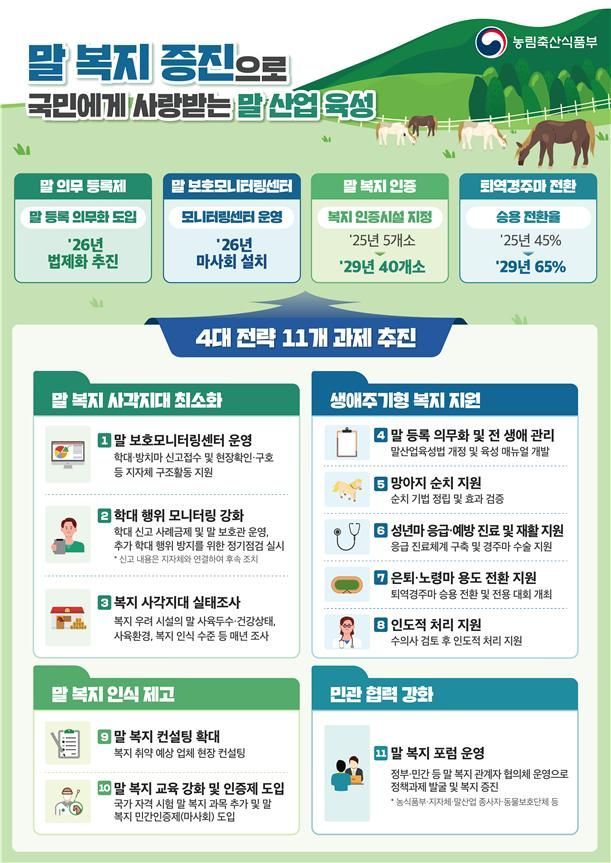
In addition, a horse welfare certification system will be introduced. Facilities with excellent horse welfare standards will receive preferential treatment in support programs, while facilities with weaker welfare standards will receive on-site consulting from experts to improve their welfare levels. To strengthen education on horse welfare, a horse welfare subject will be newly added to horse-related qualification exams, and those who have not completed horse welfare education will be restricted from participating in horse industry support programs to further promote awareness.
An Yongdeok commented, "This is the first plan specifically designed to enhance horse welfare, and we expect it will lay the foundation for eliminating blind spots in horse welfare. It will serve as an opportunity to improve horse welfare throughout the entire life cycle and to meet public expectations for horse welfare."
© The Asia Business Daily(www.asiae.co.kr). All rights reserved.
![Clutching a Stolen Dior Bag, Saying "I Hate Being Poor but Real"... The Grotesque Con of a "Human Knockoff" [Slate]](https://cwcontent.asiae.co.kr/asiaresize/183/2026021902243444107_1771435474.jpg)
















