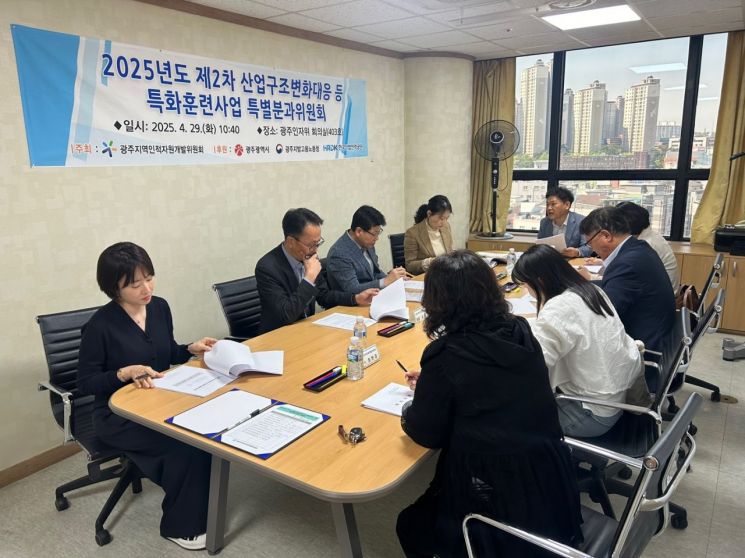
 The Gwangju Regional Human Resources Development Committee held the "2nd Special Subcommittee on Specialized Training for Responding to Industrial Structure Changes in 2025." Photo by Gwangju Chamber of Commerce and Industry
The Gwangju Regional Human Resources Development Committee announced on April 30 that it had held the "2nd Special Subcommittee on Specialized Training for Responding to Industrial Structure Changes in 2025."
The special subcommittee meeting was held on the morning of April 29 in the conference room on the 4th floor of the Gwangju Chamber of Commerce and Industry. Six working-level committee members representing labor, management, civil society, and government, including Executive Director Lee Hoo-hyung of the Gwangju HRD Committee, attended the meeting. During the session, the committee proposed the "2025 Specialized Training Project for Responding to Industrial Structure Changes" and deliberated and approved 26 training programs submitted by 16 organizations.
The "Specialized Training Project for Responding to Industrial Structure Changes" is designed to provide region-specific training programs in a timely manner in response to changes in industrial structure, supporting citizens' participation in the evolving employment landscape. Trainees receive full support for training fees and, depending on the program, may also receive special training allowances. Anyone holding a National Tomorrow Learning Card is eligible to participate.
In relation to this project, the Gwangju HRD Committee held an open call for the first round of training institutions and programs from March 28 to April 10. A total of 45 training programs from 18 institutions were submitted, and after review by local experts, 26 programs from 17 training institutions were finally approved by the special subcommittee.
This year, in particular, discussions with the local government led to the decision to foster Gwangju's nine representative industries. After gathering expert opinions, the main committee of the Gwangju HRD Committee finalized the training occupations for these industries.
Gwangju's nine representative industries include two "challenge industries" for securing future competitiveness: semiconductors and data industry; five "strategic industries" based on regional characteristics for enhancing national competitiveness: mobility, artificial intelligence (AI), cultural content, energy, and medi-healthcare; and two "foundation industries" that form the backbone of the region: optical convergence and home appliances, and smart root industries.
Executive Director Lee Hoo-hyung of the Gwangju HRD Committee stated, "This year as well, we plan to identify training and workforce needs for new industries that need to be fostered in the Gwangju region, as well as for incumbent and unemployed workers in industries facing difficulties due to changes in industrial structure and employment crises, and to provide training programs in a timely manner." He added, "We expect that this will make a significant contribution to improving the job competencies of local job seekers and employees."
© The Asia Business Daily(www.asiae.co.kr). All rights reserved.
![Clutching a Stolen Dior Bag, Saying "I Hate Being Poor but Real"... The Grotesque Con of a "Human Knockoff" [Slate]](https://cwcontent.asiae.co.kr/asiaresize/183/2026021902243444107_1771435474.jpg)















