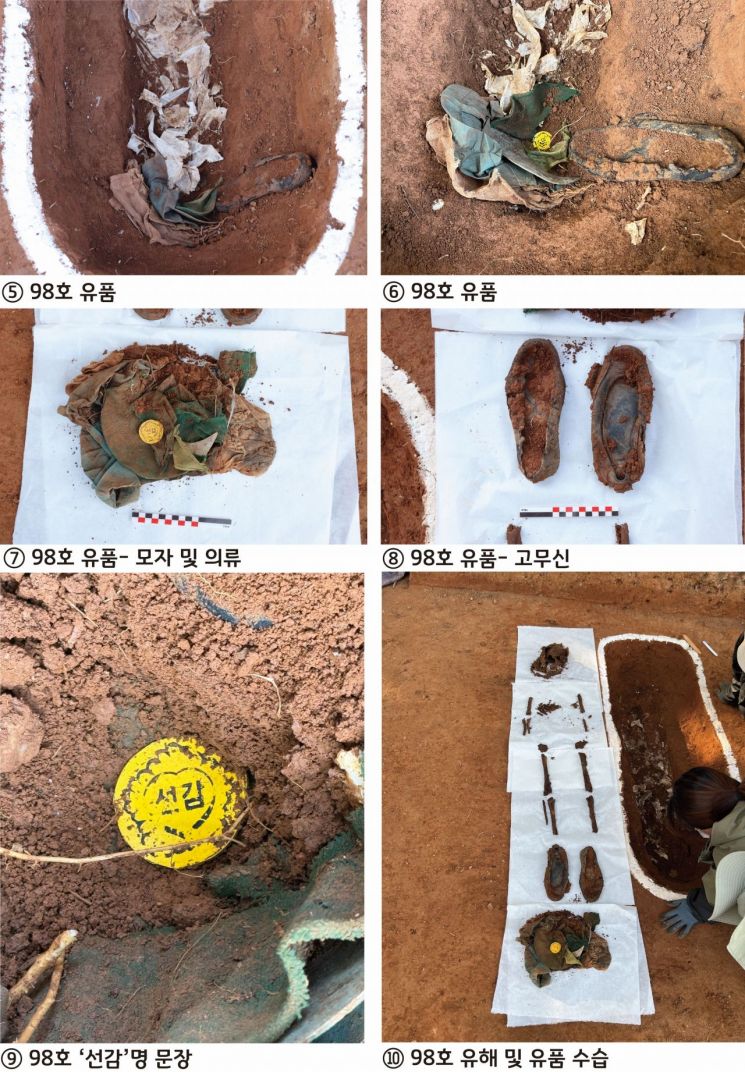
 Victims' belongings excavated from the site of Seongam Academy in Gyeonggi Province. Provided by Gyeonggi Province
Gyeonggi Province conducted an excavation of remains at the Seongam Academy communal cemetery (San 37-1, Seongam-dong, Danwon-gu, Ansan), which has been identified as a presumed burial site for the remains of children from Seongam Academy. Remains were discovered in 67 out of the 155 graves targeted for investigation.
On April 30, Gyeonggi Province held an on-site briefing session at the Seongam Academy communal cemetery, attended by around 30 people including victims of the Seongam Academy incident and local residents, where the results of the excavation were announced.
In accordance with the Act on Funeral Services, Gyeonggi Province carried out preliminary procedures for the excavation of remains, including a comprehensive survey of graves and a public notice of exhumation, from April to July last year. After holding a ground-breaking ceremony on August 8 of the same year, the excavation of remains began.
The area targeted for excavation comprised 155 graves identified through the comprehensive survey, located on a 2,400-square-meter cemetery at San 37-1, Seongam-dong, Ansan.
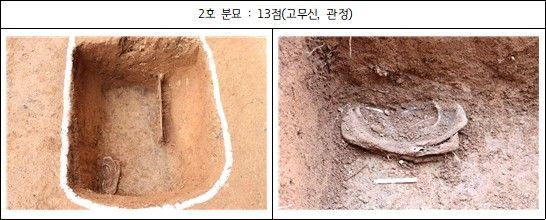 Artifacts including rubber shoes excavated from Tomb No. 2 at the Seongam Institute site in Ansan, excavated by Gyeonggi Province. Provided by Gyeonggi Province
As a result of the excavation, 133 of the sites were confirmed to be graves. Twenty-one mounds were found to be simple earth mounds (natural soil) or relocated graves, and thus were not classified as graves. One site was reported as a burial heritage site, and the investigation was halted until related procedures are completed.
Of the 133 confirmed graves, remains were recovered from 67. A total of 537 remains were collected from these graves. Teeth accounted for the largest number, and some femurs and humeri (upper arm bones) were also found. The excavated remains will undergo forensic examination by a specialized institution. Remains confirmed to be of individuals who died at age 30 or younger will be cremated and interred at Seongam-dong Public Cemetery.
For the 66 graves from which no remains were recovered, it is believed that, due to more than 40 years having passed, the humid and highly acidic soil caused the remains to decompose and thus prevented their recovery.
Choi Hyunjung, Gyeonggi Province's Human Rights Officer, stated, "The remains of victims from the Seongam Academy incident are mostly presumed to be teenagers. We will responsibly complete the remaining procedures to honor the spirits of those unjustly sacrificed by state power and to fully restore their tarnished honor."
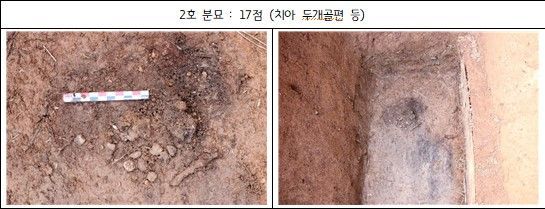 Artifacts such as teeth and skulls found in Tomb No. 2 at the Seongam Institute site in Ansan, excavated by Gyeonggi Province. Provided by Gyeonggi Province
The Seongam Academy incident was a case of human rights violations in which, under the pretext of reforming vagrants, more than 4,700 boys were subjected to forced labor, beatings, abuse, and secret burials between 1942 and 1982, in accordance with national policy during the Japanese colonial period and afterward.
Previously, in October 2022, the Truth and Reconciliation Commission concluded that the Seongam Academy incident constituted "child human rights violations by state authority." The commission recommended that Gyeonggi Province, which operated Seongam Academy, and the state, which implemented illegal vagrant policies, prepare support measures for victims of the Seongam Academy incident and carry out the excavation of victims' remains.
Accordingly, the Ministry of the Interior and Safety planned the excavation, with Gyeonggi Province as a cooperating agency. However, when the ministry-led excavation did not proceed, Gyeonggi Province decided to directly undertake the excavation in place of the state, in order to promptly implement the recommendations of the Truth and Reconciliation Commission, and proceeded with the excavation.
© The Asia Business Daily(www.asiae.co.kr). All rights reserved.
![Clutching a Stolen Dior Bag, Saying "I Hate Being Poor but Real"... The Grotesque Con of a "Human Knockoff" [Slate]](https://cwcontent.asiae.co.kr/asiaresize/183/2026021902243444107_1771435474.jpg)

















