Establishing Legal Responsibilities for Vacant House Management at National and Provincial Levels
Integrating Vacant House Information through the "Binjibae Platform"
Promoting Private Sector Utilization... Special Exemptions and Support Provided
The government will establish an integrated information system to systematically manage the increasing number of vacant houses resulting from the depopulation of local areas. It will also provide support, such as offering special exemptions, to facilitate the maintenance and management of vacant houses.
On May 1, during the Economic Ministers’ Meeting and the Industrial Competitiveness Enhancement Ministers’ Meeting, the government announced the "Comprehensive Plan for Government-wide Vacant House Management." The plan aims to establish a national vacant house management system, strengthen the vacant house maintenance capabilities of city, county, and district governments, and encourage voluntary maintenance by vacant house owners.
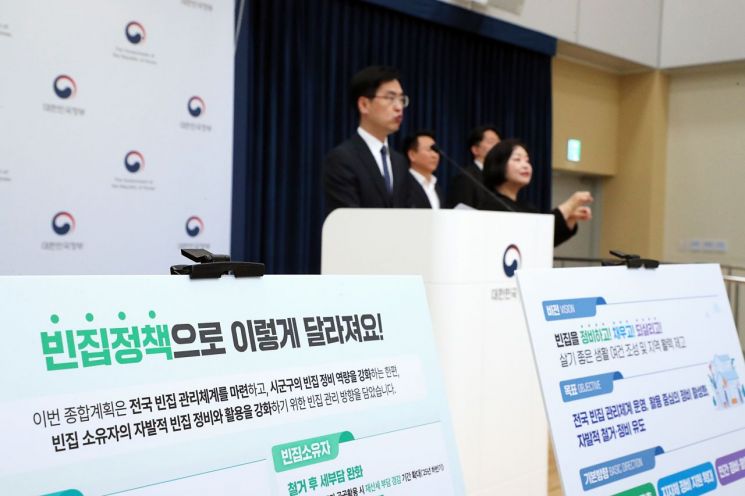 Kim Minjae, Deputy Minister for Administrative and Security Affairs, is explaining the "Comprehensive Plan for Government-wide Vacant House Management" on April 29. Photo by Ministry of the Interior and Safety
The number of vacant houses nationwide is increasing in line with the trend of population decline. According to an administrative survey conducted last year targeting 243 local governments across the country, there were 134,009 vacant houses. Of these, 57,223 were located in areas experiencing population decline.
Accordingly, the Central-Local-Public-Private Council for Vacant Houses?comprising relevant ministries such as the Ministry of the Interior and Safety and the Ministry of Land, Infrastructure and Transport, local governments, research institutes, and private experts?gathered various opinions on nationwide vacant house status management measures, institutional improvements, tax burden relief, and the establishment of an integrated platform to develop the comprehensive plan.
First, the government revised the legal framework to assign vacant house management responsibilities to both the national and provincial governments. Previously, the responsibility for managing vacant houses rested solely with city, county, and district governments, which limited their ability to address the growing problem. The government will enact the Special Act on Rural Vacant House Maintenance and the Special Act on Vacant Building Maintenance to strengthen the responsibilities of the state and property owners and expand support for vacant house maintenance. Through these special acts, the government plans to unify standards such as the definition of vacant houses, which had previously been defined differently under the Rural Area Maintenance Act and the Small-Scale Housing Maintenance Act. Various special exemptions will also be introduced, such as easing parking lot installation requirements for vacant house maintenance projects in rural areas.
An integrated information platform for vacant houses will also be established. To manage and provide information on vacant houses nationwide, the government will promote the establishment of the "Binjibae Platform" and integrate vacant house data that had previously been managed separately by each local government. Kim Minjae, Deputy Minister for Administrative and Security Affairs, stated, "In March, as the first phase of the platform's establishment, we disclosed related information such as the nationwide status of vacant houses and maintenance cases," and added, "In the second phase, we plan to provide vacant house listings, upgrade local government work systems, and offer vacant house prediction and analysis systems."
Practical support for the maintenance and utilization of vacant houses will also be strengthened. The government will expand financial support by utilizing the Local Extinction Response Fund, the Rural Community Cooperation Fund, and national projects to convert vacant houses into spaces that meet local needs. In areas with a high concentration of vacant houses that are difficult to demolish or utilize immediately, crime prevention infrastructure will be established, and on the designated monthly safety inspection day (the 4th of each month), vacant houses will be inspected in cooperation with owners and local residents.
The maintenance capabilities of local governments, which are the main entities responsible for vacant house management, will be further enhanced. Through reference ordinances, the government will support the integration of vacant house management systems that are currently divided among different departments within city, county, and district governments. In areas with declining populations, dedicated vacant house departments will also be supported. To simplify administrative procedures for local government staff, the government will expand the integration of local tax payment information and administrative information sharing so that vacant house owners can be identified based on address and property tax payment records. The system will also be improved to allow for easy issuance of notifications, such as demolition notices, through the National Secretary service.
The plan also includes measures to encourage private sector participation in vacant house maintenance and utilization. The government will reduce the tax burden to encourage vacant house owners to voluntarily engage in maintenance. For example, the period during which property tax relief applies after demolition and public use of the land will be extended from the current five years to the entire period of public use. To promote private use of vacant houses, the "Rural Vacant House Regeneration Guesthouse Project" will be newly established, and the "Vacant House Management Business," which allows a third party to manage and operate vacant houses on behalf of the owner, will also be introduced. The government will also establish a system to enable the public to view vacant house listings nationwide online, thereby revitalizing private transactions of vacant houses.
Support for the demolition of vacant houses will also be increased. This year, the government will provide national funding to support the demolition of a total of 1,500 vacant houses through the vacant house maintenance project. In addition, for small-scale buildings, the government will allow the omission of expert review for demolition plans, which previously cost between 500,000 and 1,000,000 won when demolishing vacant houses.
Deputy Minister Kim stated, "The vacant house issue is intertwined with complex factors such as local government budgets and personnel, property owners' rights, the real estate market, and regional planning, so this comprehensive plan alone may not be sufficient to bring about a dramatic improvement." He added, "We will use this plan as a starting point for solving the vacant house problem and will continue to cooperate with relevant ministries, provincial governments, and city, county, and district governments to prevent the further spread of vacant houses in local communities."
© The Asia Business Daily(www.asiae.co.kr). All rights reserved.
![Clutching a Stolen Dior Bag, Saying "I Hate Being Poor but Real"... The Grotesque Con of a "Human Knockoff" [Slate]](https://cwcontent.asiae.co.kr/asiaresize/183/2026021902243444107_1771435474.jpg)















