Implementation Plan for Civil-Military Technology Cooperation Project Finalized
Support for 132 Development Projects Including Amphibious Mobile Reconnaissance Robots and Micro-Sized Self-Destructing Drone Systems
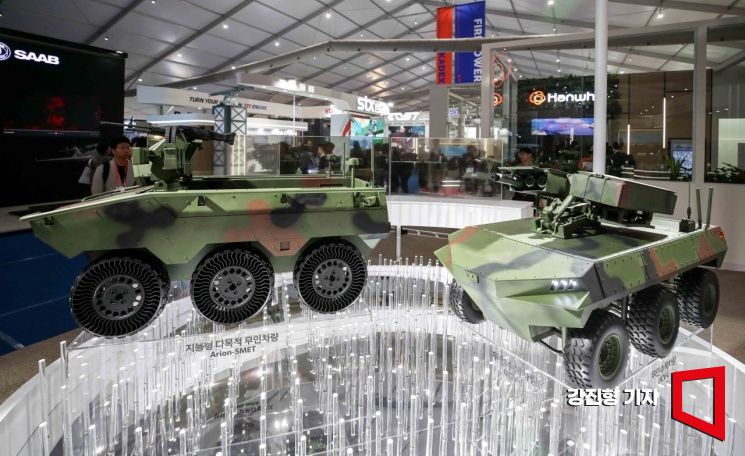 On the 2nd, a model of an unmanned vehicle by Hanwha Aerospace was displayed at the Korea International Defense Industry Exhibition held at Gyeryongdae, Chungnam. Photo by Jinhyung Kang aymsdream@
The government is accelerating the development of next-generation defense industry technologies, focusing on advanced fields such as artificial intelligence (AI), semiconductors, and robotics.
The Ministry of Trade, Industry and Energy and the Defense Acquisition Program Administration announced on the 30th that they have finalized the 2025 implementation plan for the civil-military technology cooperation project, which involves the joint participation of 15 government ministries, and will invest a total of 113.4 billion won.
This year, the government will push forward a total of 132 development projects, with approximately 63%, or 72 billion won, concentrated on the materials, parts, and equipment (so-called "Sobu-jang") sectors of strategic importance, such as AI, semiconductors, robotics, and drones. Key projects include amphibious mobile reconnaissance robots and micro-sized self-destructing drone systems.

The civil-military technology cooperation project is an inter-ministerial research and development (R&D) initiative that has been promoted since 1999. It is operated with the aim of enhancing both national technological competitiveness and defense capabilities through the development of dual-use technologies (Spin-up), the application of civilian technologies to defense (Spin-on), and the transfer of defense technologies to the civilian sector (Spin-off). Currently, a total of 15 ministries, including the Ministry of Trade, Industry and Energy and the Defense Acquisition Program Administration, are participating.
In addition to technology development, the project types include civil-military technology transfer, standardization of specifications, and technology information exchange. In particular, starting this year, the government plans to operate an "Advanced Civil-Military Council" to more quickly connect civilian technologies with military needs, and will improve the system to allow pilot operations even before the military's official requirements are determined.
A new "Ship Maintenance, Repair, and Overhaul (MRO) Civil-Military Council" will also be established, with participation from industry, academia, research institutes, and the military. Through this, new projects will be launched to foster specialized personnel in the MRO sector and to build testing and certification systems, while also strengthening the foundation for Korea-US defense industry cooperation and export support.
The government is also focusing on nurturing specialized personnel to support the defense industry base. The goal is to invest 60 billion won annually in strategic fields such as machinery and materials, electrical and electronics, and aerospace, to train more than 2,000 specialists each year. In addition, the government plans to use "Global Industrial Technology Cooperation Centers" established at leading research institutions such as the Massachusetts Institute of Technology (MIT) and Fraunhofer as hubs for joint civil-military development and export-oriented parts R&D.
The civil-military technology cooperation project has already achieved significant results. Notable examples include a 20-ton class (over 60 knots) high-speed boat developed between 2016 and 2021, and a seawater pump for destroyers equipped with submersion response technology, both of which have contributed to improving the military's survivability and operational capabilities. After undergoing military testing and evaluation, these technologies have also been recognized for their export competitiveness.
Among the new projects starting this year are lightweight protective materials applicable to both special security vehicles and tactical vehicles, a reciprocating engine usable in both civilian delivery drones and military reconnaissance/self-destructing drones, composite ground inspection equipment for both fighter jets and commercial aircraft, and an AI-based chemical agent identification kit.
Park Sungtaek, First Vice Minister of the Ministry of Trade, Industry and Energy, stated, "The convergence of advanced civilian technologies and defense technologies is more important than ever to lead the future defense industry market," adding, "We will actively promote civil-military cooperation at a pan-government level to contribute to the strategic advancement of defense exports."
© The Asia Business Daily(www.asiae.co.kr). All rights reserved.
![Clutching a Stolen Dior Bag, Saying "I Hate Being Poor but Real"... The Grotesque Con of a "Human Knockoff" [Slate]](https://cwcontent.asiae.co.kr/asiaresize/183/2026021902243444107_1771435474.jpg)
















