Demands for Anti-Discrimination Law and Non-Consensual Rape Offense
Democratic Party Remains Unclear in Its Response
As Lee Jae Myung, the Democratic Party presidential candidate, has stated his position on unifying candidacies with the Progressive Party and others, policy alliances are emerging as a key variable. Minor parties and civil society are focusing more on the Democratic Party's acceptance of policy demands rather than the method of unification itself.
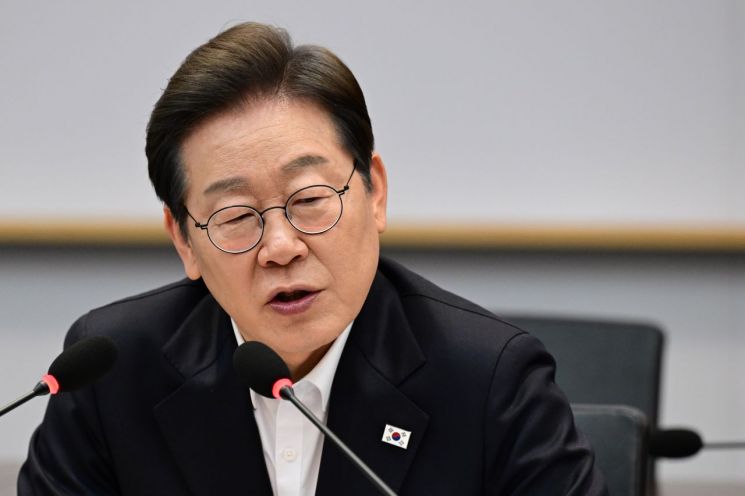 Lee Jae Myung, the Democratic Party presidential candidate, is delivering a greeting at the AI memory semiconductor company meeting held on the 28th at SK Hynix Icheon Campus in Icheon, Gyeonggi Province. Photo by the National Assembly Press Photographers Group Yonhap News.
On April 30 at 11:30 a.m., the Gwangjang Presidential Election Alliance Political Civic Solidarity held a launch press conference in front of the main building of the National Assembly, proposing a joint response to the presidential election, a policy alliance for major social reform, voter mobilization, and suggestions for policy alliances and political agreements. The group argues that, in addition to defending democratic constitutional order, society must address the tasks of major social reform to achieve a sustainable society, including combating discrimination and hate, inequality and war, promoting peace and equality, life and ecology, and care and labor.
The Civic Political Action for Major Social Reform held its inaugural ceremony at 2 p.m. on April 28 in the main auditorium of the National Assembly Library, stating, "Our tasks now are to resolve the legacy of rebellion and to achieve major social reform. We need an alliance politics that unites democracy and progress through the power of citizens," and emphasized, "Direct political participation by sovereign citizens is necessary. Only strong solidarity among citizens is the hope of history."
Currently, among parliamentary parties other than the Democratic Party, only the Progressive Party has nominated a presidential candidate. Kim Jae Yeon, the Progressive Party's presidential candidate, has called for "resolving the legacy of rebellion and building an equal republic through the solidarity of light." Her main pledges include enacting an anti-discrimination law and introducing a non-consensual rape offense. However, the Democratic Party has not provided a clear response to these policies, being conscious of Christian voters and male voters in their 20s and 30s.
The core of the anti-discrimination law is to prohibit all forms of discrimination based on gender, disability, sexual orientation, and other factors. Although legislative efforts have been ongoing since 2007, the law has yet to pass the National Assembly. The non-consensual rape offense aims to redefine the requirements for rape, focusing on the victim's lack of consent rather than the perpetrator's use of violence or threats. The proposal is based on the need to change the social perception that requires victims to show active resistance. According to statistics analyzed by the Korea Sexual Violence Counseling Center Association in 2022, 62% of the 4,756 rape counseling cases occurred without explicit violence or threats.
Previously, the Roundtable for Ending Rebellion and Defending Democratic Constitutional Order, composed of five parliamentary parties, agreed to work toward easing requirements for negotiating groups and introducing a runoff voting system. A Progressive Party official stated, "I do not think the method of unification itself will be a major controversy," and added, "The five-party roundtable and civic groups should come together to broaden the framework for discussion."
© The Asia Business Daily(www.asiae.co.kr). All rights reserved.
![Clutching a Stolen Dior Bag, Saying "I Hate Being Poor but Real"... The Grotesque Con of a "Human Knockoff" [Slate]](https://cwcontent.asiae.co.kr/asiaresize/183/2026021902243444107_1771435474.jpg)















