Only Those Who Have Summited a 7,000-Meter Peak Allowed to Climb
5 to 15 Deaths During Descent Due to Traffic Jams
"Death Zone" Emerges as Bodies of Missing Climbers Are Exposed by Global Warming
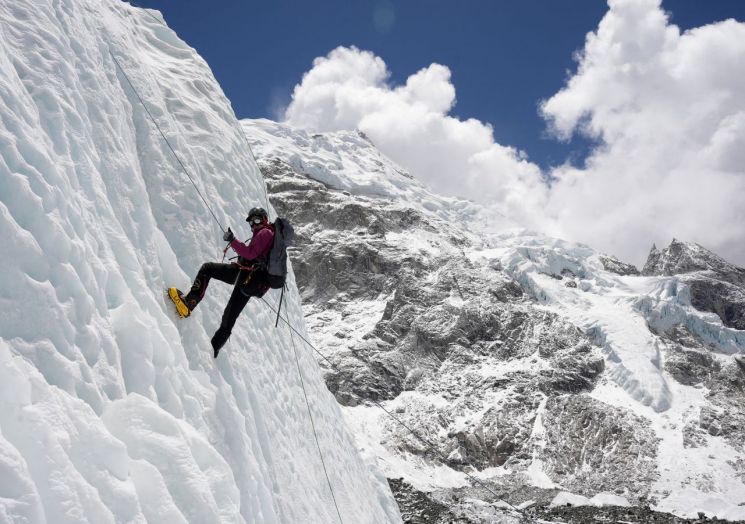
The Nepalese government has announced a ban on non-professional climbers from entering Mount Everest, the world's highest peak. This regulation comes in response to a series of accidents in which climbers died while being transported after injuries, due to severe bottlenecks on the mountain trails caused by an excessive number of simultaneous climbers. Since climbing began in earnest in 1921, more than 300 people have died or gone missing on Everest. Recently, as global warming has caused the permanent snow to melt, bodies previously buried have been exposed, making the retrieval of remains increasingly difficult.
Nepalese Government: "Climbers Must Have Summited at Least One 7,000-Meter Peak to Be Permitted on Everest"
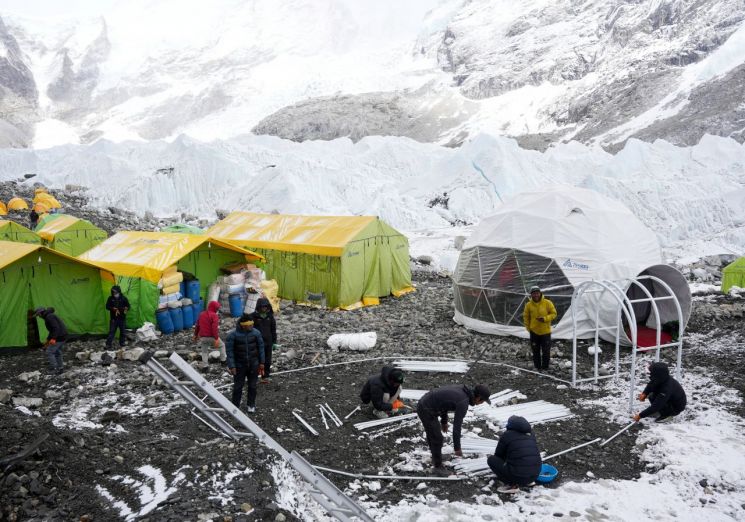
According to CNN, on April 29 the Nepalese government announced a draft bill to strengthen regulations for Everest climbing permits. The bill stipulates that permits will only be granted to professional climbers who have successfully summited at least one peak over 7,000 meters in the Himalayas. The bill also includes a regulation that all local guides accompanying climbers must be Nepalese nationals.
If enacted, this legislation will completely restrict non-professional climber tourists from entering Everest, which is expected to significantly reduce tourism revenue. Climbing tourism accounts for about 3% of Nepal's total gross domestic product (GDP), and more than 20,000 people are employed as Sherpas and guides. In addition, the Nepalese government earns over $5 million (about 7.1 billion KRW) annually solely from Everest permit fees.
Nevertheless, the Nepalese government has decided to allow only expert climbers to enter Everest in order to reduce overcrowding and improve safety. Each year, Everest sees between 5 and 20 fatalities, with 8 deaths last year and 17 in 2023. Everest is considered relatively easy to climb among the Himalayan peaks, which has attracted a large number of non-professional climbers, ironically leading to a continuous stream of casualties.
Severe "Traffic Jams" on Everest... Fatalities During Evacuation of the Injured
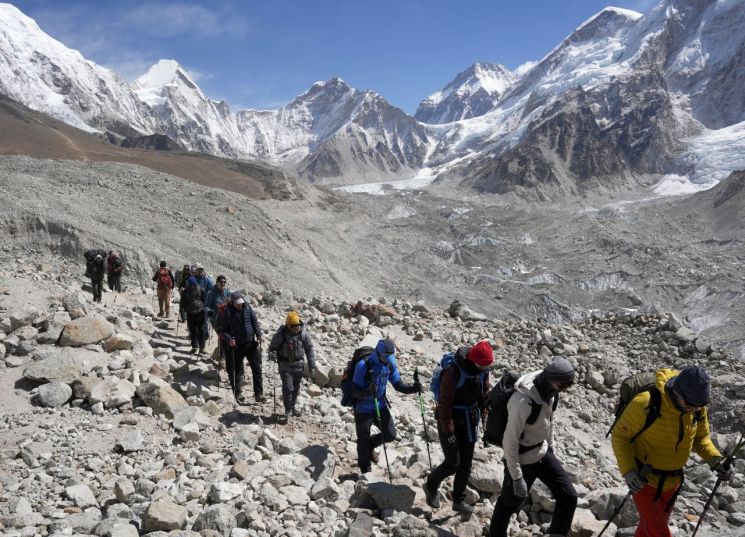
According to The Guardian, the fatality rate for Everest climbers has averaged about 5.4% since 1921, lower than the 24% rate for K2. However, the total number of deaths is much higher on Everest, with around 340 compared to about 90 on K2?almost four times as many. This is attributed to the much larger number of climbers on Everest compared to other 8,000-meter peaks.
The influx of climbers frequently causes bottlenecks on Everest’s main trails, leading to an increase in deaths among the injured during descent. More than 30% of all fatalities have occurred above 8,000 meters, where low oxygen levels and long waits due to bottlenecks have resulted in exhaustion.
During the peak climbing season from April to May, as many as 800 people?including climbers, Sherpas, and guides?attempt the ascent simultaneously, causing frequent congestion on the narrow trails. In May 2019, 10 climbers died at once from severe hypoxia while waiting their turn to descend.
Bodies of Missing Climbers Exposed by Global Warming in the "Death Zone"... 30 Tons Collected Annually
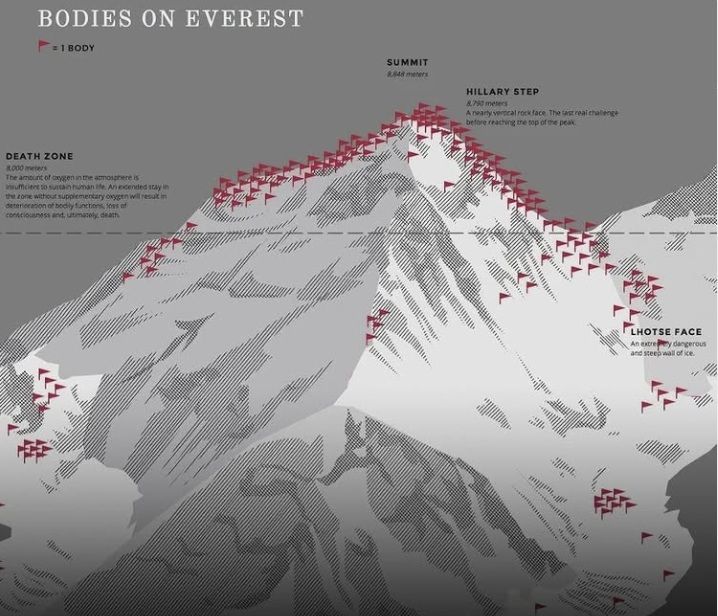
As global warming melts Everest's permanent snow, the "Death Zone," where the bodies of previously missing climbers are discovered in large numbers, is expanding. The area where these bodies are concentrated is above 8,000 meters, making it extremely difficult for Nepalese authorities to retrieve the remains.
According to the BBC, more than 200 bodies remain on Everest in a missing state. As bodies previously buried in permanent snow are now being exposed along the climbing routes due to global warming, concerns about the spread of infectious diseases have prompted the Nepalese government to begin retrieval operations. However, transporting the bodies to villages for proper handling remains a major challenge. The bodies, encased in ice, typically weigh over 170 kg, requiring significant manpower to move them down the mountain.
Most of the bodies are clustered above 8,000 meters, where oxygen is scarce, and this area is known as the "Death Zone." To address both the retrieval of bodies and the disposal of various waste left by climbers, the Nepalese government has mobilized Sherpas. Last year alone, more than 30 tons of trash were removed from the summit area of Everest.
© The Asia Business Daily(www.asiae.co.kr). All rights reserved.
![Clutching a Stolen Dior Bag, Saying "I Hate Being Poor but Real"... The Grotesque Con of a "Human Knockoff" [Slate]](https://cwcontent.asiae.co.kr/asiaresize/183/2026021902243444107_1771435474.jpg)

















