2025 Korea Nuclear Energy Annual Conference Keynote Speech
"Nuclear Power as a Solution for Energy Issues in Developing Countries"
Investment in ThorCon, a Molten Salt Reactor Developer
Building Power Plants in Shipyards Like Constructing Ships
"Korea, a Shipbuilding Powerhouse, Holds a Superpower"
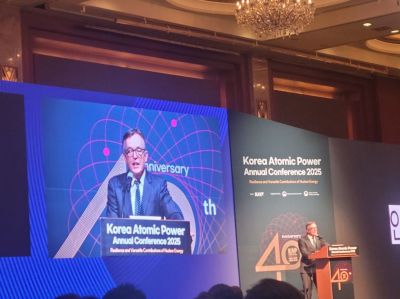 Chris Anderson, CEO of TED, is delivering the keynote speech at the '2025 Korea Nuclear Energy Annual Conference' held on the 29th. Photo by Heejong Kang
"With the current capabilities of Korea's shipbuilding industry, it is possible to produce 10 gigawatts (GW) of nuclear power each year. This is Korea's superpower."
Chris Anderson, CEO of TED, who took the stage as the keynote speaker at the '2025 Korea Nuclear Energy Annual Conference' held at Lotte Hotel in Seoul on the 29th, unexpectedly stated that Korea's shipbuilding industry has the power to maximize nuclear power plant production capacity. He explained that in order to rapidly expand nuclear power plants, a system for mass production based on standardized designs is necessary, and that nuclear plants could be built in a manner similar to the production of liquefied natural gas (LNG) carriers or container ships.
He said, "Korean shipbuilders such as HD Hyundai Heavy Industries, Samsung Heavy Industries, and Hanwha Ocean deliver ships on time and according to specifications," adding, "Building nuclear power plants is similar to shipbuilding." He further explained, "If the manufacturing and assembly of nuclear power plants can be moved to shipyards, it would be possible to reduce costs and shorten construction periods."
Chris Anderson is the figure who acquired the TED Conference in 2001 and turned it into a globally successful online knowledge-sharing platform. In his speech that day, Anderson said, "To eradicate poverty for billions, develop emerging countries, electrify transportation, and power artificial intelligence (AI), an enormous amount of electricity is required." Anderson emphasized, "Fossil fuels lead to catastrophic consequences, while solar and wind are intermittent and land-intensive," and insisted, "We must dramatically scale up stable and scalable nuclear power."
Anderson was not an advocate for nuclear power from the beginning. He said, "At first, I was not 100% convinced about nuclear power," but "after watching Stewart Brand's TED talk, I became convinced that nuclear must play a central role." Stewart Brand was originally a strong anti-nuclear activist, but later became a proponent of nuclear energy. In his TED talk, he drew attention by arguing that the lifetime nuclear waste produced for one affluent American is only enough to fill a single can of cola, whereas using coal would produce about 25,000 cans' worth of waste.
To meet global electricity demand, hundreds or even thousands of nuclear power plants must be built. Anderson explained that speed, cost, and scalability are necessary to expand nuclear power on a large scale. Currently, it takes more than 10 years to construct a nuclear power plant, and the licensing process is extremely slow. Additionally, because the cost of building large nuclear plants is high, developing countries continue to rely on coal power rather than building nuclear plants.
To overcome these challenges, nuclear power plants must be manufactured in factories, just as smartphones are produced. Anderson said, "Korea can solve these problems," and praised, "I want to let the world know about the superpower you possess that is not widely recognized." The superpower Anderson highlighted is precisely Korea's shipbuilding industry.
Anderson's fascination with Korean shipbuilding is due to his role as a major investor in ThorCon, a U.S. molten salt reactor startup. ThorCon is a developer of thorium-based molten salt reactors (MSRs). The company is based on the idea of Jack Devanney, former professor at the Massachusetts Institute of Technology (MIT), who proposed that building nuclear power plants in shipyards, as ships are constructed, could dramatically reduce construction time and costs. In other words, the plan is to build floating nuclear power plants in shipyards, just like ships.
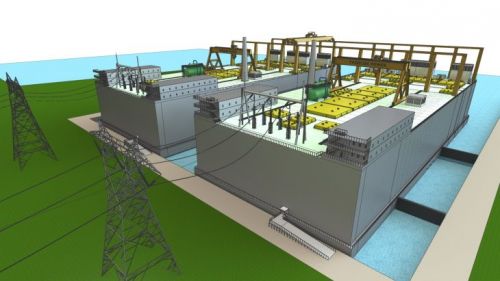
ThorCon is currently working with Indonesia on its first reactor construction project. ThorCon aims to operate a 500-megawatt (MW) nuclear power plant in Indonesia by 2032. To achieve this, the company applied for a construction permit with Indonesia's nuclear regulatory authority in March of this year. The plant is scheduled to be built on Kelasa Island in Central Bangka.
Collaboration with shipbuilders is essential to realize the power plant envisioned by ThorCon. Korean shipbuilders are being strongly considered as partners. In December of last year, local media reported that the first ThorCon power plant would be built by Hanwha Ocean of Korea. Anderson's high praise for Korean shipbuilders, saying, "Korea has the world's best shipbuilding industry," appears to be influenced by this context.
Anderson said, "Molten salt reactors promise very safe and abundant energy and can create a new energy paradigm," adding, "Korea can establish itself as a global leader in this new era."
© The Asia Business Daily(www.asiae.co.kr). All rights reserved.
![Clutching a Stolen Dior Bag, Saying "I Hate Being Poor but Real"... The Grotesque Con of a "Human Knockoff" [Slate]](https://cwcontent.asiae.co.kr/asiaresize/183/2026021902243444107_1771435474.jpg)
















