Spotlighting the Entire Oceania Region
Collaboration Between the National Museum of Korea and Mus?e du quai Branly ? Jacques Chirac
Featuring 179 Items Including a Large Canoe, Musical Instruments, and Ornaments
The special exhibition "Mana Moana - Sacred Sea Art, Oceania," which offers an in-depth look at the entire Oceania region, is being held at the National Museum of Korea. Until now, Oceania has mostly been introduced in fragments, focusing on Australia or the Australian continent, but this is the first time an exhibition is presenting the whole of Oceania.
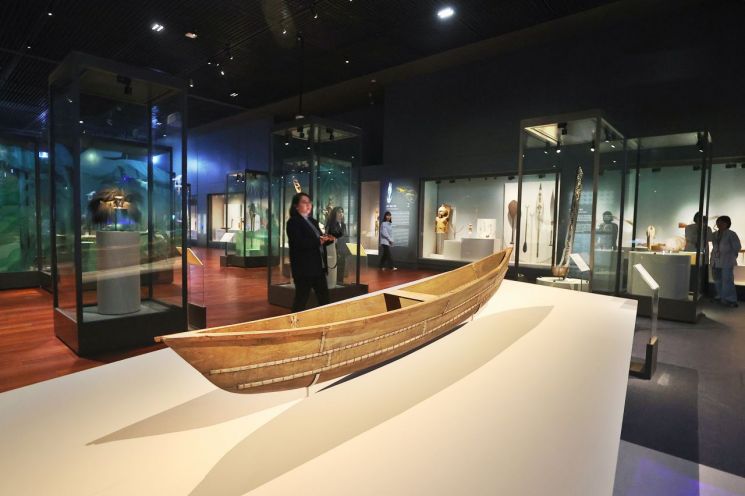 On the 29th, attendees are viewing the exhibition at the press preview of the special exhibition "Mana Moana - Sacred Sea Art, Oceania" held at the National Museum of Korea in Yongsan-gu, Seoul. Photo by Yonhap News
The exhibition title "Mana Moana" reflects the curatorial intent to introduce reverence for invisible forces and the sacredness of the sea. "Mana" is a Polynesian word representing the sacred power inherent in all beings, while "Moana" refers to the vast, boundless ocean. The exhibition features 171 heritage items from the 18th to 20th centuries and eight works by contemporary artists.
The entrance to the exhibition hall is designed to look as if visitors are entering by canoe through a large graphic, creating an atmosphere as if being drawn into a new world by canoe.
Part 1, "Territory of Water," explores the navigation and worldview of Oceanians who traveled by boat among the countless islands of Oceania. It introduces the history of migration spanning thousands of years, navigation techniques, canoe-making skills, and creation myths.
Oceanians created tools and forms from materials found in nature and believed that spirits and traces of creation were embedded in these objects. For example, a "navigation stick chart" was made by arranging wood to represent sea routes and using shells to indicate islands. Curator Baek Seungmi explained, "At that time, people used the chart at home to memorize sea routes before setting out on a voyage."
Oceanians regarded the "paddle" used for navigation as containing the memories of their ancestors and considered it extremely sacred. Curator Baek said, "They believed that the energy of their ancestors was transmitted through the paddle. Because they thought that touching the paddle connected them to their ancestors, it was regarded as a very sacred tool and was kept with great care."
Part 2, "Land of Life," introduces the Melanesia region, which spans from Fiji on the right to Papua New Guinea on the left. It explores a community-centered worldview, including ancestor worship, sacred spaces, power, and exchange rituals.
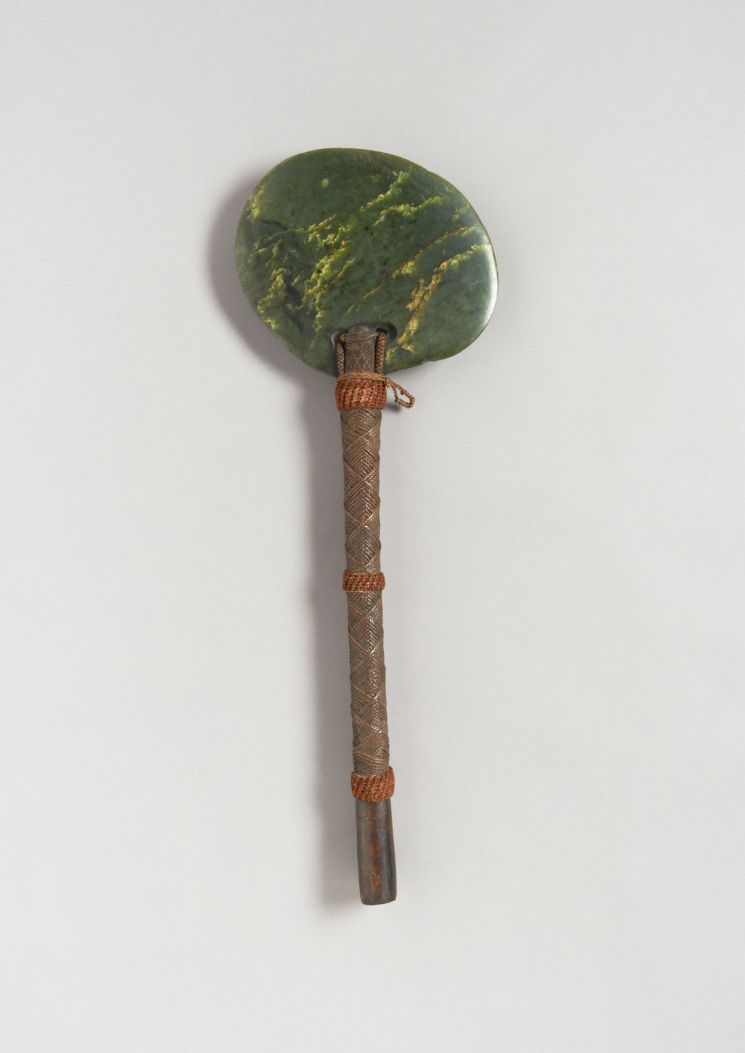 A ceremonial axe decorated with thread made by dyeing bat fur and polishing a raw stone. National Museum of Korea
A ceremonial axe, made by polishing raw stone and decorating it with rare materials, served as a symbol of power at the time. Chiefs used it as a symbol of their prestige during public speeches or important ceremonies. To emphasize authority, the handle of the axe was finished with a herringbone-patterned fabric woven from coconut fiber and tied with cords made from plant fiber and bat fur. Bat fur, which was a very rare material at the time, was sometimes dyed red and used for decoration.
Part 3, "Time Connecting Generations," examines the unique visual perceptions of time and existence that have been passed down in the region, including Hawaii to the north and New Zealand to the south.
According to Maori legend, "Hei Tiki" is an ornament deeply associated with lineage. "Hei" means "to wear around the neck," and "Tiki" refers to the first human and a sacred being. It was believed that those who wore Hei Tiki possessed mana, symbolizing power and honor, and carried "mauri," representing life force and memory of ancestors. To this day, Hei Tiki is passed down from generation to generation, embodying the history of families and communities.
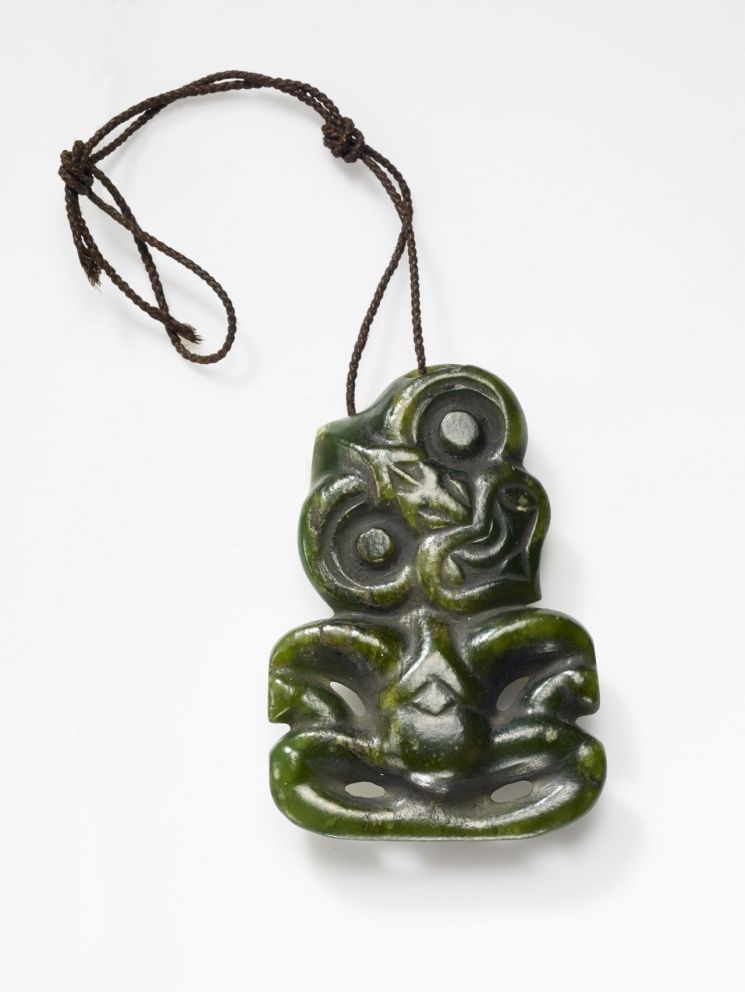 'Hey Tiki,' a traditional ornament passed down through generations related to lineage. National Museum of Korea
Part 4, "Islands...and People," delves into ornaments and crafts that serve as tools for self-adornment and symbols of status and identity. Several paintings by Maori artists are displayed near the exit of the exhibition hall, presenting a markedly different perspective from what has been previously known. Greg Semu, an artist from Samoa, reinterpreted the portrait styles of colonial-era New Zealand painters Nicholas Chevalier (1828-1902) and Charles Goldie (1870-1902). These painters depicted the Maori people by emphasizing their external features, portraying them as "noble savages," which satirizes the lack of true understanding of the indigenous people's real lives and dignity.
Throughout the exhibition, panels featuring questions that children might be curious about are installed to spark interest, and explanations tailored to children's perspectives are provided.
Emmanuel Kasarh?rou, director of the Mus?e du quai Branly - Jacques Chirac, said, "As someone from Oceania, I feel a mission to share our culture. Although Oceania is neither an economic powerhouse nor an IT powerhouse, it possesses a unique sensibility. Through this exhibition, I hope to share the lives and love of Oceanians with the world."
The exhibition will run until September 14.
© The Asia Business Daily(www.asiae.co.kr). All rights reserved.
![Clutching a Stolen Dior Bag, Saying "I Hate Being Poor but Real"... The Grotesque Con of a "Human Knockoff" [Slate]](https://cwcontent.asiae.co.kr/asiaresize/183/2026021902243444107_1771435474.jpg)

















