China and the Philippines Raise National Flags in Disputed Area
All Four Neighboring Countries Assert Territorial Claims
Could This Become the Next Center of US-China Tensions After Taiwan?
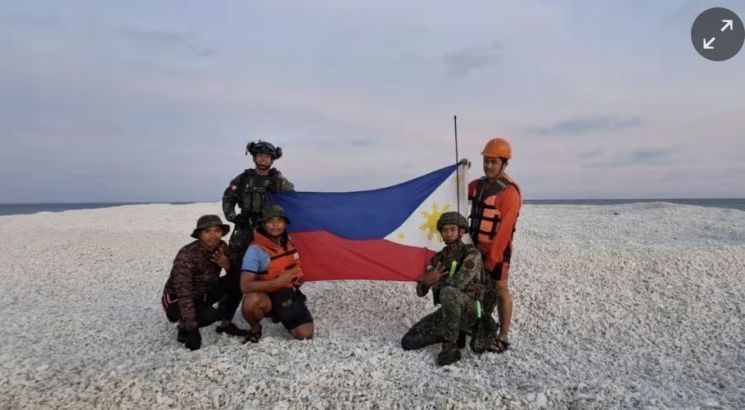 On the 27th of last month, the Philippine Coast Guard raised the national flag on the sandbar of Sandy Cay Island, a disputed area in the South China Sea. Philippine Coast Guard X (formerly Twitter) account
China and the Philippines are engaged in an intense territorial dispute over the small sandbar of Sandy Cay (known as Tiexianjiao in China), located in a contested area of the South China Sea. As the coast guards of both countries have repeatedly raised their national flags to assert sovereignty, Taiwan and Vietnam are also claiming ownership of the territory. With Southeast Asian nations strengthening military cooperation with the United States to protect their territorial claims, there are growing concerns that this region could become the next front line in the power struggle between the US and China, following Taiwan.
China and the Philippines Engage in Flag-Raising Standoff on Sandy Cay Sandbar: "Clearly Our Land"
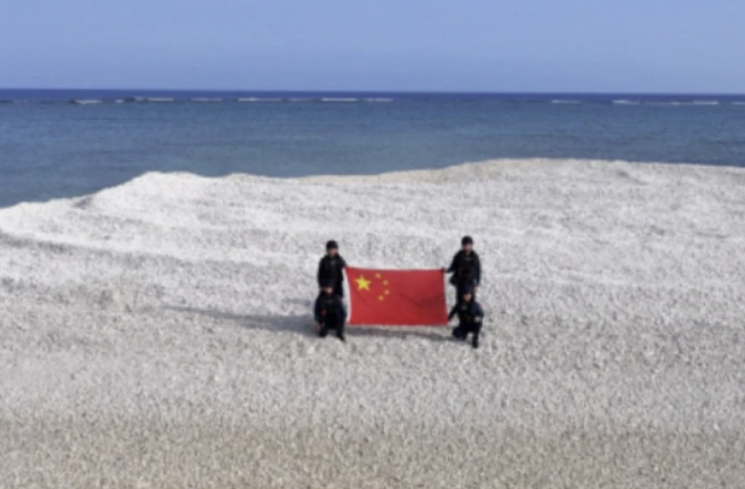 Chinese Coast Guard raising the national flag at Sandy Cay Reef, publicly shown on the 25th of last month. Photo by China Central Television (CCTV)
According to CNN, the Philippine Coast Guard released photos on its X (formerly Twitter) account on April 27 showing the national flag being raised on Sandy Cay Island. In a statement, the Philippine Coast Guard said, "We conducted an operation to expose false information that China has occupied the area and to verify whether China has installed infrastructure and surveillance equipment."
Previously, the Chinese Coast Guard had raised its national flag on Sandy Cay Island, asserting its claim to the territory. On April 25, China Central Television (CCTV), a state-run media outlet, released photos of the Chinese Coast Guard raising the national flag. The Chinese Coast Guard stated, "China has clear sovereignty over the surrounding waters," and added, "We will continue to protect our rights and enforce the law in the jurisdictional waters in accordance with the law."
In response to the Philippine Coast Guard's flag-raising, the Chinese government has strongly protested, calling it a violation of sovereignty. Liu Dejun, spokesperson for the Chinese Coast Guard, said, "Despite warnings from the Chinese side, six Philippine personnel illegally intruded, and the coast guard took action in accordance with the law," claiming, "The actions of the Philippine side infringe on China's territorial sovereignty and undermine peace and security in the South China Sea."
Taiwan and Vietnam Also Assert Claims... Oil and Gas Resources Present
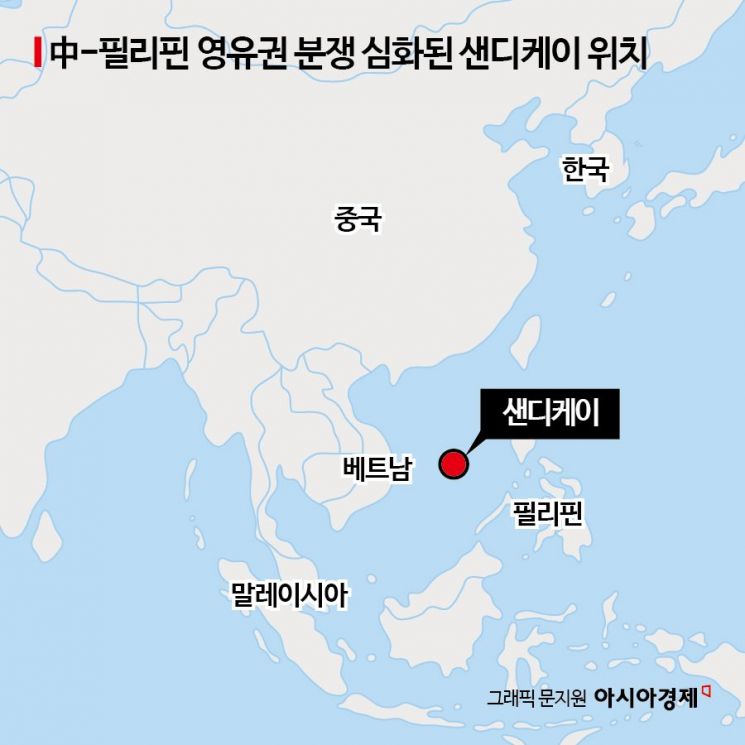
Sandy Cay Island, the site of the standoff between the two countries, is a representative disputed area in the South China Sea, also claimed by Vietnam and Taiwan. It is part of the Spratly Islands (known as Nansha Qundao in China) in the South China Sea. The Philippines and China have clashed over territorial claims not only on Sandy Cay but also at Scarborough Shoal (Huangyandao in China) and Second Thomas Shoal (Ren'aijiao in China) within the Spratly Islands area.
The territorial disputes among neighboring countries over this region began to intensify after the United Nations Economic Commission for Asia and the Far East (ECAFE) released a report in 1968 on the economic value of the mineral resources in these waters. According to the report, the Spratly Islands area is believed to contain tens of billions of tons of oil and natural gas. Since then, not only China and the Philippines, but also Taiwan, Vietnam, Brunei, and Malaysia have claimed sovereignty over adjacent islands, and the disputes have continued.
China claims that the South China Sea has been Chinese waters since ancient times, unilaterally asserting that more than 90% of the entire South China Sea is its territorial waters. There have been no negotiations with neighboring countries such as the Philippines, which also claim sovereignty over the area. In 2016, the Permanent Court of Arbitration (PCA) ruled that China's claims had no legal basis, but the Chinese government has ignored the ruling and has not ceased its territorial assertions.
Another Link in US-China Tensions: "China Violates International Law"
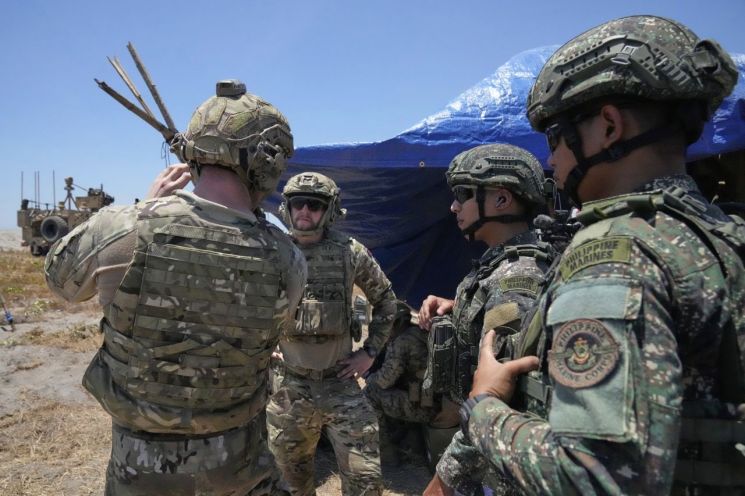 On the 27th, the United States and Philippine Marine Corps conducted the joint Balikatan training at the Philippine Navy training camp. Photo by AP Yonhap News
The United States has also expressed concern over the South China Sea territorial dispute. James Hewitt, spokesperson for the White House National Security Council (NSC), stated, "Such actions by China threaten regional stability and violate international law," and added, "We are closely consulting with our allies." This was a warning regarding China's threats to Philippine islands, a US ally.
This latest conflict occurred during the annual joint US-Philippines military exercise, Balikatan, prompting an even more sensitive response from the United States. This year's exercise, which began on April 21, involved over 17,000 troops from 16 countries, including the United States, the Philippines, and Australia. The training areas included Palawan Island, which borders the South China Sea, and islands north of Luzon in the northern Philippines, close to Taiwan.
For the first time, the US Navy-Marine Expeditionary Ship Interdiction System (NMESIS), the latest US anti-ship missile system, was deployed in this exercise. The system is known to have been developed by the United States to counter China in disputes in the Taiwan Strait and the South China Sea. There is even speculation that the system could be deployed in the Philippines on a long-term basis following the exercise. The Chinese government has protested the exercise, calling it a US-led military provocation.
© The Asia Business Daily(www.asiae.co.kr). All rights reserved.
![Clutching a Stolen Dior Bag, Saying "I Hate Being Poor but Real"... The Grotesque Con of a "Human Knockoff" [Slate]](https://cwcontent.asiae.co.kr/asiaresize/183/2026021902243444107_1771435474.jpg)

















