It has been confirmed that the United States is not targeting South Korea as a currency manipulator in the course of bilateral trade consultations. While there is speculation that the U.S. Treasury Department's currency report, which must be submitted to Congress by June, could become a new point of pressure in trade talks, there is a broad consensus within and outside the government that the likelihood of the currency manipulation issue materializing is very low.
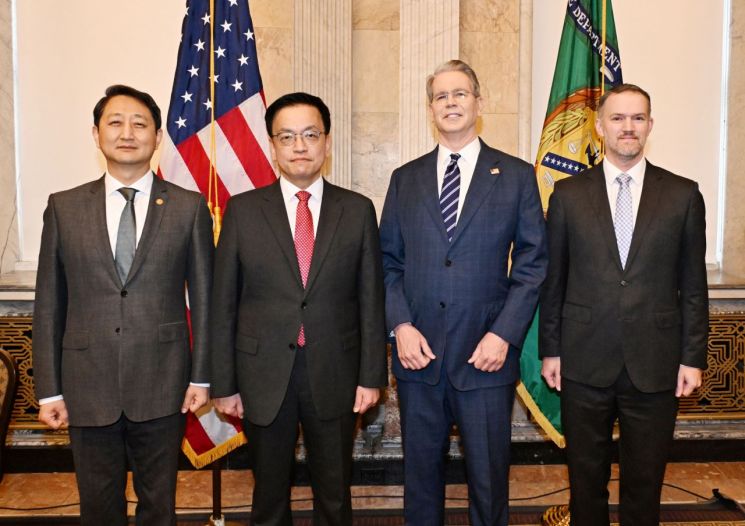
According to relevant ministries on the 28th, the issue of South Korea being designated as a currency manipulator is not expected to be included in the working-level monetary policy (exchange rate) consultations between the U.S. Treasury Department and South Korea's Ministry of Economy and Finance, which will take place starting this week. An official from the Ministry of Economy and Finance stated, "We have sufficiently explained to the U.S. side that South Korea does not qualify as a currency manipulator and that there has been no artificial market intervention to depreciate the Korean won. We have received feedback that the U.S. understands this." This means that the South Korean government actively clarified that it did not intentionally attempt to depreciate the won to boost trade competitiveness with the U.S., and that the U.S. has acknowledged and agreed with this explanation.
In the market, there has been speculation that the U.S. side may include monetary (exchange rate) policy in the "July package," which South Korea is preparing with the goal of eliminating tariffs, and that the schedule for the release of the currency report, which may include a currency manipulator designation, could become a new point of pressure in trade talks. There have also been concerns that the U.S. could include a large number of strong and binding regulations prohibiting currency manipulation in upcoming working-level consultations.
A government official stated, "There is a consensus within and outside the government that the U.S. is unlikely to wield the currency manipulator designation as a weapon in future trade consultations," adding, "This is because the U.S. government is well aware that it cannot actually achieve its desired goal (appreciation of the Korean won) through such measures." The U.S. side is fully aware that the South Korean government already transparently discloses its dollar buying and selling activities in the foreign exchange market on a quarterly basis, and that the size of the foreign exchange market has become so large that intervention by the authorities is unlikely to have a significant long-term effect. It is also noteworthy that, in the recent U.S.-Japan trade talks, the U.S. did not demand corrective action regarding the weak yen situation.
The U.S. Treasury Department evaluates the top 20 trading partners with the largest trade volumes every year in the first and second halves and designates a country as a currency manipulator if it meets three criteria: a bilateral trade surplus with the U.S., a current account surplus, and evidence of intervention in the currency market. If a country meets two of these criteria, it is designated as a country on the monitoring list. In the currency report released in November last year, South Korea was classified as a country on the monitoring list, as it met two conditions: a bilateral trade surplus with the U.S. ($50 billion) and a current account surplus (3.7% of GDP). The net dollar purchases in the foreign exchange market accounted for 0.5% of GDP. Large-scale net dollar purchases can raise suspicions of currency manipulation, as buying dollars in the foreign exchange market increases the value of the dollar and decreases the value of the local currency, thereby enhancing export price competitiveness.
Similar content is expected to be included in the report for the first half of this year. As of the end of last year, South Korea's bilateral trade surplus with the U.S. was estimated at $66 billion, and the current account surplus ratio was also estimated at 5.3% of GDP. The foreign exchange authorities made net dollar sales totaling $11.2 billion throughout last year to strengthen the won (appreciate the Korean won), partly in response to the 12·3 martial law incident.
The currency report is expected to be released after May. An official from the Ministry of Economy and Finance stated, "While the currency report for the first half of the year has typically been released in April, it has become common for it to be released in June, as it was in mid-June 2022 and for three consecutive years recently," adding, "It is unlikely to be released this month, but we believe it could be published at any time after May."
© The Asia Business Daily(www.asiae.co.kr). All rights reserved.
![Clutching a Stolen Dior Bag, Saying "I Hate Being Poor but Real"... The Grotesque Con of a "Human Knockoff" [Slate]](https://cwcontent.asiae.co.kr/asiaresize/183/2026021902243444107_1771435474.jpg)















