National Assembly Begins Review of 12.2 Trillion Won Extra Budget
Focus on Expanding Livelihood Support and Tariff Response
The National Assembly will begin its review of the government's proposed supplementary budget (extra budget) this week. Discussions are expected to focus on support for livelihoods and responses to tariff damages stemming from former U.S. President Trump's policies.
According to political sources on April 23, the National Assembly plans to hold a plenary session on May 1 to review and vote on the extra budget bill. To prepare for this, the Special Committee on Budget and Accounts and the relevant standing committees will soon begin their budget review, with plenary meetings scheduled for April 28 and 29.
During the plenary meetings, the agenda will include motions to skip the public hearing on the extra budget, the formation of a subcommittee to adjust the extra budget bill, and the "2025 Supplementary Budget Bill." If the schedule proceeds as planned, comprehensive policy questioning is also likely to take place during this period. The Budget Adjustment Subcommittee is set to begin reviewing proposed reductions and increases from April 30. The government’s extra budget proposal submitted to the National Assembly amounts to 12.2 trillion won. Specifically, 3.2 trillion won is allocated for disaster and emergency response, 4.4 trillion won for trade and artificial intelligence (AI) support, and 4.3 trillion won for livelihood support.
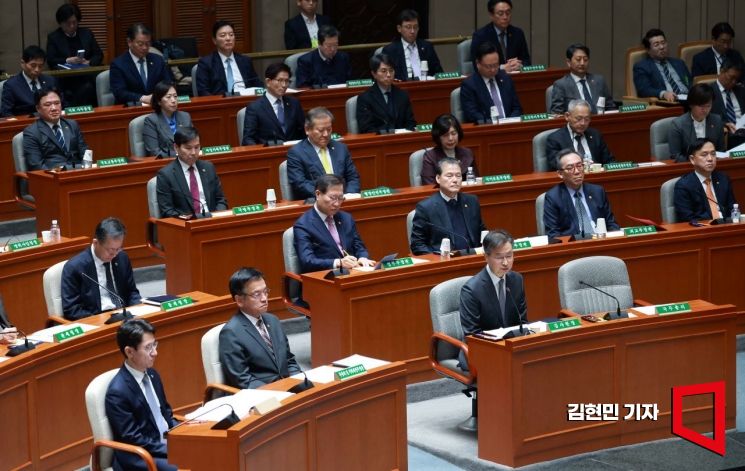 Choi Jaehae, Chairman of the Board of Audit and Inspection, is speaking at the plenary meeting of the Special Committee on Budget and Accounts held at the National Assembly on the 29th. Photo by Kim Hyunmin
The Democratic Party of Korea intends to increase the size of the extra budget through the parliamentary review process. The party argues that expanding the supplementary budget is essential for real recovery of livelihoods and economic growth. The Democratic Party claims that if the central government provides 2 trillion won in support for local currency programs, it could stimulate consumption worth up to 20 trillion won, thereby boosting the domestic economy. Jin Sungjoon, the Democratic Party’s Policy Committee Chair, stated, "The scale set by the government is far too insufficient to serve as a catalyst for livelihood recovery, as it would only increase GDP by 0.1 percentage points."
Some within the Democratic Party have left open the possibility of adding budget support for issuing local currency, a policy advocated by former party leader Lee Jaemyung. This is because support for local currency has been proven effective in stimulating consumption. However, the party has expressed its intention to prioritize negotiation and expedite the process rather than engaging in extreme confrontation over the budget increase. Jung Taeho, the Democratic Party’s secretary on the National Assembly’s Strategy and Finance Committee, told Asia Economy, "Speed is important for livelihood support, so we do not intend to drag out discussions for a long time." There is also internal discussion within the party about the possibility of a second supplementary budget after the presidential election, with a potential change of government in mind.
The People Power Party also recognizes, to some extent, the need to increase support for livelihoods and economic response, leaving open the possibility that the final extra budget may be somewhat expanded. The government, considering the urgency of the supplementary budget, maintains that the National Assembly should complete its review no later than early next month. Acting President and Prime Minister Han Ducksoo plans to request the National Assembly’s cooperation in a policy speech on the supplementary budget on April 24.
© The Asia Business Daily(www.asiae.co.kr). All rights reserved.
![Clutching a Stolen Dior Bag, Saying "I Hate Being Poor but Real"... The Grotesque Con of a "Human Knockoff" [Slate]](https://cwcontent.asiae.co.kr/asiaresize/183/2026021902243444107_1771435474.jpg)















