Attracting Companies and Talent Through Industrial Incentives and Residential Environment Improvements
Creation of Regulation-Free Special Zones and Tax-Free Funds
Fostering Advanced Talent and a Two-Year Comprehensive National Infrastructure Development Plan
Han: "Relocating the Administrative Capital to Sejong Is a Ploy to Win Votes in Chungcheong"
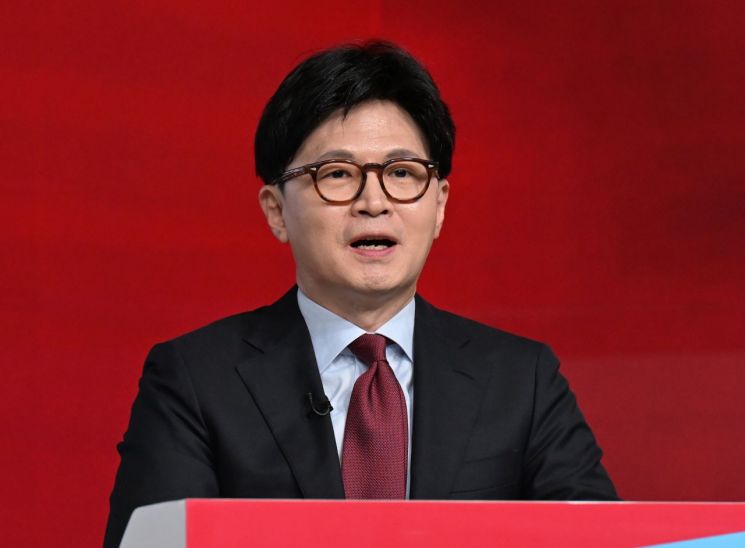
Han Donghoon, a presidential hopeful from the People Power Party, announced on April 22 his "Five Mega-Polis Pledge," stating, "I will address the issue of overconcentration in the Seoul metropolitan area not simply by dispersing resources, but by pursuing strategic concentration to create five Seouls nationwide." His plan aims to establish genuine mega-cities through a two-year comprehensive national infrastructure development plan that includes attracting industries, creating residential environments, fostering advanced talent, and improving infrastructure.
At the National Assembly's press center that morning, Han held his second policy vision presentation and stated, "We will approach this issue with a pragmatic attitude, not with the fiscal political correctness of simply dividing the budget equally."
His proposal is to attract five national strategic industries?artificial intelligence (AI), bio, energy, future vehicles, and semiconductors?to the mega-polis areas, thereby drawing in collaboration among industry, academia, and research institutes, as well as young talent and private capital. As incentives for industrial attraction, he suggested the creation of regulation-free special zones and tax-free funds.
He pledged to completely lift regulations in AI and medical convergence sectors within these special zones. Additional benefits would include deferring capital gains tax if proceeds from metropolitan area real estate sales are invested in the special zones, a 50% reduction in capital gains tax for investments held over five years, and a complete exemption for investments held over ten years, all to encourage industrial inflow.
To improve residential environments, Han promised to establish and expand boarding science high schools, gifted high schools, international schools, and foreign schools; develop integrated complexes combining research institutes, residential areas, and cultural spaces; and introduce living infrastructure equipped with autonomous shuttles, smart safety and welfare systems, and digital healthcare. He emphasized, "A strategic approach is needed across education, housing, and overall living infrastructure."
For fostering advanced talent, Han cited successful examples such as the Boston Biotech Hub, London’s MedCity, the Golden Triangle (London-Oxford-Cambridge), Silicon Valley, and London’s Tech City.
He also introduced a two-year comprehensive national infrastructure development plan, which would consider efficient land use and regional development from the initial stage of mega-polis placement. Han explained, "While developing national infrastructure such as roads, railways, and dams, we will also comprehensively plan for power grids, communication networks, gas pipelines, and water pipelines. Since public cooperation is essential for infrastructure development, we will design appropriate incentives and utilize resources like the Electric Power Business Fund to push forward at a rapid pace."
Regarding Lee Jaemyung, former leader of the Democratic Party of Korea, and his pledge to relocate the administrative capital to Sejong, Han said, "A Constitutional Court ruling in 2004 declared it unconstitutional," dismissing the pledge as "a ploy to win votes in the Chungcheong region."
When asked by reporters about the differences from existing mega-city plans, Han replied, "Most previous discussions were at the level of negotiations among metropolitan cities. What I am proposing is to make this a core policy of the central government. We will completely abolish key regulations for each mega-polis and dramatically increase the benefits for companies operating in those regions."
In response to questions about whether the two-year comprehensive national infrastructure development plan could be realized within his proposed three-year presidential term, Han said, "If the president sits in the war room and discusses the two-year plan every week, it will get done. If a policy at the top of the priority list cannot be completed in two years, it won't be done even in twenty. This aligns with the development aspirations of local governments, so we can move forward together. Moreover, it is not an issue tied to political camps."
Addressing concerns that the Democratic Party of Korea and others might obstruct the plan, Han asserted, "The five mega-polis areas will certainly be established even in regions where the Democratic Party is strong. Since this will be carried out with nationwide considerations, I don't think it will be easy to oppose. If the public agrees with this vision and supports me to become president, I will have ample momentum to push it forward."
© The Asia Business Daily(www.asiae.co.kr). All rights reserved.
![Clutching a Stolen Dior Bag, Saying "I Hate Being Poor but Real"... The Grotesque Con of a "Human Knockoff" [Slate]](https://cwcontent.asiae.co.kr/asiaresize/183/2026021902243444107_1771435474.jpg)















