Trump Warns of Economic Slowdown Without Immediate Rate Cut
Calls Powell a "Loser" and "Mr. Too Late"
No Progress in U.S. Trade Talks With Other Countries
Dollar Weakens... Gold Prices Hit All-Time High
The three major indices on the New York Stock Exchange opened lower on April 21 (local time). The market's losses widened as President Donald Trump continued to pressure Federal Reserve Chair Jerome Powell, demanding an immediate interest rate cut. In addition, investor sentiment was weighed down by the lack of clear progress in trade negotiations between the United States and other countries.
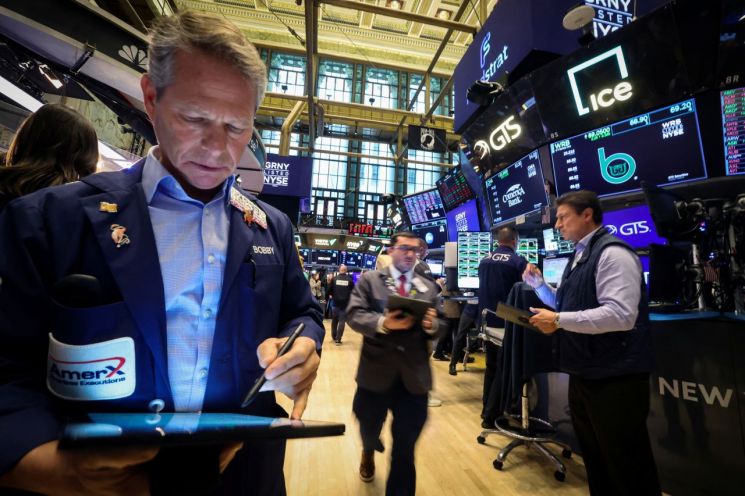
As of 10:53 a.m. on the same day in the New York stock market, the blue-chip Dow Jones Industrial Average (Dow) was down 833.53 points (2.13%) from the previous trading day, standing at 38,308.7. The S&P 500, which focuses on large-cap stocks, had fallen by 117.99 points (2.23%) to 5,164.71, while the tech-heavy Nasdaq was down 430.22 points (2.64%) at 15,856.23.
By sector, technology stocks were experiencing sharp declines. Tesla was down 6.33%, Nvidia had dropped 5.02%, and Meta was down 3.05%. Apple was showing a 2.68% decrease, while Alphabet, Google's parent company, and Microsoft (MS) were down 2.26% and 2.03%, respectively. Heavy equipment manufacturer Caterpillar was also down 2.76%.
President Trump continued to pressure Chair Powell, further fueling concerns over the independence of monetary policy. On his self-created social media platform, Truth Social, Trump wrote, "In reality, there is no inflation occurring," and warned, "If Mr. Too Late, the major loser, does not cut rates immediately, the economy could slow down." Just four days earlier, on April 17, he had demanded a rate cut and mentioned Powell's dismissal, stating, "If I want him out, he would be gone very quickly." The Trump administration has indicated that it is considering dismissing Chair Powell. Kevin Hassett, Chairman of the White House National Economic Council (NEC), said on April 18, "President Trump and his team will continue to review the matter."
As President Trump undermines the independence of the monetary authorities, selling pressure has intensified in the stock market. Amid growing concerns over a tariff-induced recession, Trump is pressuring the Fed to cut rates, while also positioning to blame Chair Powell if a recession materializes. With stagflation (rising prices amid economic slowdown) concerns emerging due to the impact of tariffs, the Fed now faces a dilemma regarding the future path of monetary policy.
Amid worries over the erosion of monetary policy independence, capital outflows from U.S. assets have accelerated, weakening not only stocks but also the dollar. The dollar index, which measures the value of the dollar against the currencies of six major countries, was down 0.98% from the previous trading day at 98.16. In contrast, demand for safe-haven gold increased, with gold futures surpassing $3,400 per ounce on April 21, marking an all-time high.
Michael Brown, senior research strategist at Pepperstone, said, "If Chair Powell is dismissed, the initial reaction would inject tremendous volatility into financial markets," adding, "A dramatic rush out of U.S. assets, at the most extreme level imaginable, could be expected." He further noted, "Not only is the Fed's independence clearly under threat, but a weaker dollar and the potential weakening of U.S. hegemony are also becoming increasingly real."
There are no clear signs of progress in trade negotiations between the United States and other countries, making it difficult to find catalysts for a rebound. China has warned countries negotiating trade deals with the United States that if they secure tariff exemptions at the expense of China, it will retaliate. On April 21, the Chinese Ministry of Commerce stated, "China firmly opposes any country achieving deals at the expense of China's interests," and warned, "If such a situation arises, we will take reciprocal countermeasures."
Robert Haworth, senior investment strategist at US Bank, said, "There is no way to know which direction tariffs will go," and assessed, "If uncertainty persists for a long time, it is expected to make corporate earnings and decision-making even more difficult."
This week, major tech companies will announce their earnings. Tesla's earnings are scheduled for April 22, and Alphabet, Google's parent company, will report on April 24. Among key economic indicators, S&P Global will release the U.S. services and manufacturing Purchasing Managers' Index (PMI) on April 23, and the Fed will also publish its Beige Book, an economic conditions report, on the same day.
Yields on U.S. Treasury bonds are mixed. The benchmark 10-year U.S. Treasury yield, a global bond market benchmark, was up 2 basis points (1bp=0.01 percentage point) from the previous trading day at 4.34%, while the 2-year Treasury yield, which is sensitive to monetary policy, was down 6 basis points from the previous day at 3.72%.
© The Asia Business Daily(www.asiae.co.kr). All rights reserved.
![Clutching a Stolen Dior Bag, Saying "I Hate Being Poor but Real"... The Grotesque Con of a "Human Knockoff" [Slate]](https://cwcontent.asiae.co.kr/asiaresize/183/2026021902243444107_1771435474.jpg)















